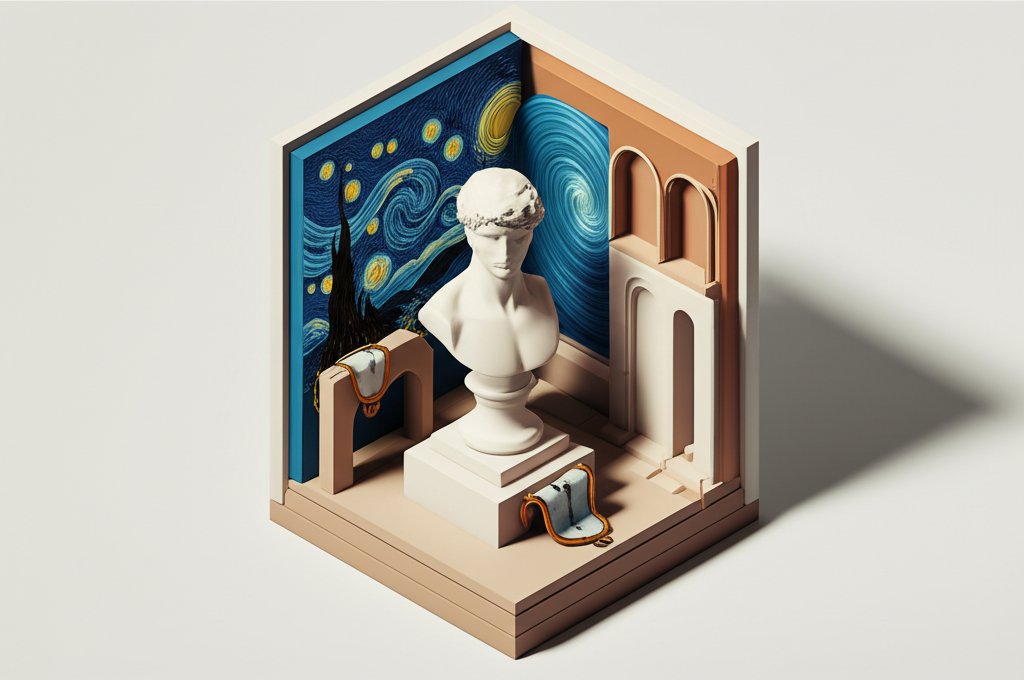
Why do we stand in line to catch a fleeting glimpse of a small, centuries-old portrait? What makes certain images so powerful they appear on coffee mugs, T-shirts, and countless internet memes, while thousands of other technically brilliant paintings hang in quiet museum halls? The journey of most famous art pieces from canvas to cultural icon is rarely a straight line. It’s a complex alchemy of genius, story, scandal, and timing.
These works aren’t just paint on a surface; they are historical artifacts, emotional touchstones, and nodes in our shared cultural network. They stick with us because they managed to do more than just exist—they sparked a conversation that has never ended.
At a Glance: What Makes an Artwork Unforgettable
- Uncover the Four Pillars of Fame: Learn the crucial ingredients—innovation, story, spectacle, and endorsement—that elevate a painting from masterpiece to legend.
- Go Beyond the Brushstrokes: Understand how an artist’s biography, a subject’s mystery, or a dramatic historical event can be more important than the technique itself.
- See How Art Becomes an Icon: Discover the role that museums, media, and even theft play in cementing a work’s place in the public consciousness.
- Develop a Sharper Eye: Gain a practical framework for analyzing why any piece of art has earned its enduring power, changing how you view art forever.
The Anatomy of Fame: Four Elements That Create an Icon
A painting’s ability to command attention for centuries isn’t accidental. It’s the result of a powerful combination of factors that resonate on both an intellectual and emotional level. While our broader guide helps you Explore iconic paintings’ power by showcasing the ‘what,’ here we dissect the ‘why.’ Nearly every enduringly famous art piece owes its status to at least one, and often several, of these four pillars.
1. Groundbreaking Innovation: The Art That Broke the Rules
Many famous works were revolutionary for their time. They introduced a new way of seeing, a new technique, or a new subject that shattered the conventions of their era. This rule-breaking quality makes them historical anchors, marking a “before” and an “after” in the story of art.
- Conceptual Rupture: Pablo Picasso’s Les Demoiselles d’Avignon (1907) is a prime example. It violently dismantled traditional European notions of beauty and perspective. Inspired by Iberian sculpture and African masks, its fragmented, jagged figures were so shocking they initially repulsed even Picasso’s closest friends. Yet, it became the foundational work of Cubism and, arguably, of 20th-century modernism.
- Technical Mastery: Jan van Eyck’s The Arnolfini Portrait (1434) is considered one of the first masterpieces created with oil paint. The new medium allowed for a depth of color, detail, and realism that was previously unimaginable, from the texture of the fur-lined robes to the convex reflection in the mirror on the back wall. It wasn’t just a portrait; it was a demonstration of a new artistic technology.
- A New Atmosphere: Claude Monet’s Impression, Sunrise (1872) famously gave the Impressionist movement its name. Its quick, visible brushstrokes and focus on capturing the fleeting quality of light over precise detail were a direct rebellion against the polished, formal standards of the French Academy.
2. A Compelling Narrative: The Story Behind the Canvas
We are creatures of story. A painting with a powerful narrative—whether about its creator, its subject, or its creation—forges a human connection that transcends time.
- The Tortured Artist: Vincent van Gogh’s The Starry Night (1889) is inseparable from the story of its creation. Painted from his window in a French asylum, the swirling, energetic sky is universally interpreted as a window into his turbulent mental state. We don’t just see a landscape; we feel Van Gogh’s emotional intensity. His tragic life story fuels the painting’s fame.
- The Enduring Mystery: Leonardo da Vinci’s Mona Lisa (1503–1519) is perhaps the ultimate example. Who was she? Why is her smile so enigmatic? The centuries of debate over her identity and expression have turned the portrait into a perpetual puzzle. The mystery is the marketing. Similarly, the unknown identity of the model in Vermeer’s Girl with a Pearl Earring (c. 1665) invites speculation, which was famously amplified by a historical novel and film.
- A Moment in History: Eugène Delacroix’s Liberty Leading the People (1830) is not just a painting; it’s the spirit of a revolution captured on canvas. By blending an allegorical figure of Liberty with realistic details of the 1830 July Revolution in Paris, Delacroix created a timeless symbol of rebellion and freedom that continues to inspire.
3. Scandal and Spectacle: The Events That Create Buzz
Sometimes, an artwork is launched into the stratosphere by an event completely unrelated to its artistic merit. A major theft, a public controversy, or a brush with destruction can transform a painting into a front-page news story and, in turn, a household name.
Case Snippet: The Theft That Made the Mona Lisa Famous
While admired by connoisseurs, the Mona Lisa was not a global superstar until 1911. That year, an Italian handyman named Vincenzo Peruggia stole it from the Louvre by simply hiding in a closet and walking out with it under his coat. For two years, the world followed the sensational story of its disappearance. Newspapers plastered its image everywhere, making its face recognizable to millions who had never set foot in a museum. When it was recovered, the public flocked to see the “kidnapped” painting. The theft, not just Leonardo’s genius, cemented its status as the most famous art piece in the world.
Other examples include:
- Near Destruction: Sandro Botticelli’s The Birth of Venus (1484–1486), one of the first full-scale, non-religious nudes since antiquity, narrowly escaped being burned in the 1497 “Bonfire of the Vanities,” a crusade against art deemed immoral. Its survival adds to its legendary status.
- Modern Heist: Rembrandt’s The Storm on the Sea of Galilee (1633), his only known seascape, is famous today largely because it was stolen from the Isabella Stewart Gardner Museum in 1990 in one of the biggest art heists in history. Its empty frame still hangs in the museum, a haunting testament to its absence and a constant source of public fascination.
4. Institutional Power and Cultural Repetition: The Ubiquity Machine
Fame needs a platform. The world’s most powerful museums, influential critics, and the constant engine of popular culture work together to place certain artworks in front of our eyes again and again until they become part of our collective visual vocabulary.
- The Museum Effect: Where a painting hangs matters. The Museum of Modern Art (MoMA) in New York acquired The Starry Night in 1941, placing it at the heart of the 20th-century art world and ensuring it was seen by millions of visitors and reproduced in countless textbooks. The same is true for Picasso’s anti-war epic Guernica (1937), which spent decades at MoMA as a political statement before its symbolic return to a democratic Spain, where it now anchors the Museo Reina Sofía in Madrid.
- Pop Culture Saturation: Andy Warhol’s silkscreens of the Mona Lisa and the endless parodies of Edvard Munch’s The Scream (1893) or Grant Wood’s American Gothic (1930) are not just homages; they are acts of reinforcement. Every time The Great Wave off Kanagawa (c. 1831) appears on a tote bag or The Kiss (1907–1908) on a puzzle, their iconic status is strengthened. The Scream has become so ubiquitous it’s even an emoji 😱.
A Tale of Two Masterpieces: Comparing Paths to Fame
To see these pillars in action, let’s compare two famous art pieces that achieved immortality through different routes: Leonardo’s Mona Lisa and Velázquez’s Las Meninas.
| Factor of Fame | Mona Lisa (Leonardo da Vinci, 1503-1519) | Las Meninas (Diego Velázquez, 1656) |
|---|---|---|
| Innovation | Masterful use of sfumato (smoky, soft transitions) and atmospheric perspective creates a lifelike, mysterious presence. | A mind-bendingly complex composition that shatters the rules of portraiture by playing with perspective, gazes, and the roles of subject, artist, and viewer. |
| Story | Dominated by mystery: the subject’s debated identity, the enigmatic smile, and Leonardo’s refusal to part with it. | A “behind-the-scenes” glimpse into the Spanish royal court, with the artist placing himself prominently in the scene. The central mystery is compositional: who is everyone looking at? |
| Spectacle | The 1911 theft was the defining event, turning the painting from a masterpiece into a global media sensation. | Its fame is built on intellectual awe, not public drama. It’s a “painter’s painting” that has fascinated artists and philosophers for centuries with its visual riddles. |
| Endorsement | The crown jewel of the Louvre, protected by bulletproof glass, and a universal icon of Western culture, reproduced endlessly. | A cornerstone of the Prado Museum in Madrid and a central subject of art historical debate, famously analyzed by philosopher Michel Foucault. Its fame is more academic but profoundly influential. |
| Both are undisputed masterpieces, but the Mona Lisa‘s fame is a perfect storm of all four pillars, especially spectacle and story. Las Meninas‘ fame is quieter, built almost entirely on its staggering innovation and the institutional endorsement of art history itself. |
Quick Answers: Common Questions About Artistic Fame
A few common misconceptions often cloud our understanding of why certain artworks become so famous.
Q: Are famous art pieces always the “best” technically?
Not necessarily. While many, like The Arnolfini Portrait, display incredible skill, fame is a messier equation. An artist’s story, a work’s shock value, or a historical accident often outweighs pure technical prowess. Van Gogh’s raw, emotional brushwork was not considered “good” by the academies of his time, yet its expressive power is what makes The Starry Night so beloved. Fame is about impact, not just perfection.
Q: Can a new artwork become as famous as the Mona Lisa today?
It’s highly unlikely in the same way. The 21st-century media landscape is incredibly fragmented. A contemporary piece might achieve widespread, viral fame (think of a Banksy stunt), but the slow-burning, multi-generational fame of a Leonardo or a Rembrandt was forged in an era with a more centralized cultural canon. Today’s “fame” is often intense but fleeting; theirs has been cumulative and enduring.
Q: Does a high price tag at auction make a painting famous?
A record-breaking sale generates headlines and certainly boosts an artwork’s profile, but it’s more often a symptom of established fame than its cause. The astronomical prices are a reflection of an artist’s or a piece’s already-cemented cultural and historical value. The most famous art pieces in the world—Guernica, The Last Supper, The Birth of Venus—are considered priceless cultural treasures and will never be for sale. Their value isn’t monetary; it’s historical.
Start Seeing Art Like an Expert
The next time you stand before a famous painting, look beyond the frame. Don’t just ask, “Is this beautiful?” or “Is this skillful?” Instead, become a detective and ask the questions that reveal the true source of its power:
- What rule did this break for its time? (Innovation)
- What is the human story behind it? (Narrative)
- What lucky break or dramatic event shaped its journey? (Spectacle)
- Who decided this was important, and why do I keep seeing it? (Endorsement)
By applying this lens, famous art pieces transform from static images into dynamic survivors of history. They are the ones that broke the rules, told the best stories, caused a scene, or won the support of the right people at the right time. That is the secret to their enduring power—and why, centuries later, we are still looking.










