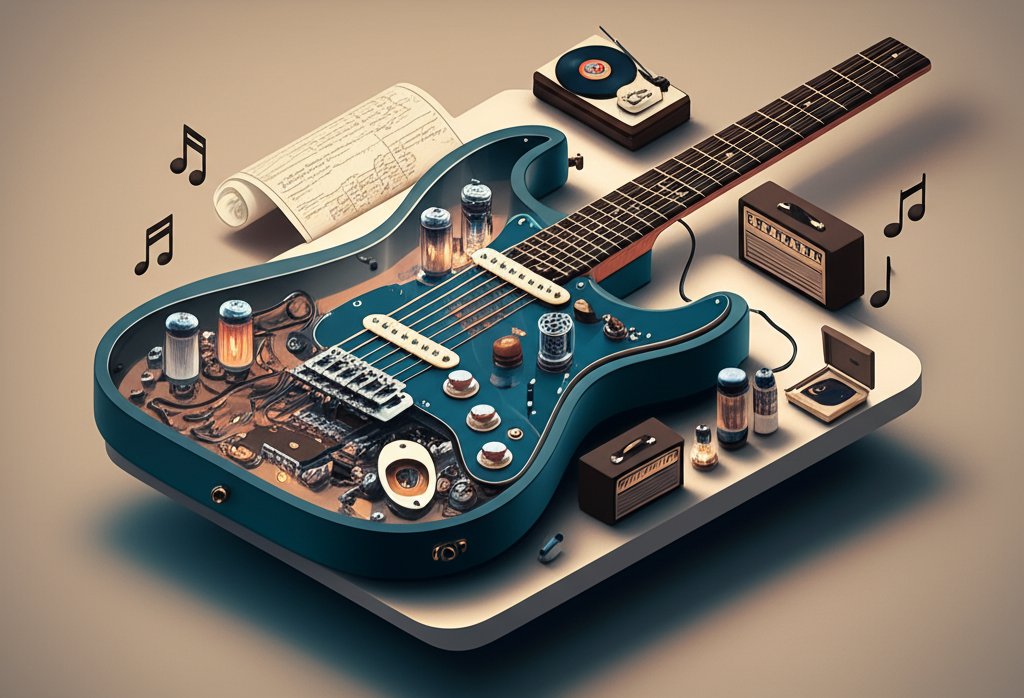
Welcome to the electrifying universe of the electric guitar! More than just an instrument, it’s a cultural phenomenon, a voice for generations, and a marvel of engineering that forever changed the soundscape of humanity. If you’ve ever wondered about the thunderous power of rock, the soulful cry of the blues, or the intricate melodies of jazz, you’ve heard the electric guitar at its heart.
In this deep dive, we’re not just scratching the surface. We’re going on an unparalleled journey to uncover the hidden secrets and mind-blowing facts about electric guitars that even seasoned musicians might not know. From its humble beginnings in the hands of visionary inventors to its current status as an indispensable icon, prepare to have your understanding of this legendary instrument amplified like never before. Get ready to explore the definitive electric guitar facts and discover why these magnificent machines continue to captivate and inspire.
The Electrifying Birth of the Electric Guitar
Imagine a world where a guitarist could barely be heard over a booming brass section or a thunderous drum kit. This wasn’t a hypothetical problem; it was the reality of the early 20th century. The acoustic guitar, for all its charm, simply lacked the volume needed to compete in rapidly expanding musical genres like jazz and big band. This pressing need for amplification sparked an innovation that would ignite a revolution.
From Acoustic Whispers to Amplified Roars: The Early Need
As music moved from intimate parlors to large dance halls and concert venues, acoustic instruments struggled to project. Violinists, trumpeters, and saxophonists could cut through the noise, but guitarists often found themselves relegated to the background, their intricate playing lost in the sonic shuffle. The solution wasn’t just louder strings or bigger bodies; it required a fundamental shift in how the sound was produced and projected. This was the dawn of electrical amplification, a concept that would soon transform a quiet strum into a roaring crescendo.
The Frying Pan and the Pioneers: Rickenbacker and Beauchamp
The year 1931 marked a pivotal moment. George Beauchamp, a guitarist and inventor, teamed up with Adolph Rickenbacker, a tool and die maker, to tackle the amplification challenge. Their brainchild was the “Frying Pan” – officially known as the Electro A-22 Hawaiian Guitar. This isn’t just a quirky name; it was arguably the first commercially marketed electric guitar. Its aluminum body, often shaped like a frying pan, housed the crucial innovation: electromagnetic pickups. These pickups converted the vibrations of the metal strings into electrical signals, which could then be sent to an amplifier. Suddenly, the guitar could be heard loud and clear, opening up a world of possibilities for electric guitars.
Solid Foundations: The Era of Les Paul and Leo Fender
While the “Frying Pan” was groundbreaking, it was the solid-body electric guitar that truly reshaped popular music. The hollow or semi-hollow bodies of early amplified guitars were prone to feedback at higher volumes, a frustrating limitation. Enter two titans of guitar facts and innovation:
- Les Paul: A legendary guitarist and inventor, Les Paul experimented with solid-body designs in the early 1940s, famously creating “The Log” by attaching guitar parts to a 4×4 piece of lumber. His insights profoundly influenced the iconic Gibson Les Paul, released in 1952, which provided unparalleled sustain and minimized feedback.
- Leo Fender: A radio repairman with no formal musical training, Leo Fender adopted a practical, modular approach to guitar design. His Fender Broadcaster (later renamed Telecaster) in 1950 and the revolutionary Stratocaster in 1954 were simpler to manufacture, easier to repair, and offered distinct, versatile tones. These were truly the first complete electric guitars that defined the modern era, setting the stage for countless models and inspiring generations of musicians. The solid-body design allowed for greater volume, sustain, and the ability to control feedback, unleashing the instrument’s full potential.
Anatomy of an Icon: How Electric Guitars Truly Work
Unlike their acoustic ancestors that rely on a vibrating soundboard to project sound, electric guitars are intricate electro-mechanical devices. Understanding their components reveals the genius behind their diverse sonic capabilities. These guitar facts dive into the core mechanics.
The Magic of Pickups: Single-Coils vs. Humbuckers
At the heart of any electric guitar are its pickups – small marvels that translate physical vibrations into an electrical current. This is perhaps one of the most crucial facts about electric guitars: without them, there is no electric sound.
- Single-Coil Pickups: These consist of a single coil of wire wrapped around magnetic pole pieces. Known for their bright, clear, and articulate tone, they are characteristic of the Fender Stratocaster and Telecaster. Their drawback? They are susceptible to electromagnetic interference, producing a “hum.”
- Humbucker Pickups: Invented to “buck the hum” (hence “humbucker”), these pickups feature two coils wired out of phase. This cancels out the noise while delivering a fatter, warmer, and higher-output sound. They are staples of the Gibson Les Paul and are favored in genres like rock and metal for their powerful, thick tones.
The type, placement, and wiring of pickups profoundly shape an electric guitar’s voice, offering a vast palette of sounds from crisp and twangy to deep and aggressive.
Tonewoods and Body Construction: Shaping the Sound
While pickups are electronic, the wood and construction of an electric guitar still play a significant role in its acoustic resonance and overall tone. This goes beyond simple aesthetics and forms another vital area of electric guitar facts.
- Solid-body Guitars: The most common type (e.g., Stratocaster, Les Paul), these have a solid piece of wood for the body. This construction minimizes feedback at high volumes, maximizes sustain, and offers a punchy, direct tone. Common tonewoods include alder, ash, mahogany, and maple, each contributing unique sonic characteristics.
- Hollow-body Guitars: Resembling acoustic guitars with larger, resonant chambers and f-holes, these produce a warmer, airier tone, making them popular in jazz and blues. However, they are highly prone to feedback at louder volumes.
- Semi-hollow Body Guitars: A brilliant compromise, these guitars feature a central wood block running through the body, flanked by hollow wings, often with f-holes (like B.B. King’s legendary Lucille or the Gibson ES-335). They offer a blend of the warmth of hollow-bodies with improved feedback resistance and sustain, providing a sweet, plaintive, or funky tone favored in blues, ’60s pop, and indie rock. The central block minimizes vibrations from the body being picked up, focusing more on string vibration.
Necks, Frets, and Scale Length: The Playability Equation
Beyond the body, the neck and its configuration are crucial for playability and tone.
- Neck Construction: Necks can be bolted on (Fender), set in (Gibson), or neck-through-body (some custom models). Each method affects sustain and resonance.
- Frets: Metal strips embedded in the fretboard that determine note pitch. The number and size of frets influence playability, especially for bending strings.
- Scale Length: The distance from the nut (at the headstock) to the bridge. A longer scale length (e.g., Fender, ~25.5 inches) generally results in a brighter tone, greater string tension, and more sustain, while a shorter scale (e.g., Gibson, ~24.75 inches) yields a warmer sound, easier string bending, and a more comfortable feel for some players. These subtle guitar facts profoundly impact a player’s interaction with the instrument.
Bridges, Tremolos, and Tuning: Fine-Tuning Expression
The bridge is where the strings terminate at the body, and its design significantly impacts tuning stability and expressive capabilities.
- Fixed Bridges: Offer excellent tuning stability and sustain (e.g., Tune-o-matic on Les Pauls, hardtail Stratocasters).
- Tremolo Systems (Whammy Bars): Allow players to bend the pitch of notes up or down, creating dramatic vibrato effects. From the classic synchronised tremolo on a Stratocaster (Jimi Hendrix was a master) to the locking Floyd Rose systems favored by metal shredders, these mechanisms add immense expressive power to electric guitars.
Electric Guitars Through the Genres: A Sonic Revolution
The electric guitar isn’t just an instrument; it’s a chameleon, adapting its voice to countless musical styles. Its versatility is one of the most compelling facts about electric guitars.
Blues, Jazz, and the Big Band Era: Early Adaptations
In its infancy, the electric guitar found its first champions in blues and jazz. Trailblazers like Charlie Christian used early archtop electrics to cut through big band arrangements, laying the groundwork for the modern jazz guitar. In the blues, the amplified guitar became a raw, emotional extension of the human voice, with legends like T-Bone Walker and Muddy Waters defining its early sound. The ability to increase volume allowed blues guitarists to reach larger audiences and convey more powerful emotion.
Rock ‘n’ Roll and Beyond: The Guitar as a Lead Voice
The 1950s exploded with rock ‘n’ roll, and the electric guitar became its undisputed monarch. Chuck Berry’s iconic riffs, Elvis Presley’s electrifying performances, and the birth of rock saw the guitar transform from a rhythm instrument into a dominant lead voice. The 60s and 70s brought psychedelic rock, hard rock, and arena rock, with guitar heroes like Jimi Hendrix, Eric Clapton, and Jimmy Page pushing the boundaries of what these electric guitars could do, utilizing feedback, distortion, and extended solos to create entirely new sonic landscapes.
Metal, Punk, and Alternative: Pushing Sonic Boundaries
The evolution continued. Heavy metal in the late 60s and early 70s demanded even more power and aggression, leading to high-output humbucker pickups and more extreme amplification. Punk rock stripped things back, favoring raw, aggressive tones. The alternative and grunge movements of the 80s and 90s explored new textures and tunings, proving the electric guitar’s endless adaptability. From the shredding solos of Van Halen to the dissonant chords of Nirvana, the electric guitar remained central to youth culture and musical expression.
Iconic Guitars and Legendary Players: Their Untold Stories
Certain electric guitars have achieved legendary status, inextricably linked to the artists who wielded them.
- Fender Stratocaster: Synonymous with rock and blues, played by Jimi Hendrix, Eric Clapton, David Gilmour, and countless others. Its distinctive sound and ergonomic design made it a timeless classic.
- Gibson Les Paul: The powerhouse for rock and blues, favored by Jimmy Page, Slash, Duane Allman, and Joe Bonamassa. Known for its thick tone and sustain.
- Fender Telecaster: The workhorse, revered for its bright, twangy sound. Bruce Springsteen, Keith Richards, and Jeff Buckley are just a few who made it famous across genres.
- B.B. King’s “Lucille”: A series of Gibson ES-335 style semi-hollow bodies, famous for its soulful tone and lack of f-holes (to prevent feedback), becoming a signature sound for the King of the Blues.
These instruments aren’t just wood and wires; they’re cultural artifacts, their stories intertwined with the history of modern music – truly compelling guitar facts.
Just like the fascinating stories surrounding the electric guitar, the lives of the musicians who wield them are often filled with surprising details, making exploring further facts about musicians a truly captivating pursuit.
The Endless Palette: Effects and Modern Innovations
The electric guitar’s true magic lies not just in its inherent tone but in its incredible ability to be sculpted, manipulated, and transformed by electronic effects. This is where the term “sonic wonders” truly comes alive.
Beyond Clean Tones: Distortion, Overdrive, and Fuzz
The first “effect” was often simply turning up the amp to create natural overdrive or distortion. However, soon dedicated pedals emerged:
- Fuzz: One of the earliest effects, creating a thick, harmonically rich, often sputtering distortion (e.g., Jimi Hendrix’s “Foxy Lady” or “Satisfaction” by The Rolling Stones).
- Overdrive: Simulates the sound of a tube amplifier pushed to its limits, adding warmth, sustain, and grit without completely obscuring the guitar’s original tone (e.g., Stevie Ray Vaughan’s blues tones).
- Distortion: Provides a more aggressive, compressed, and saturated sound than overdrive, often favored in hard rock and metal for its sustained, powerful crunch.
These foundational effects alone opened up countless new avenues for musical expression and are integral to any discussion of facts about electric guitars.
Modulation and Delay: Adding Depth and Dimension
Beyond simple gain, other effects add atmosphere and movement:
- Chorus: Creates a shimmering, thicker sound by subtly detuning and delaying a copy of the original signal.
- Flanger/Phaser: Produce swirling, jet-engine-like sounds by sweeping a filter across the frequency spectrum.
- Delay/Echo: Repeats the guitar’s signal, creating anything from a subtle slapback to vast, ambient soundscapes.
- Reverb: Simulates the natural reflections of sound in a space, adding depth and spaciousness.
These effects allow guitarists to paint vast sonic landscapes, turning a simple riff into an ethereal journey.
Digital Age: Modeling, Synth Guitars, and the Future
Modern technology has further expanded the electric guitar’s sonic capabilities. Digital modeling amplifiers and pedals can accurately replicate the sounds of dozens of classic amps and effects, offering unprecedented versatility. Synth guitars, equipped with MIDI pickups, can trigger synthesizers, allowing guitarists to play orchestral sounds, pianos, or any electronic sound imaginable. The future of electric guitars promises even more integration with digital platforms, artificial intelligence, and new materials, ensuring its place as an endlessly evolving instrument.
Mind-Blowing Electric Guitar Facts You Never Knew

Let’s dive into some truly fascinating and lesser-known electric guitar facts that showcase the instrument’s depth and curious history.
The Rarity of Left-Handed Legends
While left-handed guitarists exist, many famous ones—like Jimi Hendrix and Kurt Cobain—played right-handed guitars strung in reverse. This often forced them to adapt to instruments not naturally designed for them, or required custom modifications, highlighting the early scarcity of left-handed models.
The Science of Sustain
A fact about electric guitars often overlooked is the role of mass and material in sustain. Heavier bodies, dense neck woods, and sturdy bridges all contribute to longer sustain, allowing notes to ring out for extended periods. This is why solid-body guitars generally sustain better than hollow-bodies and why different tonewoods are chosen not just for tone but for their vibrational properties.
Unique Materials and Custom Builds
Beyond traditional tonewoods, electric guitars have been crafted from incredibly diverse materials. Aluminum guitars were experimented with early on (like the Frying Pan), and modern builders use everything from carbon fiber for lightweight, durable instruments to exotic woods, acrylic, and even recycled materials. Custom builders continuously push boundaries, creating instruments that are as much works of art as they are musical tools, making these some truly unique guitar facts.
Feedback: From Bug to Feature
Early on, feedback (the piercing squeal when an amplified guitar gets too close to its amp) was a major problem. However, innovators like Jimi Hendrix turned this bug into a feature, harnessing controlled feedback as an expressive tool, adding harmonic richness and raw power to his sound. Today, it’s a vital part of many rock and metal genres.
The “Death” of the Electric Guitar? Not Likely.
Despite predictions over the decades that synthesizers or DJ culture would diminish its role, the electric guitar has consistently reinvented itself. Its tactile nature, expressive range, and powerful cultural resonance ensure its continued dominance in music around the world. Every generation finds new ways to make it speak, proving its enduring adaptability.
Conclusion
From the innovative spark that solved a simple volume problem to its current status as a technological and artistic marvel, the electric guitar has journeyed through a truly mind-blowing history. We’ve explored the fascinating electric guitar facts behind its birth, delved into the intricate mechanics that give it voice, and traced its indelible mark across every genre imaginable. The evolution of electric guitars is a testament to human ingenuity, pushing the boundaries of sound and expression.
Whether you’re a seasoned player, a curious music lover, or just someone looking for incredible guitar facts, we hope this journey has deepened your appreciation for this iconic instrument. The electric guitar isn’t just a collection of wood, wire, and magnets; it’s a conduit for passion, a symbol of rebellion, and a source of endless musical inspiration. So, plug in, turn up, and let the magic of the electric guitar continue to resonate!
FAQ
Q: What was the first commercially marketed electric guitar?
A: The first commercially marketed electric guitar was the “Frying Pan” (Electro A-22 Hawaiian Guitar), designed by George Beauchamp and Adolph Rickenbacker in 1931.
Q: How do electric guitars produce sound?
A: Electric guitars produce sound through electromagnetic pickups, which convert the vibrations of metal strings into electrical signals. These signals are then sent to an amplifier, which boosts them and projects the sound.
Q: What is the difference between single-coil and humbucker pickups?
A: Single-coil pickups (e.g., Fender Stratocaster) produce a bright, clear tone but are susceptible to hum. Humbucker pickups (e.g., Gibson Les Paul) use two coils to cancel out hum, producing a fatter, warmer, and higher-output sound.
Q: What is “scale length” on an electric guitar?
A: Scale length is the distance from the guitar’s nut to its bridge. It significantly influences tone and playability: longer scales (e.g., 25.5 inches) generally offer brighter tones and more sustain, while shorter scales (e.g., 24.75 inches) produce warmer tones and are easier for string bending.
Q: What are hollow-body and semi-hollow body electric guitars used for?
A: Hollow-body guitars are often used for jazz and blues due to their warm, resonant tone but are prone to feedback. Semi-hollow body guitars (with a central wood block) provide a blend of warmth with better feedback resistance and sustain, popular in blues, ’60s pop, and indie rock.
Q: Who are some key figures in the early development of the electric guitar?
A: George Beauchamp and Adolph Rickenbacker (for the “Frying Pan”), Les Paul (for solid-body experimentation and the Gibson Les Paul), and Leo Fender (for the Fender Telecaster and Stratocaster) are considered pioneers.
Q: Can electric guitars be made from materials other than wood?
A: Yes, while wood is traditional, electric guitars have been made from materials like aluminum, carbon fiber, acrylic, and various composite materials for different tonal and structural properties.
Q: What genres of music are most associated with the electric guitar?
A: The electric guitar is a primary instrument in a vast array of genres, including rock, pop, blues, jazz, metal, punk, R&B, country, reggae, and more. Its versatility has allowed it to adapt to nearly every modern musical style.










