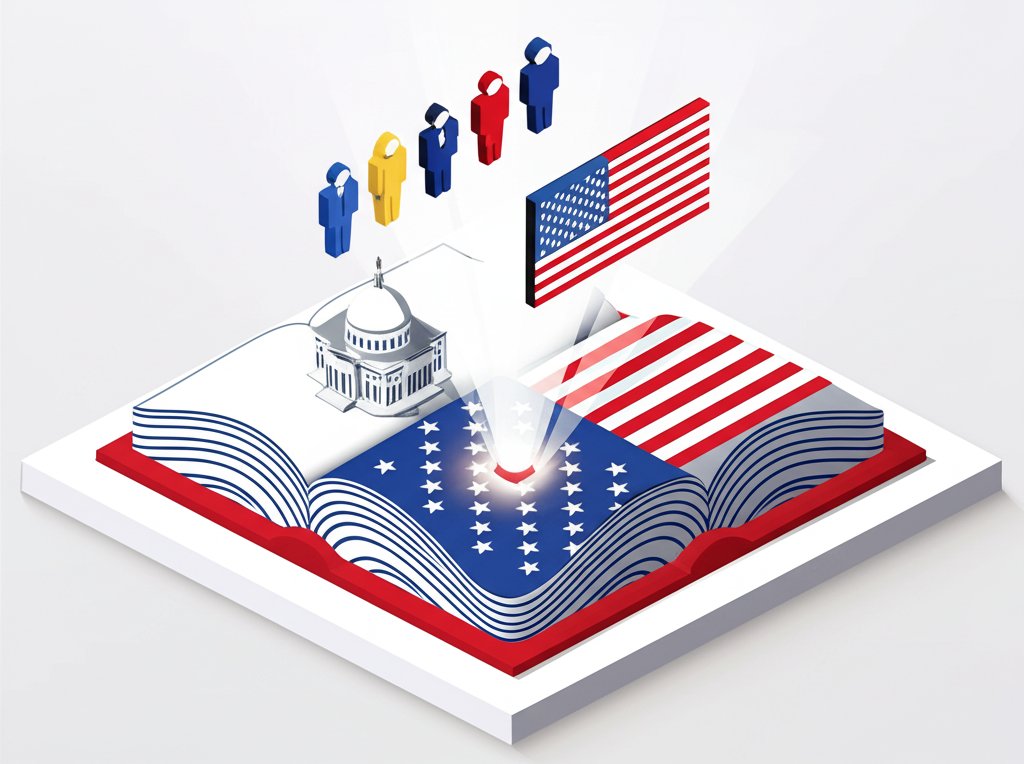
Many of the best American history books don’t just recount events; they reframe them, forcing us to confront uncomfortable truths and question long-held assumptions. The tidy, heroic narrative often taught in schools crumbles under the weight of deep archival research, revealing a story that is far more complex, contested, and ultimately, more human. These are the books that challenge us, showing how the past is not a settled artifact but a live wire running directly into the present.
Reading these works isn’t about discarding patriotism; it’s about embracing a more honest and durable understanding of the nation. They uncover the hidden figures, forgotten struggles, and systemic forces that have shaped the American experiment from its very beginnings.
At a Glance: What You’ll Find Inside
- Deconstruct Core Myths: Discover books that dismantle foundational stories about America’s origins, from the “untouched wilderness” to the unified vision of the Founding Fathers.
- Confront Systemic Injustice: Explore powerful histories that center on the perspectives of marginalized groups, revealing how racial and economic inequality were not byproducts but foundational elements of US policy.
- Uncover Hidden Histories: Learn about America’s overlooked colonial past and the epic migrations and conflicts that defined the continent in ways standard textbooks often ignore.
- A Practical Guide to Reading: Get actionable tips on how to engage with these challenging narratives critically and constructively.
These books offer more than just facts; they provide a new lens for viewing the American story. For a wider selection covering various eras and themes, you can Discover best US history books in our comprehensive pillar guide.
Deconstructing the Foundational Myths
Some of the most powerful American history books are those that challenge the very bedrock of our national story. They use meticulous research to question what we think we know about the nation’s founding and the land it was built upon.
1. 1491: New Revelations of the Americas Before Columbus by Charles C. Mann
Mann’s work fundamentally overhauls the image of a sparse, virgin wilderness greeting European settlers. It reveals that the pre-Columbian Americas were, in fact, a bustling, highly engineered landscape.
- The Truth Revealed: Indigenous societies were not passive inhabitants but active shapers of their environment. They built sprawling cities like Tenochtitlan (larger than any European city of its time), managed vast agricultural systems through techniques like terraforming, and even genetically engineered corn from a wild grass.
- Why It Changes Everything: This knowledge reframes the European “conquest” not as the taming of a wilderness, but as the dismantling of complex, advanced civilizations. The “empty” land the colonists found was often a landscape recently depopulated by European-borne diseases that raced ahead of the settlers themselves.
2. These Truths: A History of the United States by Jill Lepore
Lepore’s single-volume history places a central question at its core: has America lived up to its founding “truths” of political equality, natural rights, and the sovereignty of the people? She traces this question through centuries of political turmoil, technological change, and social conflict.
- The Truth Revealed: The founding ideals were aspirational and, from the start, deeply contested. Lepore shows how the nation has continually wrestled with its own contradictions—fighting for liberty while upholding slavery, championing democracy while disenfranchising entire populations.
- Why It’s Essential: It moves beyond a simple “good vs. evil” narrative, presenting American history as an ongoing, often brutal, argument over the meaning of its own creed.
3. Lies My Teacher Told Me by James W. Loewen
This book is a direct critique of the high school history curriculum. Loewen surveyed eighteen leading American history textbooks and exposed the pervasive misinformation, patriotic blind spots, and outright falsehoods that have been taught to generations of students.
- The Truth Revealed: Textbooks often present a sanitized, hero-centric version of history, glossing over the darker aspects of figures like Christopher Columbus and Woodrow Wilson, downplaying racial conflict, and ignoring the history of labor movements.
- Why It’s a Game-Changer: It equips readers to become more critical consumers of historical information, questioning not just what is said, but what is left unsaid.
Confronting Injustice and Power

This set of books shifts the historical lens from the powerful to the powerless. They argue that to understand America, you must understand the struggles of those who were exploited, oppressed, and silenced.
1. Stamped from the Beginning: The Definitive History of Racist Ideas in America by Ibram X. Kendi
Winner of the National Book Award, Kendi’s work is a monumental intellectual history of anti-Black racist ideas. He makes a provocative and powerfully argued claim: racist policies come first, and racist ideas are then created to justify them.
- The Truth Revealed: Racist ideas are not born of ignorance or hate. Instead, they are sophisticated constructs designed to defend and normalize discriminatory policies that benefit a powerful few. Kendi traces this pattern through the lives of five major American thinkers.
- Why It’s a Must-Read: It forces a re-evaluation of the origins of racism. Rather than a problem of the heart, Kendi presents it as a problem of power and policy, which has profound implications for how we address it today.
2. A People’s History of the United States by Howard Zinn
Perhaps the most famous “history from below,” Zinn’s book intentionally tells the American story from the perspective of those left out of traditional narratives: Indigenous peoples, enslaved Africans, women, factory workers, and immigrants.
- The Truth Revealed: Major historical progress—from the 8-hour workday to civil rights—was not graciously granted from on high. It was won through fierce, often violent, grassroots struggle by ordinary people.
- Why It’s So Influential: It provides a powerful counter-narrative to the “great man” theory of history, suggesting that the true engine of change is collective action and resistance.
3. Bury My Heart at Wounded Knee: An Indian History of the American West by Dee Brown
Published in 1970, this book was a landmark achievement. Using council records, autobiographies, and firsthand accounts, Brown tells the story of the American West’s expansion from the perspective of the Native American tribes being systematically displaced and destroyed.
- The Truth Revealed: The “settling” of the West was a brutal, decades-long campaign of broken treaties, massacres, and cultural annihilation. Brown details the specific experiences of tribes like the Sioux, Cheyenne, and Navajo.
- Why It Endures: It gives voice and humanity to the victims of westward expansion, transforming them from faceless obstacles in the path of “manifest destiny” into people defending their homes and way of life.
Uncovering Hidden Histories and Forgotten People
The official borders of the United States on a map can be deceiving. These books expand our understanding of what “America” is, who Americans are, and the global forces that have shaped the nation.
1. How to Hide an Empire: A History of the Greater United States by Daniel Immerwahr
Immerwahr’s stunning book argues that our standard “logo map” of the contiguous United States is a lie. He reveals the forgotten history of America’s overseas territories—from the Philippines and Puerto Rico to the Guano Islands—and the millions of people who have lived under U.S. rule without the rights of citizens.
- The Truth Revealed: The United States has been a colonial power for much of its history. This imperial past has profoundly shaped everything from technology (the development of radio and aviation was driven by the need to manage a global empire) to culture and demographics.
- Why It’s Transformative: It forces you to see the U.S. not as an isolated republic, but as a global empire whose mainland history is inseparable from its overseas territories.
2. The Warmth of Other Suns by Isabel Wilkerson
This Pulitzer Prize-winning work chronicles the Great Migration, the mass movement of six million African Americans from the rural South to the urban North and West between 1915 and 1970. Wilkerson tells this epic story through the intimate lives of three individuals.
- The Truth Revealed: The Great Migration was one of the largest and most under-documented internal migrations in history. It wasn’t just a demographic shift; it was a political and cultural movement that reshaped American cities, culture, and politics.
- Why It’s a Masterpiece: It personalizes a vast historical force, making the hopes, fears, and courage of the migrants tangible and unforgettable. It demonstrates that these individuals were not just subjects of history, but agents of their own destiny.
A Practical Playbook: How to Read Challenging Histories
Engaging with books that upend familiar narratives can be disorienting. Here’s a simple framework for reading them critically and getting the most out of the experience.
| Approach | Actionable Tip | Example in Practice |
|---|---|---|
| Question the Narrative | Before starting, ask yourself: “What is the traditional story of this event?” This creates a baseline to compare against. | When reading 1491, recall the “Columbus discovers an empty wilderness” story you learned in elementary school. |
| Follow the Footnotes | Pay attention to the sources. Is the author relying on primary documents (letters, diaries, official records) or reinterpreting other historians? | Ibram X. Kendi in Stamped meticulously cites the writings of figures like Cotton Mather to show their racist ideas in their own words. |
| Connect Past to Present | Constantly ask: “How does this historical pattern or event explain something I see in the world today?” | Reading Erika Lee’s America for Americans about xenophobia helps contextualize modern debates over immigration policy. |
| Seek Multiple Voices | A single book is one interpretation. If a topic fascinates you, find another book on the same subject with a different perspective. | After Zinn’s A People’s History, you might read Joseph J. Ellis’s Founding Brothers to get a different, “top-down” view of the Revolutionary era. |
Quick Answers to Common Questions
Q: Are these books “anti-American”?
A: Not at all. A critical history is not an unpatriotic one. These authors often write from a place of deep engagement with America’s founding ideals, arguing that acknowledging the nation’s failures is the only way to truly live up to its promise. They challenge blind patriotism in favor of an informed, honest understanding.
Q: I feel overwhelmed. Where is the best place to start?
A: For a broad, paradigm-shifting overview, Charles C. Mann’s 1491 is an excellent choice because it starts before the United States even existed and fundamentally changes your perception of the American landscape. For a more direct examination of core American ideas, Jill Lepore’s These Truths is both readable and comprehensive.
Q: How can history written by one person be the “truth”?
A: That’s a great question. No single book is the final word. The best historians make an argument based on evidence. They present their interpretation, supported by extensive research. The goal for a reader isn’t to accept it as gospel, but to engage with the evidence and decide if the author’s argument is convincing. That’s why reading multiple perspectives is so important.
Moving from Knowledge to Understanding
The best American history books don’t provide easy answers. Instead, they arm you with a more nuanced and powerful set of questions. They reveal that the story of our nation is not a finished monument to be admired, but an ongoing, often-painful process that we are all a part of.
By embracing these challenging narratives, you move beyond simple memorization of dates and names. You begin to understand the complex forces that have shaped the country, the deep-seated conflicts that remain unresolved, and the vital importance of engaging with our history in all its uncomfortable, contradictory, and illuminating glory. Your next step is to pick one of these works and begin the journey.










