
Ancient Greek philosophy, a cornerstone of Western thought, emerged in the 6th century BC and profoundly shaped our understanding of the world. Driven by reason, it encompassed an astonishing range of subjects, from the cosmos and mathematics to ethics and politics. Its influence reverberates through Roman philosophy, the Renaissance, and even contemporary society, impacting everything from legal codes to personal belief systems. This hub explores the key figures, concepts, and periods of ancient Greek philosophy, providing a launchpad for deeper exploration.
Understanding the Foundations: Reason and the World

At its heart, ancient greek philosophy represents the quest to understand the world through reason. Before the rise of philosophy, explanations for natural phenomena often relied on mythology and divine intervention. The early Greek philosophers, however, sought rational explanations based on observation and logical deduction. They grappled with fundamental questions about existence, knowledge, and morality, laying the groundwork for subsequent philosophical traditions.
Pre-Socratic Philosophy: Seeds of Inquiry
The period before Socrates, known as the Pre-Socratic era, was marked by intense speculation about the nature of reality. These thinkers, often from cities in Ionia (modern-day Turkey) and southern Italy, focused on cosmology, ontology (the study of being), and mathematics. They sought to identify the arche, the fundamental principle or substance from which all things originate.
- Thales of Miletus believed water was the arche.
- Anaximander proposed the apeiron, an unlimited and undefined substance.
- Anaximenes argued that air was the fundamental element.
- Heraclitus famously proclaimed that “everything flows” (panta rhei), emphasizing constant change and the unity of opposites, linked by the logos, a governing principle or formula.
- Parmenides, in contrast, argued that being is One, indivisible, and unchanging, presenting a stark challenge to Heraclitus’s view.
- Zeno of Elea, a student of Parmenides, developed paradoxes designed to demonstrate the impossibility of motion and plurality.
- Empedocles suggested that multiple elements (earth, air, fire, and water) are moved by love and strife.
- Anaxagoras introduced the concept of Nous (Mind) as the organizing principle of the cosmos.
- Leucippus and Democritus proposed the revolutionary idea of atomism, suggesting that reality is composed of indivisible particles (atoms) and empty space.
- Xenophanes critiqued assumptions about gods and argued for natural explanations.
The Sophists: Challenging Traditional Values
The Sophists emerged in the 5th century BC, shifting the philosophical focus from cosmology to human affairs. They were itinerant teachers who emphasized rhetoric, argumentation, and practical skills. The Sophists challenged traditional values and beliefs, arguing that morality and justice were matters of convention rather than inherent truths, leading to the debate between physis (nature) and nomos (law/convention). Protagoras, a prominent Sophist, famously claimed that “man is the measure of all things,” advocating perspectivism and subjectivity. Gorgias, another influential Sophist, argued that nothing exists or, even if it did, couldn’t be known or communicated.
The Golden Age: Socrates, Plato, and Aristotle
The Classical period of Greek philosophy, dominated by Socrates, Plato, and Aristotle, marked a high point in intellectual achievement.
Socrates: The Father of Western Philosophy
Socrates, though he left no written works, is considered the father of Western philosophy. He revolutionized philosophical inquiry with his relentless questioning and his focus on ethics. Socrates believed that true wisdom consisted in recognizing one’s own ignorance. He employed the elenchos, a method of questioning and cross-examination, to expose contradictions in people’s beliefs and to encourage them to examine their values. His unwavering commitment to truth led to his trial and execution, solidifying his legacy as a martyr for philosophy.
Plato: The Realm of Forms
Plato, Socrates’ student, developed a comprehensive philosophical system that encompassed metaphysics, epistemology, ethics, and politics. He is best known for his Theory of Forms, which posits that the physical world is merely a shadow of a higher realm of perfect and eternal Forms. These Forms, such as Justice, Beauty, and Goodness, are the true objects of knowledge. Plato believed that philosophers, with their ability to grasp the Forms, were best suited to rule society, advocating for philosopher-kings in his Republic. He founded the Academy, a center of learning that shaped philosophical thought for centuries.
Aristotle: Logic, Science, and Ethics
Aristotle, Plato’s student, was a polymath whose contributions spanned virtually every field of knowledge. He developed formal logic, made significant contributions to biology and physics, and formulated a comprehensive ethical and political theory. Unlike Plato, Aristotle emphasized empirical observation and believed that knowledge is derived from experience. He rejected Plato’s Theory of Forms, arguing that Forms exist within particular things. Aristotle believed in teleology, the idea that everything has a purpose or end goal. He explored concepts of virtue, happiness, and the good life, offering profound insights into human nature. If you’re looking for guidance in living a virtuous life, you might appreciate these ethics aristotle quotes to inspire your decision-making. Aristotle founded the Lyceum, a rival school to Plato’s Academy.
Hellenistic Philosophy: Seeking Meaning in a Changing World
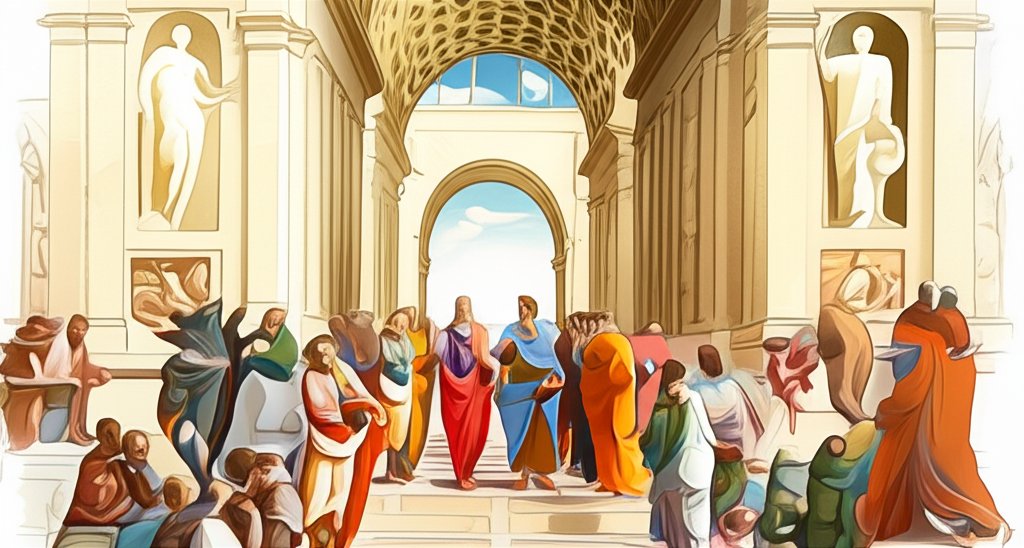
The Hellenistic period, following the death of Alexander the Great, saw the rise of new philosophical schools that grappled with questions of ethics, happiness, and how to live a good life in a turbulent world.
Cynicism: Living According to Nature
Cynicism, founded by Antisthenes, a disciple of Socrates, advocated a life of simplicity, self-sufficiency, and freedom from social conventions. Cynics rejected material possessions, social status, and political power, seeking to live in accordance with nature. Diogenes, the most famous Cynic, epitomized this philosophy with his unconventional lifestyle and his disdain for social norms.
Epicureanism: The Pursuit of Pleasure
Epicureanism, founded by Epicurus, emphasized pleasure as the ultimate good. However, Epicurean pleasure was not simply about sensual gratification. Rather, it was about the absence of pain and disturbance. Epicureans sought tranquility and moderation, believing that the greatest pleasure came from intellectual pursuits, friendship, and a simple life.
Stoicism: Virtue and Acceptance
Stoicism, founded by Zeno of Citium, taught that virtue is the only good and that happiness depends on accepting what we cannot control. Stoics emphasized reason, self-control, and duty. They believed that the universe is governed by a rational principle and that we should live in accordance with nature. Stoicism offered a practical philosophy for coping with adversity and finding inner peace. With its focus on self-control and acceptance of what you cannot change, you might be keen to explore is stoicism a religion, which explores the connections between ancient philosophies and modern spirituality.
Pyrrhonism: The Value of Skepticism
Pyrrhonism, founded by Pyrrho of Elis, advocated skepticism as a path to ataraxia, a state of equanimity or freedom from disturbance. Pyrrhonists argued that we can never know anything for certain and that we should suspend judgment on all matters. By abstaining from dogmatic beliefs, they believed we could avoid the anxiety and frustration that come from believing we know things we do not.
Neo-Platonism: The One and the Divine
Neo-Platonism, founded by Plotinus, was a revival of Plato’s philosophy that emphasized the mystical and religious aspects of his thought. Neo-Platonists believed in a transcendent “One,” from which all things emanate. They saw the soul as seeking to return to the One through contemplation and mystical union.
The Enduring Legacy
Ancient Greek philosophy has had a profound and lasting impact on Western civilization. Its influence can be seen in Roman philosophy, medieval scholasticism, the European Renaissance, and the Age of Enlightenment. Aristotle’s works, in particular, were influential in Islamic, Jewish, and medieval Christian philosophy. The ideas of the ancient Greeks continue to shape modern philosophical thought, cultural values, legal codes, and belief systems worldwide. Even today, people debate whether was aristotle a stoic, showcasing the enduring relevance of these thinkers.
By delving into the world of ancient Greek philosophy, we gain a deeper understanding of the foundations of Western thought and the enduring questions that continue to shape our understanding of ourselves and the world around us. The quest for wisdom remains a timeless pursuit, and the ancient Greeks provide a rich source of inspiration for navigating the complexities of modern life.










