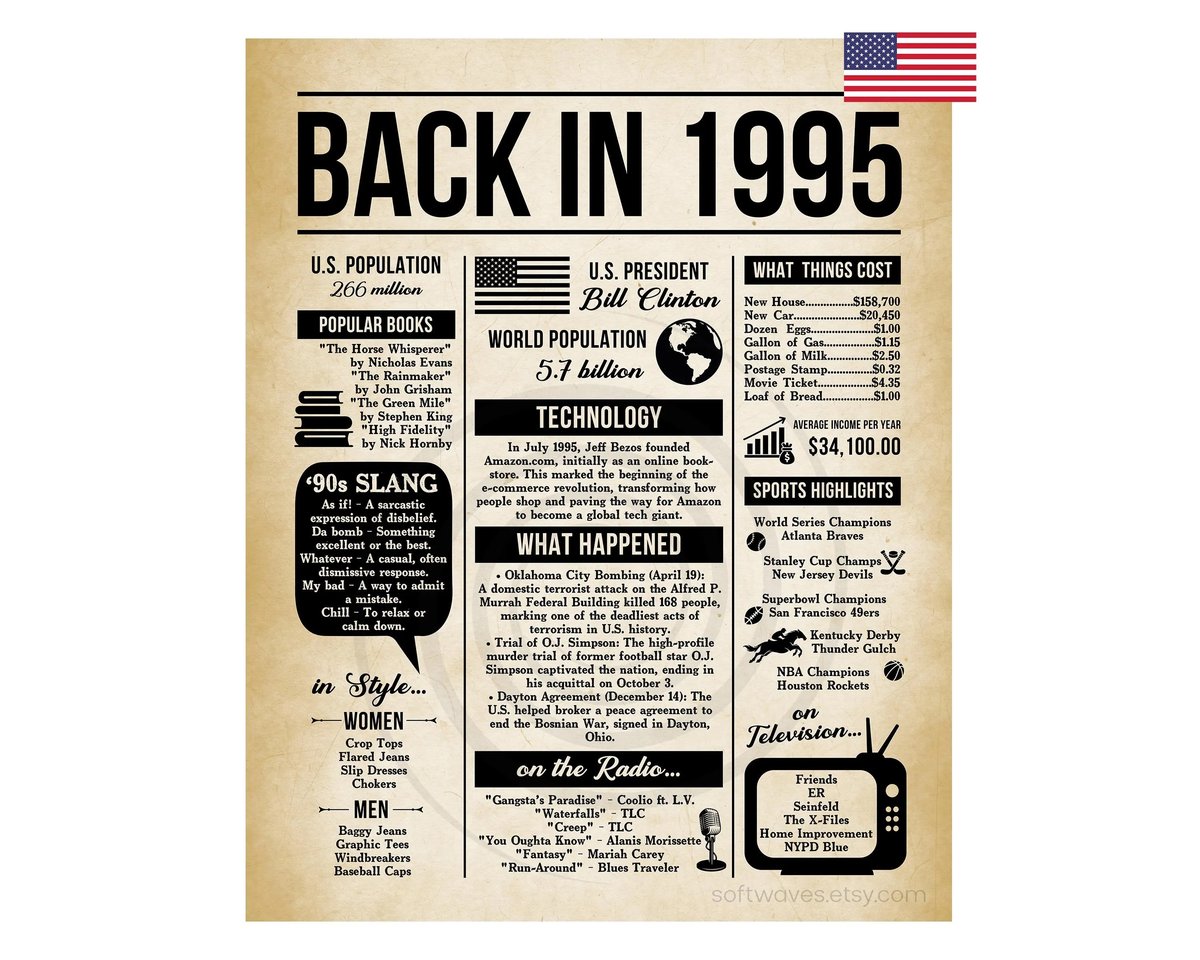
The year 1995 stands as a remarkable pivot point in modern history, a twelve-month span where a multitude of historical events of 1995 collectively reshaped geopolitical landscapes, ignited technological revolutions, and challenged societal norms. It was a year that felt like the cusp of an entirely new era, with the analog world of the past rapidly giving way to the digital future, marked by both profound tragedy and extraordinary progress. Understanding these shifts isn’t just about cataloging dates; it’s about grasping the underlying currents that continue to influence our world today.
At a Glance: Unpacking the Year 1995
- Global Architecture Reconfigured: Witness the rise of new international bodies and the escalation or resolution of regional conflicts that defined the post-Cold War world.
- The Internet Takes Hold: See how foundational technologies like Java and Yahoo! emerged, setting the stage for the digital age.
- Societal Fractures and Resilience: Explore high-profile domestic events, terrorist attacks, and cultural milestones that revealed both the fragility and strength of human communities.
- Scientific Frontiers Expanded: Discover groundbreaking scientific achievements, from particle physics to exoplanet discoveries and space exploration milestones.
- Lessons from Disasters: Understand the profound impact of natural catastrophes and human-made tragedies, and the global responses they demanded.
The World on the Brink: Setting the 1995 Stage
As 1995 dawned, the geopolitical aftershocks of the Cold War were still reverberating, creating a volatile mix of new freedoms, ethnic conflicts, and economic reconfigurations. The internet, while not yet a household staple, was clearly gaining momentum, hinting at the profound societal changes it would soon unleash. This was a world navigating a complex transition, where the promise of a globalized future collided with the harsh realities of ancient animosities and emergent threats. The events of this year, from the quiet incorporation of a search engine to the devastating detonation of a bomb, reflect a humanity grappling with unprecedented complexity.
Reshaping Global Governance and Geopolitics
The year 1995 truly marked a new chapter in international relations, characterized by the formalization of global economic structures and the intense struggles within newly independent or re-aligning nations.
On January 1st, a significant shift occurred with the World Trade Organization (WTO) officially beginning its operations, establishing a new framework for global commerce and dispute resolution. This same day, Austria, Finland, and Sweden joined the European Union, further consolidating the bloc’s influence, while the ‘Conference for Security and Co-operation in Europe’ transitioned into the Organization for Security and Co-operation in Europe (OSCE), signaling a more robust commitment to security in post-Cold War Europe. These institutional changes reflected a global aspiration for stability and cooperation in a world still finding its footing.
However, beneath the surface of cooperation, conflict continued to simmer. The First Chechen War saw Russian President Boris Yeltsin announce a temporary halt to bombing operations in Chechnya on January 5th, a brief pause in a brutal conflict. In South America, Ecuador and Peru engaged in a boundary dispute throughout January and February, eventually ending in a UN-brokered ceasefire on February 17th. These regional skirmishes underscored the fragility of peace in a rapidly changing world.
Perhaps the most harrowing conflicts unfolded in the Bosnian War. July brought the grim reality of the Srebrenica massacre, where more than 8,000 Bosniaks were systematically killed following Serbian forces’ attack on the town. This horrific event prompted a decisive international response, with NATO launching Operation Deliberate Force against Bosnian Serb forces on August 30th, a critical intervention that fundamentally altered the course of the war and led to the Dayton Accords later that year. Concurrently, Croatian forces launched Operation Flash (May 1st) and Operation Storm (August 4th), recapturing significant Serb-held territories and ultimately shifting the balance of power in the region.
The Middle East also saw a flicker of hope and a profound tragedy. On September 28th, Israeli Prime Minister Yitzhak Rabin and PLO Chairman Yasser Arafat signed the Interim Agreement on the West Bank and the Gaza Strip, a monumental step towards peace. Tragically, this progress was brutally interrupted on November 4th when Rabin was assassinated by an extremist Israeli, a devastating blow to the peace process and a stark reminder of internal divisions.
Even established nations faced existential questions. On October 30th, Quebec citizens narrowly voted (50.58% to 49.42%) to remain a province of Canada in their second referendum on national sovereignty, averting a potential national split by the slimmest of margins. These events collectively demonstrate a year marked by both grand diplomatic ambitions and the persistent specter of conflict and political upheaval.
Laying the Digital Highway: Technological Breakthroughs
While geopolitical events dominated headlines, the quiet revolutions in technology and science in 1995 were arguably laying the groundwork for the world we inhabit today. This was the year the internet truly began its ascent into public consciousness, transitioning from a niche academic tool to a burgeoning public utility. For a deeper dive into how these shifts impacted the broader technological and societal landscape, consider exploring What happened in 1995?
Crucially, March 1st saw Yahoo! incorporated, a pivotal moment for what would become one of the internet’s most recognizable brands. While search engines were still primitive, Yahoo!’s directory-based approach provided crucial navigation for early web users. Building on this momentum, the first version of the Java programming language was released on May 23rd. This seemingly technical event had monumental implications: Java’s “write once, run anywhere” philosophy would become a cornerstone for enterprise applications, mobile development, and, critically, for interactive web content (applets), paving the way for dynamic online experiences.
Scientific exploration also reached new heights. In February, Space Shuttle Discovery (STS-63) launched, notable for being the first mission to include a female commander, Eileen Collins, who became the first woman to pilot the Space Shuttle. This mission also marked a significant milestone with its rendezvous with the Russian space station Mir, foreshadowing greater international cooperation in space. Later, on June 29th, Space Shuttle Atlantis docked with Mir for the first time, further cementing this partnership. Meanwhile, Cosmonaut Valeriy Polyakov returned to Earth on March 22nd after setting a record of 438 days in space, demonstrating the human capacity for long-duration missions.
Groundbreaking discoveries weren’t limited to space. On March 2nd, researchers at Fermilab announced the discovery of the top quark, the last fundamental particle of matter predicted by the Standard Model, confirming decades of theoretical physics. Another monumental scientific achievement occurred on June 5th with the first creation of the Bose–Einstein condensate, a new state of matter with unique quantum properties. Looking outward, October 6th saw the stunning announcement of 51 Pegasi, the second major star (apart from the Sun) found to have a planet orbiting it. This discovery validated the existence of exoplanets and ignited the scientific search for life beyond our solar system.
These technological and scientific advancements, from the quiet lines of code to the grand gestures of space exploration, illustrate how 1995 wasn’t just a year of current events, but a foundational period for the future of innovation.
Society Under Stress: Disasters, Crime, and Cultural Shifts
The year 1995 also brought moments that tested the resilience of societies, from devastating acts of terror to high-profile criminal trials and moments of cultural significance.
One of the most horrific domestic terrorist attacks in U.S. history occurred on April 19th when the Alfred P. Murrah Federal Building in Oklahoma City, Oklahoma, was bombed, killing 168 people. This act of domestic terror shocked the nation, leading to a massive investigation and ultimately the indictment of Timothy McVeigh and Terry Nichols on August 10th. Globally, the chilling nature of terror also manifested in Japan, where a sarin gas attack on the Tokyo subway on March 20th killed 13 and wounded 1,300, perpetrated by the Aum Shinrikyo cult. These events underscored a growing awareness of new and frightening forms of internal and external threats.
Justice, or the lack thereof, captivated public attention. On October 3rd, after one of the most publicized trials in history, O. J. Simpson was acquitted of the murders of Nicole Brown Simpson and Ronald Goldman. The verdict polarized the nation, exposing deep racial and societal divisions within the American justice system. Earlier in the year, on January 6th, a chemical fire in a Manila apartment complex led to the discovery of plans for Project Bojinka, a mass-terrorist attack, revealing a chilling plot that was thankfully thwarted. The conviction of Yolanda Saldívar for the murder of singer Selena on October 23rd also drew significant media attention, highlighting the tragic loss of a rising music star.
Beyond the headlines of crime and terror, 1995 also witnessed major social and cultural milestones. The Million Man March occurred in Washington, D.C., on October 16th, bringing hundreds of thousands of African American men together to promote family and community values, serving as a powerful demonstration of unity and self-empowerment. In sports, Cal Ripken, Jr. of the Baltimore Orioles played in his 2,131st consecutive game on September 6th, breaking Lou Gehrig’s 56-year record and becoming a symbol of endurance and dedication. The world of sports also saw South Africa defeat New Zealand in the Rugby World Cup final on June 24th, a momentous occasion where Nelson Mandela presented Francois Pienaar with the Webb-Ellis trophy, symbolizing the power of sport in healing a divided nation.
Tragic accidents also left their mark. On May 27th, actor Christopher Reeve was paralyzed from the neck down after falling from his horse, becoming a prominent advocate for spinal cord injury research. A devastating earthquake on May 28th hit the Russian town of Neftegorsk, killing at least 2,000 people, half of its population. The Sampoong Department Store collapsed in Seoul, South Korea, on June 29th, killing 501 and injuring 937, a stark reminder of the dangers of structural negligence. In Azerbaijan, the Baku Metro fire on October 28th killed 289 people, making it the deadliest subway disaster in history. These events, both human-made and natural, brought profound sorrow and forced communities to confront their vulnerabilities.
A Practical Playbook for Reflecting on 1995’s Legacy
Looking back at the historical events of 1995, it’s clear that the year wasn’t just a collection of isolated incidents but a dynamic interplay of forces shaping the modern world. Here’s how to distill the lessons:
- Recognize Interconnectedness: The rise of the WTO and the deployment of U.S. Marines to Somalia weren’t isolated. They were facets of a world grappling with globalization and humanitarian crises. Technology, from Java to the burgeoning internet, became an underlying thread connecting disparate events.
- Understand the Seeds of Change: Many of 1995’s events planted seeds that continue to bear fruit. The early web technologies, the NPT extension, the peace efforts in the Middle East – these were not endpoints, but crucial starting points for ongoing global narratives.
- Appreciate Resilience and Vulnerability: The Oklahoma City bombing and Tokyo subway attack highlighted the terrifying new face of terrorism, while devastating earthquakes and building collapses underscored human vulnerability to both natural forces and negligence. Yet, events like the Million Man March and South Africa’s Rugby World Cup victory demonstrated powerful human resilience and unity.
- Trace Causal Chains: Consider how the end of the Cold War directly led to regional conflicts (like Chechnya or the Bosnian War) but also opened doors for broader international cooperation (like NATO’s intervention or EU expansion).
- Identify Pivotal Moments: The creation of Java, the launch of Yahoo!, the Srebrenica massacre, and the Rabin assassination were not merely events; they were pivotal moments that significantly altered trajectories in technology, human rights, and diplomacy.
Quick Answers: Common Questions about 1995
Q: What was the biggest technological shift in 1995?
A: While the internet was still emerging, the release of the Java programming language and the incorporation of Yahoo! were arguably the biggest technological shifts. Java provided the framework for interactive web content and robust applications, while Yahoo! became a key gateway for early internet users, fundamentally shaping the digital landscape.
Q: What were the major global conflicts that dominated 1995?
A: The Bosnian War was central, with the Srebrenica massacre and subsequent NATO intervention being defining moments. The First Chechen War and the Cenepa War between Ecuador and Peru also represented significant regional conflicts that year.
Q: How did 1995 impact the United States specifically?
A: The Oklahoma City bombing was a devastating domestic terrorist attack that profoundly shocked the nation. The O. J. Simpson trial verdict sparked widespread debate on race and justice. Politically, Newt Gingrich became Speaker of the House, signifying a significant shift in congressional power.
Q: Were there any major scientific discoveries in 1995?
A: Absolutely. Scientists at Fermilab announced the discovery of the top quark, completing the Standard Model of particle physics. The Bose–Einstein condensate was first created, leading to new avenues in quantum physics. Also, the discovery of 51 Pegasi, the second exoplanet known, opened a new era of astronomical research.
Q: What major cultural or sporting events took place that year?
A: The Million Man March in Washington, D.C., was a powerful demonstration of African American unity. In sports, Cal Ripken, Jr. broke Lou Gehrig’s consecutive game record, and South Africa won the Rugby World Cup, a hugely symbolic victory for the newly democratic nation. The O.J. Simpson trial and its verdict also dominated cultural discourse.
Echoes of 1995 in Today’s World
The year 1995 was more than just a chronological marker; it was a crucible where the forces that would define the 21st century were forged. From the internet’s nascent steps to the complex dance of global politics and the raw impacts of human tragedy, the historical events of 1995 painted a vivid picture of a world in flux. Understanding these moments isn’t just an academic exercise; it’s a vital way to grasp the origins of our technological landscape, the enduring challenges to peace, and the resilience of the human spirit in the face of profound change. The decisions made, the technologies launched, and the conflicts endured in that pivotal year continue to echo, shaping the opportunities and challenges we face in the present.










