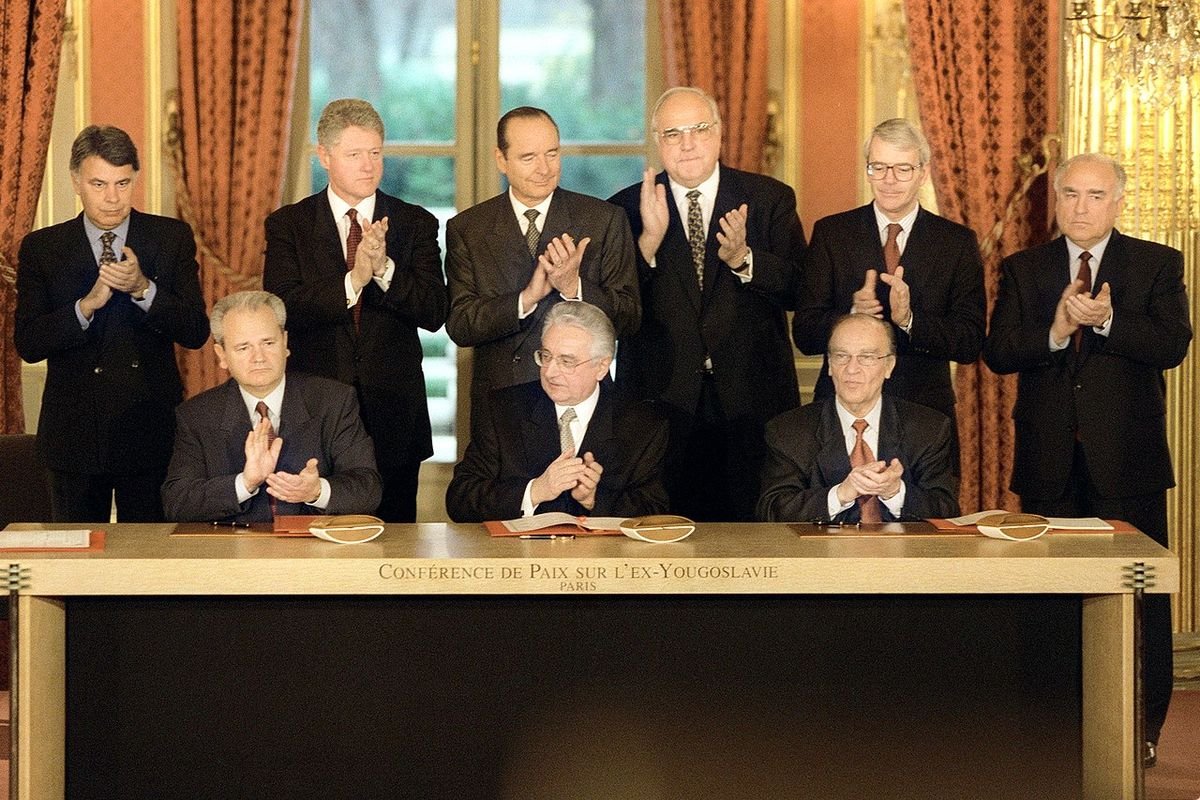
The year 1995 wasn’t just another calendar page turning; it was a profound inflection point, rich with important events of 1995 that reshaped global politics, technology, and societal norms. From devastating acts of terror to groundbreaking scientific discoveries and dramatic cultural shifts, these moments didn’t merely happen; they set trajectories, illuminated vulnerabilities, and heralded new eras. Understanding them offers a unique lens into the world we inherited and continue to build.
At a Glance: Key Turning Points of 1995
- Geopolitical Shifts: Europe expanded, trade rules solidified globally, and post-Cold War conflicts continued to simmer and erupt.
- Terrorism’s Shadow: Major attacks in Oklahoma City, Tokyo, and Israel underscored evolving threats and led to heightened security.
- Digital Frontiers: The internet began its path to privatization, and foundational programming languages like Java emerged, laying groundwork for the tech boom.
- Scientific Breakthroughs: Discoveries ranging from new galaxies and subatomic particles to rare weather phenomena challenged our understanding of the universe.
- Societal & Cultural Markers: High-profile trials, iconic sporting moments, and major protests reflected deep societal conversations and changing values.
- Economic Volatility: Major financial collapses and international aid packages highlighted the interconnectedness of global economies.
Reshaping the Global Map: Geopolitical & Economic Realignment
1995 began with significant institutional shifts. On January 1, the European Union expanded to include Austria, Finland, and Sweden, signaling a deepening commitment to economic integration and political stability within the continent. Simultaneously, the World Trade Organization (WTO) officially commenced operations, replacing GATT and establishing a new framework for global commerce. These institutional developments aimed to foster cooperation but also set the stage for future debates on sovereignty and globalization.
Regional conflicts and political transitions also dominated the headlines. In Russia, President Boris Yeltsin announced a temporary halt to bombing operations in Chechnya on January 5, amid international criticism, though the conflict remained deeply volatile. Further east, on June 26, Qatar saw a bloodless coup as Hamad bin Khalifa al-Thani deposed his father. The year also brought a significant, if narrowly passed, vote in Quebec on October 30, with citizens deciding to remain a province of Canada in a referendum that underscored enduring national identity debates.
Economically, the year presented stark challenges. On January 31, the U.S. authorized a $20 billion loan to Mexico, complemented by a $52 billion international package, to stabilize its economy—a decisive move to prevent a wider financial contagion. In stark contrast, Russia’s ruble experienced a significant decline on January 20, a critical moment in the nation’s post-Soviet economic crisis. The banking world was also rocked on February 26 by the dramatic collapse of Barings Bank, due to a rogue trader’s colossal losses speculating on the Tokyo Stock Exchange. These financial tremors highlighted the increasing interconnectedness and fragility of global markets.
The Rise of New Threats: Security and Terrorism
The specter of terrorism cast a long shadow over 1995, marking a grim escalation in global security concerns. On January 6, the discovery of the Project Bojinka terror plot in Manila, involving plans to bomb multiple airplanes, sent shockwaves through the airline industry and led to significantly increased global security measures.
Tragically, these threats materialized with devastating force. On March 20, the Aum Shinrikyo cult carried out a sarin gas attack on the Tokyo subway, killing 13 and injuring 1,300, an unprecedented act of domestic chemical terrorism. Just weeks later, on April 19, the Alfred P. Murrah Federal Building in Oklahoma City was bombed by Timothy McVeigh and Terry Nichols, killing 168 people and wounding 680. This became the deadliest terrorist attack on U.S. soil prior to 9/11, forcing America to confront the reality of large-scale domestic terrorism. In the Middle East, the Beit Lid massacre on January 22, a suicide bombing at a bus stop, killed 19 Israelis and further heightened regional tensions. These events collectively signaled a new, more pervasive era of global and domestic security threats.
Amidst these rising threats, law enforcement scored some victories. On February 7, Ramzi Yousef, the mastermind behind the 1993 World Trade Center bombing, was arrested in Islamabad, Pakistan. Later, on February 15, notorious hacker Kevin Mitnick was apprehended, charged with wire fraud and breaking into secure computer systems, an early high-profile case highlighting the evolving landscape of digital crime. The Norwegian rocket incident on January 25, where Russia nearly launched a nuclear attack after mistaking a research rocket for a U.S. missile, also underscored the hair-trigger nature of international security, even after the Cold War’s end.
The Dawn of Digital and Scientific Revolutions
While geopolitical shifts and security threats defined much of the headlines, the quiet work of scientists and technologists in 1995 was charting a course for unprecedented change. The first version of the Java programming language was released on May 23, a pivotal moment for software development that would enable the next generation of interactive web content and applications. This release was a key step in the burgeoning digital revolution. For those seeking to understand more about how these developments fit into the broader narrative of technological and societal change, you might want to Explore 1995’s pivotal changes.
The internet itself underwent a fundamental transformation. On April 30, U.S. government funding for the National Science Foundation Network (NSFNET) ceased, effectively privatizing the internet and opening it up for widespread commercial use. This decision was a critical catalyst for the explosive growth of the World Wide Web in the late 1990s.
Beyond computing, scientific exploration pushed boundaries. On March 2, researchers at Fermilab announced the discovery of the top quark, confirming a fundamental piece of the Standard Model of particle physics. Astronomy made its own strides; on January 2, scientists announced the discovery of the most distant galaxy known at the time, using the Keck telescope. Later in the year, on October 6, 51 Pegasi was discovered to be the second major star, apart from the Sun, to have a planet orbiting around it – the first exoplanet around a Sun-like star, fundamentally altering our understanding of planetary systems beyond our own.
Space exploration continued its ambitious journey. February 2 saw the launch of Space Shuttle Discovery (STS-63), notably featuring Eileen Collins as the first female Space Shuttle pilot. The mission also achieved a rendezvous with the Russian space station Mir. Later, on June 29, Space Shuttle Atlantis (STS-71) docked with Mir for the first time, symbolizing a new era of international cooperation in space.
Social Reflection and Cultural Impact
1995 was a year of intense societal reflection, often played out on public stages. The O. J. Simpson murder trial culminated on October 3 with his acquittal for the murders of Nicole Brown Simpson and Ronald Goldman. This verdict, televised live, captivated a nation and sharply divided public opinion along racial lines, sparking profound discussions about justice, race, and media influence.
Meanwhile, a different kind of public gathering made history. On October 16, the Million Man March drew hundreds of thousands of African American men to Washington, D.C., a powerful demonstration advocating for unity, atonement, and community building. This event underscored significant racial and social dynamics still at play in American society.
In sports, icons made their mark. Cal Ripken, Jr. of the Baltimore Orioles played his 2,131st consecutive game on September 6, breaking a 56-year record and embodying endurance and dedication. Earlier, on March 18, Michael Jordan announced his highly anticipated return to the NBA, ending his retirement and reigniting excitement in basketball. Globally, the Rugby World Cup final on June 24 saw South Africa defeat New Zealand, with Nelson Mandela presenting the trophy in an iconic post-apartheid moment of national unity and reconciliation.
The entertainment world saw its share of triumphs and tragedies. On January 29, the San Francisco 49ers dominated Super Bowl XXIX, securing their fifth NFL championship. On January 27, Mary Pierce won her first Grand Slam singles title at the Australian Open. Yet, the year also brought profound loss, as singer-songwriter Selena was tragically murdered by Yolanda Saldívar on March 31, sending shockwaves through the music world, particularly among her fervent Latin American fanbase.
Nature’s Fury and Human Resilience: Disasters and Response
1995 was tragically defined by several large-scale natural and human-made disasters, testing the limits of resilience and prompting massive humanitarian efforts. The Great Hanshin earthquake struck the Kobe region of Japan on January 12, a magnitude 7.2-7.3 tremor that caused widespread destruction and over 6,000 fatalities. This catastrophic event highlighted vulnerabilities in urban infrastructure and prompted significant rebuilding efforts.
Colombia also experienced a devastating year for seismic activity. On January 11, Intercontinental de Aviación Flight 256 crashed near María La Baja, killing 51. Just days later, on January 19, a magnitude 6.6 earthquake struck Armenia, Colombia, causing thousands of casualties and widespread damage, marking it as one of the country’s deadliest earthquakes. Later, on February 8, another magnitude 6.4 earthquake struck western Colombia, causing at least 28 fatalities.
Another significant natural disaster occurred on May 28, when a magnitude 7.6 earthquake devastated Neftegorsk, Russia, killing at least 2,000 people. These seismic events across continents served as a stark reminder of the planet’s raw power. Adding to these, on January 1, the Draupner wave, a massive “freak wave,” was detected in the North Sea, confirming the existence of these rare and dangerous oceanic phenomena, pushing the boundaries of oceanography and maritime safety. The Soufrière Hills volcano on Montserrat also erupted on July 18, beginning a multi-year devastation of the Caribbean island.
Beyond natural calamities, human-made disasters also claimed many lives. On June 29, the Sampoong Department Store collapsed in Seoul, South Korea, killing 501 people and injuring 937 in a structural failure that became a symbol of unchecked development. On October 28, the Baku Metro fire killed 289 people and injured 265, making it the deadliest subway disaster in history. A gas pipe explosion in Daegu, South Korea, on April 28, caused by metro construction, killed 101 people, mostly teenage schoolboys. These incidents underscored the critical importance of safety regulations and disaster preparedness.
A Practical Lens: Understanding the Ripple Effects
When reflecting on the important events of 1995, it’s not just about listing occurrences, but grasping their interconnectedness and long-term consequences. Many of the year’s events — from the privatization of the internet to major terrorist attacks and geopolitical realignments — laid groundwork that continues to influence our present.
- Global Interdependency: The Mexican loan, Barings Bank collapse, and the formation of the WTO all highlight an increasingly globalized world where economic and political shocks in one region can quickly cascade.
- Evolving Security Paradigms: The scale and nature of terrorist attacks, both domestic and international, fundamentally changed how nations approached security, intelligence, and even urban planning (e.g., closing Pennsylvania Avenue in front of the White House after Oklahoma City).
- Technological Inflection Point: The release of Java and the internet’s commercialization weren’t just technical curiosities; they were foundational steps that unlocked entirely new industries, communication methods, and societal interactions.
- Societal Discourse: High-profile events like the O.J. Simpson trial and the Million Man March forced difficult but necessary conversations about race, justice, and community within nations.
Quick Answers: Common Questions on 1995’s Key Moments
Q: What was the most significant technology-related event in 1995?
A: The two most significant were the release of the first version of the Java programming language and the privatization of the internet (when U.S. government funding for the NSFNET ceased), both of which were foundational for the internet’s explosive growth and modern software development.
Q: Did any major wars or conflicts end in 1995?
A: Yes, the Cenepa War between Peru and Ecuador ended on February 17 with a UN-brokered ceasefire. However, other conflicts, like the Bosnian War, saw major escalations (e.g., the Srebrenica massacre, NATO’s Operation Deliberate Force) and peace efforts (e.g., the Interim Agreement on the West Bank and the Gaza Strip).
Q: Were there any major assassinations or attempted assassinations in 1995?
A: Tragically, yes. Israeli Prime Minister Yitzhak Rabin was assassinated by an extremist Israeli on November 4. There was also an attempted assassination of Egyptian President Hosni Mubarak in Addis Ababa on June 26. Selena, the singer-songwriter, was also murdered by Yolanda Saldívar on March 31.
Q: What major natural disasters occurred in 1995?
A: The Great Hanshin earthquake in Kobe, Japan, on January 12 was particularly devastating, causing over 6,000 fatalities. Other significant seismic events included major earthquakes in Armenia and Neftegorsk, Russia.
Q: How did 1995 impact European unity?
A: European unity advanced significantly with the expansion of the European Union to include Austria, Finland, and Sweden on January 1, and the Schengen Treaty coming into effect on March 26, easing cross-border travel for several European nations.
Charting the Course: The Enduring Legacy of 1995
The important events of 1995 were more than isolated incidents; they were interconnected threads weaving a complex tapestry of change. From the grim realities of terrorism to the boundless potential of a privatized internet and new scientific frontiers, 1995 was a year where the world wrestled with its demons, celebrated its triumphs, and fundamentally reoriented itself towards the millennium.
These events taught us profound lessons about global interdependence, the evolving nature of conflict, the transformative power of technology, and the enduring strength of the human spirit in the face of both natural and man-made disasters. They shaped policy, influenced culture, and continue to serve as benchmarks for understanding contemporary challenges and opportunities. The year truly marked a global turning point, setting the stage for much of what unfolded in the subsequent decades.










