Nineteen ninety-five was far more than just another year; it was a crucible where the forces of technology, geopolitics, and human nature converged, forging a new global landscape. The array of significant events in 1995 didn’t just unfold; they actively reshaped the trajectory of nations, the fabric of societies, and the very concept of daily life for billions. From the quiet launch of a programming language to devastating acts of terror, and from breakthroughs in space to shifts in world power, 1995 delivered a series of seismic shifts whose aftershocks are still felt today.
At a Glance: 1995’s Pivotal Shifts
- Geopolitical Realignment: Witnessed the expansion of the European Union, the birth of the WTO, and critical movements in Middle East peace, alongside severe internal conflicts.
- Unprecedented Disasters & Conflicts: Suffered devastating natural calamities, high-profile terror attacks, and horrific acts of genocide, forcing global introspection on security and humanitarian aid.
- Digital Revolution Accelerates: Saw the public debut of Java, laying foundational elements for the internet’s explosive growth, alongside remarkable scientific discoveries in space and physics.
- Cultural & Societal Turning Points: Experienced landmark legal verdicts, historic marches for civil rights, and shifts in sports and media that reflected evolving public consciousness.
- Enduring Legacies: Many events of 1995 continue to influence international policy, technological development, and societal resilience decades later.
Geopolitical Realignment: Crafting a New Global Order
The year 1995 was a masterclass in evolving international relations, illustrating both the promise of multilateral cooperation and the persistent challenges of conflict and self-determination. The map of Europe and the framework for global trade underwent significant transformations, while peace efforts in volatile regions faced brutal setbacks.
European Union Expansion and the Dawn of Global Trade
On January 1, the European Union welcomed Austria, Finland, and Sweden, marking a significant expansion that deepened economic and political integration across the continent. This move strengthened the bloc’s collective influence, setting the stage for future enlargements and solidifying its role as a major global player.
Simultaneously, the World Trade Organization (WTO) officially came into effect, replacing GATT (General Agreement on Tariffs and Trade). The WTO’s establishment was a monumental step toward a more structured and rules-based system for international commerce, designed to foster free trade and resolve disputes among member nations. Its launch underscored a growing global commitment to economic interdependence, albeit one that would bring its own set of challenges and criticisms over the decades.
Peace Efforts and Persistent Conflicts
The Middle East saw a mix of hope and tragedy. On September 28, Israeli Prime Minister Yitzhak Rabin and PLO Chairman Yasser Arafat signed the Interim Agreement on the West Bank and the Gaza Strip, known as Oslo II. This agreement was a crucial step in the Israeli-Palestinian peace process, outlining the transfer of further powers and responsibilities to the Palestinian Authority. However, the fragile promise of peace was shattered on November 4, when Rabin was tragically assassinated by an extremist Israeli, sending shockwaves through the region and globally, and highlighting the deep divisions that threatened any lasting resolution.
Elsewhere, internal conflicts continued to rage. Russian President Boris Yeltsin’s announcement of a halt to bombing in Chechnya on January 5 offered a brief reprieve, but the conflict would endure for years, claiming countless lives and demonstrating the brutal complexities of post-Soviet geopolitical struggles.
National Identity and Sovereignty Debates
One of the most nail-biting political dramas of the year unfolded in Canada. On October 30, Quebec held its second referendum on national sovereignty. The vote to remain a province of Canada passed by the slimmest of margins: 50.58% to 49.42%. This near-secession vividly illustrated the powerful, often divisive, forces of national identity and regional autonomy within established nations, prompting profound introspection on Canadian unity and governance.
Living on the Edge: Global Disasters and Conflicts
The year 1995 was also marked by a series of devastating events that laid bare human vulnerability to natural forces and malevolent intent. These incidents provoked global responses, spurred advancements in disaster preparedness, and forever altered the perception of security.
Earthquakes and Urban Resilience
The Great Hanshin earthquake struck Kobe, Japan, on January 17, registering a magnitude of 7.3. This catastrophic quake killed 6,434 people, primarily due to collapsing buildings and subsequent fires. The devastation exposed vulnerabilities in urban infrastructure, even in a highly prepared nation like Japan. Kobe’s recovery became a case study in disaster management, resilience, and the critical need for robust building codes and emergency response systems. The event profoundly influenced seismic engineering and urban planning worldwide.
Later that year, on May 28, the Russian town of Neftegorsk was virtually wiped out by a 7.6 magnitude earthquake, killing at least 2,000, half of its population. This less-publicized disaster served as another stark reminder of nature’s indiscriminate power.
Acts of Terror and Societal Shockwaves
The world grappled with a disturbing rise in sophisticated and deadly acts of terrorism. On March 20, the Aum Shinrikyo cult carried out a sarin gas attack on the Tokyo subway, killing 13 people and injuring over 1,300. This unprecedented chemical attack on a civilian target in a developed nation introduced a chilling new dimension to urban terrorism and highlighted the threat of non-state actors wielding weapons of mass destruction.
Less than a month later, on April 19, the Alfred P. Murrah Federal Building in Oklahoma City, United States, was bombed. This domestic terrorist attack, perpetrated by Timothy McVeigh, killed 168 people, including 19 children, and shocked the nation. It was, at the time, the deadliest act of terrorism on U.S. soil and fundamentally reshaped American perceptions of internal security, leading to significant changes in federal building design and counter-terrorism strategies.
Humanitarian Catastrophe in the Balkans
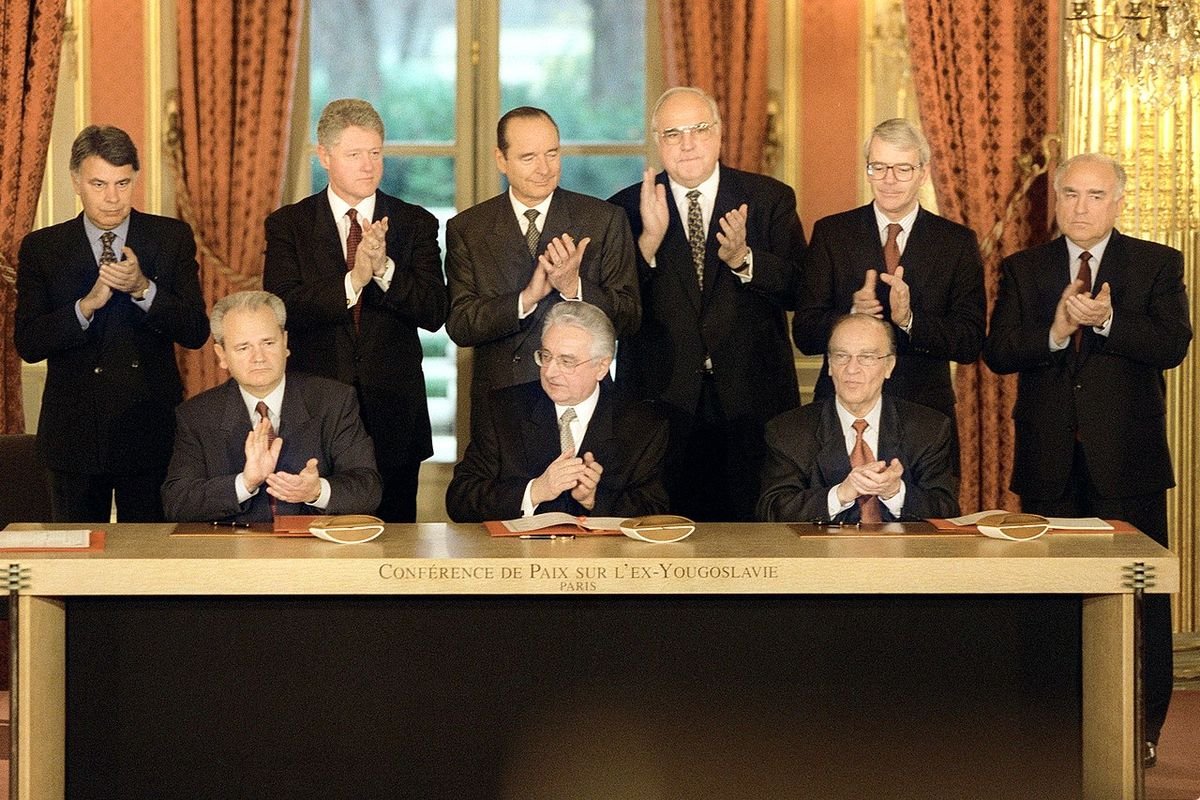
The Bosnian War continued to claim lives with unimaginable brutality. On July 6, Serbian forces under General Ratko Mladić began their attack on Srebrenica, leading to the Srebrenica massacre on July 11. In the days that followed, more than 8,000 Bosniak men and boys were systematically murdered, an act later recognized as genocide. This horrific event stands as a grim testament to the failures of international intervention and the devastating consequences of ethnic conflict, prompting a reevaluation of UN peacekeeping mandates and the “Responsibility to Protect” doctrine.
The Dawn of Digital & Scientific Breakthroughs
While the world wrestled with political upheaval and tragic events, 1995 quietly laid some critical groundwork for the technological revolution that was about to explode. It was a year where science pushed boundaries, from the subatomic to the far reaches of the cosmos.
Programming the Future: Java’s Genesis
May 23, 1995, might not have made front-page news globally, but it was a watershed moment for technology: the first version of the Java programming language was released. Developed by Sun Microsystems, Java’s promise of “write once, run anywhere” was revolutionary. It quickly became the backbone for web applications, enterprise software, and mobile platforms, transforming how developers built software and enabling the interactive web experiences that would soon become ubiquitous. Without Java, the internet as we know it today would likely look very different. To understand more about how these technological shifts impacted the broader world, you can delve deeper into the context of the era: Discover 1995’s world-changing shifts.
Expanding the Cosmic Frontier
Astronomical discoveries in 1995 literally expanded our universe. On January 2, scientists using the Keck telescope in Hawaii announced the discovery of the most distant galaxy yet, estimated at 15 billion light-years away, pushing the boundaries of observable cosmology.
Even more profoundly, October 6 marked the discovery of 51 Pegasi b, the first exoplanet found orbiting a sun-like star. This groundbreaking finding confirmed that our solar system was not unique in hosting planets, igniting a new era of exoplanet hunting and fundamentally altering humanity’s perspective on life beyond Earth. It transformed exoplanet science from speculation into a vibrant field of empirical research.
Unveiling the Universe’s Building Blocks
At the microscopic level, physicists at Fermilab announced the discovery of the top quark on March 2. This subatomic particle, the heaviest known elementary particle, was the last of the six quarks predicted by the Standard Model of particle physics to be experimentally observed. Its discovery was a monumental triumph for high-energy physics, validating fundamental theories about the universe’s most basic constituents.
Adding to the list of scientific firsts, the Bose-Einstein condensate (BEC) was first created on June 5. This exotic state of matter, predicted decades earlier, occurs when a dilute gas of bosons is cooled to temperatures very close to absolute zero. Its creation opened new avenues for quantum mechanics research, leading to advancements in fields like quantum computing and supercomputing.
Cultural Milestones and Societal Shifts
Beyond the headlines of politics and technology, 1995 saw significant cultural moments that reflected the ongoing evolution of society, justice, and identity.
The O.J. Simpson Verdict: A Nation Divided
Perhaps no single event captivated American society more than the O. J. Simpson murder trial. After a lengthy and highly publicized trial, Simpson was acquitted of the murders of Nicole Brown Simpson and Ronald Goldman on October 3. The verdict was met with starkly different reactions along racial lines, exposing deep-seated divisions within American society regarding race, justice, and the legal system. The trial became a cultural phenomenon, influencing media coverage of legal proceedings and sparking debates that continue to resonate today.
The Million Man March: A Call for Unity and Atonement
On October 16, hundreds of thousands of African American men gathered in Washington, D.C., for the Million Man March. Organized by Louis Farrakhan of the Nation of Islam, the event called for unity, atonement, and a renewed commitment to family and community values within the Black community. It was a powerful demonstration of collective strength and a significant moment in the ongoing struggle for civil rights and racial justice in the United States, emphasizing personal responsibility and community action.
Sports Heroes and Historic Feats
In the world of sports, Cal Ripken, Jr. of the Baltimore Orioles etched his name into baseball history on September 6. He played in his 2,131st consecutive game, breaking Lou Gehrig’s “Iron Horse” record that had stood for 56 years. Ripken’s achievement was a testament to dedication and consistency, captivating fans and reminding them of the enduring appeal of traditional sports values.
In global sports, South Africa defeated New Zealand in the Rugby World Cup on June 24. The iconic image of Nelson Mandela presenting the Webb-Ellis trophy to Springboks captain Francois Pienaar became a powerful symbol of national unity and reconciliation in post-apartheid South Africa, demonstrating sport’s unique ability to bridge divides.
Practical Playbook: Deciphering the Lasting Impact of 1995
Understanding the significant events in 1995 isn’t just about recalling facts; it’s about recognizing patterns, anticipating future challenges, and appreciating the interconnectedness of global phenomena. Here’s how these events offer enduring insights:
- Geopolitical Resilience:
- Lesson: International cooperation (WTO, EU expansion) builds stability but doesn’t erase internal conflicts or sovereignty disputes (Quebec, Chechnya).
- Actionable Insight: Look for how regional blocs and global organizations react to internal dissent or border disputes—their responses often set precedents.
- Security Evolution:
- Lesson: Threats evolve from traditional state-on-state conflicts to non-state actors using unconventional methods (sarin gas, Oklahoma City).
- Actionable Insight: Modern security strategies must be multifaceted, addressing both external threats and the rise of domestic extremism and sophisticated terror plots.
- Technological Inflection Points:
- Lesson: Seemingly niche developments (like a programming language) can trigger massive societal shifts (the internet boom).
- Actionable Insight: Monitor foundational technology changes, not just flashy gadgets. The underlying infrastructure (like Java for the internet) often determines future capabilities.
- Societal Echoes:
- Lesson: High-profile cultural events (O.J. Simpson trial, Million Man March) reveal deep-seated societal tensions and aspirations.
- Actionable Insight: Pay attention to cultural narratives and public discourse following landmark events. They often provide barometers for social progress or persistent divides.
Quick Answers: Unpacking 1995’s Legacy
Was 1995 truly a pivotal year for technology, or just another step?
1995 was undoubtedly a pivotal year. While many technological components were already in development, 1995 saw the public release of Java, which quickly became indispensable for web development, and the first discovery of an exoplanet orbiting a sun-like star, which profoundly changed astrophysics. These weren’t incremental steps; they were foundational shifts that enabled entirely new fields and capabilities.
How did 1995’s political events influence today’s global landscape?
The expansion of the EU and the establishment of the WTO set critical precedents for globalization and multilateral governance, shaping today’s interconnected world economy. Conversely, the assassination of Yitzhak Rabin and the Srebrenica massacre underscored the fragility of peace and the ongoing challenges of ethnic conflict and extremist violence, influencing international humanitarian and security policies to this day.
What was the lasting impact of the natural disasters and terror attacks of 1995?
The Great Hanshin earthquake spurred advancements in seismic engineering and disaster preparedness globally, leading to more resilient urban infrastructures. The Tokyo subway sarin attack and the Oklahoma City bombing radically altered perceptions of terrorism, pushing governments worldwide to enhance counter-terrorism measures, intelligence sharing, and domestic security protocols against both international and homegrown threats.
Beyond the Headlines: Enduring Impacts
The significant events in 1995 weren’t isolated incidents; they were interwoven threads in the fabric of a rapidly changing world. From the quiet code that would power the internet to the devastating echoes of war and terrorism, that single year underscored humanity’s boundless capacity for innovation, cooperation, and, regrettably, destruction. Reflecting on 1995 provides more than just a historical overview; it offers a crucial lens through which to understand the forces that continue to shape our present and influence our future. It was a year that emphatically reminded us that progress is rarely linear and that vigilance, resilience, and adaptability remain our most vital assets in navigating an ever-evolving global stage.










