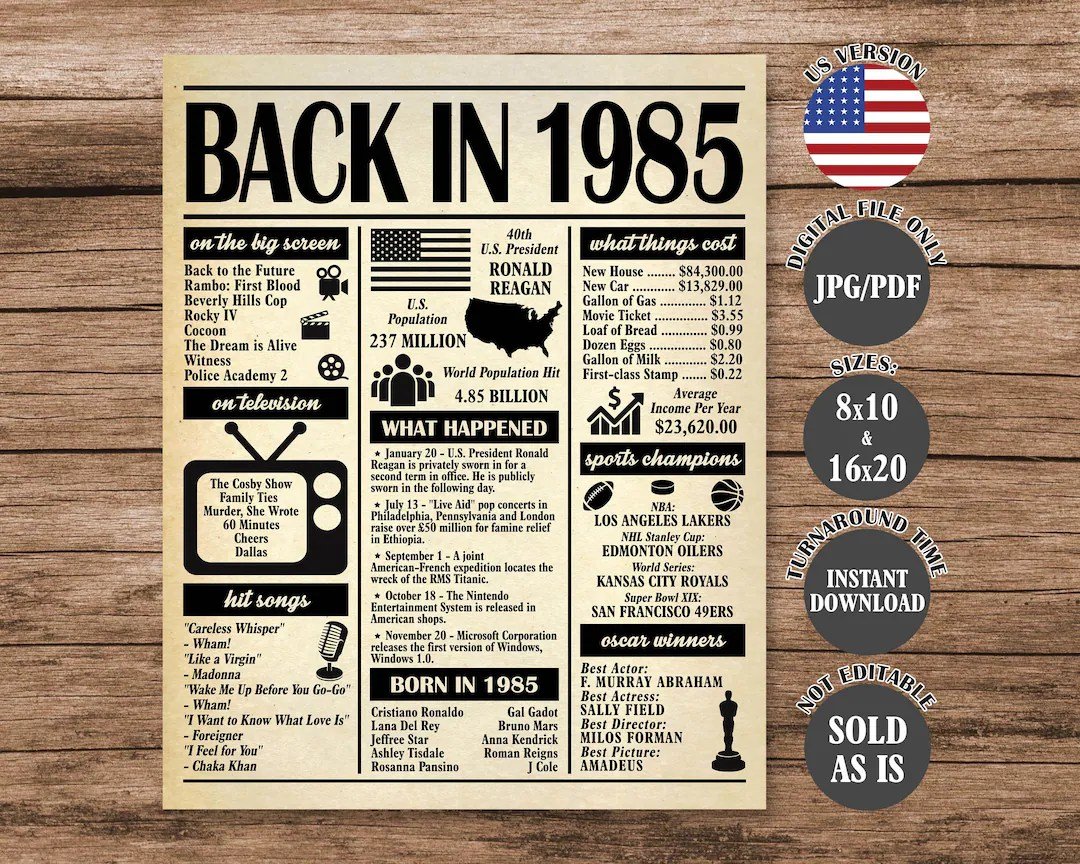
Nineteen eighty-five was a year of stark contrasts, where devastating global hunger shared headlines with groundbreaking technological firsts and the birth of enduring pop culture phenomena. From the unified global response to the Ethiopian famine to the very first registered internet domain and the iconic release of Super Mario Bros., these 1985 big events underscored a world grappling with immense challenges while simultaneously accelerating into a future shaped by connectivity and media. It was a period where collective human spirit shone brightly, even as geopolitical tensions simmered and technological innovation laid the groundwork for decades to come.
At a Glance: Understanding the Impact of 1985
- Global Solidarity & Famine Aid: Witness how Live Aid and USA for Africa redefined humanitarian response, demonstrating the power of celebrity and media to mobilize millions for urgent global crises.
- Tech’s Early Footprint: Explore the nascent steps of mobile communication, deep-space exploration, and the internet, revealing the foundational moments that would utterly reshape our daily lives.
- Cultural Milestones & Public Opinion: Understand how events like the New Coke debacle and the rise of Rock in Rio signaled shifts in consumer power and the global reach of popular entertainment.
- Geopolitical Undercurrents: Grasp the complex political landscape, from anti-apartheid movements and regional conflicts to the delicate dance of Cold War diplomacy and emerging terror threats.
- Disaster Preparedness Lessons: Reflect on the numerous natural and man-made disasters of the year, and the critical insights they offered into safety, infrastructure, and international response protocols.
The World Answers a Crisis: A New Era of Global Solidarity
The mid-1980s brought the stark reality of the Ethiopian famine into global consciousness, largely amplified by relentless media coverage. While the crisis had been escalating since 1983, 1985 became a pivotal year for unprecedented international humanitarian action, demonstrating a new model for collective aid.
Operation Moses and the Ethiopian Exodus: Even before the major concerts, the year began with a dramatic, covert effort to save lives. In early January 1985, Israel concluded “Operation Moses,” an elaborate, multi-national mission that airlifted approximately 8,000 Ethiopian Jews (Falashas) from famine-stricken refugee camps in Sudan to safety in Israel. This daring rescue, involving the Israel Defense Forces, the CIA, and Sudanese authorities, was a testament to the urgency and human cost of the famine, highlighting the dire circumstances that required such extraordinary measures. It underscored a humanitarian imperative that transcended typical political boundaries, albeit with its own delicate geopolitical complexities.
USA for Africa and “We Are the World”: By January 28, 1985, an unprecedented assembly of pop music’s biggest stars gathered in a Los Angeles studio. The result was “We Are the World,” a single recorded by the supergroup USA for Africa, aimed directly at raising funds for Ethiopian famine relief. Its release in March became a global phenomenon, selling millions and becoming one of the best-selling singles of all time. This wasn’t just a song; it was a blueprint for celebrity activism, proving that collective artistic effort could translate into tangible aid on a massive scale.
Live Aid: A Global Concert Event: Building on this momentum, July 13, 1985, saw the culmination of these efforts with Live Aid, a monumental dual-venue concert held in London and Philadelphia. Orchestrated by Bob Geldof and Midge Ure, it was broadcast globally, captivating an estimated 1.9 billion viewers across 100 countries. Performers like Queen, U2, David Bowie, and Madonna lent their voices, drawing unparalleled attention and raising over $127 million for famine relief. Live Aid didn’t just raise funds; it raised global awareness, proving the immense power of synchronized media events to galvanize action and foster a sense of shared responsibility for human suffering across continents. It fundamentally reshaped how large-scale humanitarian disasters are communicated and addressed.
Seeds of Disruption: Early Tech, Space, and Digital Foundations
While the world was united by humanitarian crises, another force was quietly laying the groundwork for a future defined by connectivity and digital experiences: technology. Many of the 1985 big events in tech were foundational, subtle shifts that would only reveal their true impact years later.
The First UK Mobile Phone Call: January 1, 1985, marked a seemingly modest but profoundly significant milestone: the first reported commercial mobile phone call in the UK. Comedian Ernie Wise or Vodafone’s chairman, Sir Ernest Harrison, made the call on a clunky Motorola DynaTAC 8000X, a device more akin to a brick than a sleek smartphone. This wasn’t just a novelty; it was the genesis of a telecommunications revolution that would fundamentally alter personal and business communication, shrinking distances and accelerating information exchange in ways unimaginable just a decade prior.
Japan’s Foray into Deep Space: On January 7, Japan launched Sakigake, its first deep space probe. Designed to study Halley’s Comet, it was a remarkable achievement, making Japan only the third nation (after the US and Soviet Union) to send an interplanetary spacecraft. This mission wasn’t just about scientific discovery; it signaled a broader internationalization of space exploration, demonstrating that cutting-edge technological prowess was no longer the sole domain of two superpowers. It opened the door for more nations to contribute to our understanding of the cosmos.
The Birth of the Internet Domain Name: March 15, 1985, passed largely unnoticed by the general public but was a watershed moment for the digital age: symbolics.com became the very first registered internet domain name. This simple act of assigning a human-readable name to an IP address was a critical step in making the nascent internet accessible and usable beyond academic and military circles. It was the conceptual genesis of the World Wide Web as we know it, paving the way for e-commerce, social media, and the entire digital economy. Without this, navigating the internet would have remained a technical labyrinth.
Gaming Gets Super-Sized with Mario: While personal computers were still primarily for enthusiasts, a different kind of tech was about to explode: video games. September 13, 1985, saw the release of ‘Super Mario Bros.’ in Japan for the Nintendo Entertainment System (NES). This game wasn’t just a sequel; it was a paradigm shift. Its innovative side-scrolling gameplay, vibrant graphics, and compelling character design made it an instant classic, rescuing the video game industry from a previous crash. Super Mario Bros. became the blueprint for platforming games and cemented Nintendo’s place as a global entertainment powerhouse, introducing millions to interactive digital worlds.
These technological 1985 big events show a clear trajectory: from specialized, high-cost tools to mass-market devices and experiences. They hint at a future where technology would be intertwined with daily life, reshaping how we connect, learn, and play. For a deeper look into how these technological advancements intertwined with the broader cultural landscape, you might want to See 1985’s cultural and tech impact.
Geopolitical Tremors: From Conflict Zones to Global Diplomacy
Amidst the humanitarian and technological advancements, the geopolitical landscape of 1985 remained fraught with tension, marked by both localized conflicts and attempts at broader peace. These 1985 big events reflect a world navigating the complexities of the Cold War, regional instability, and the nascent stages of modern terrorism.
The Anti-Apartheid Struggle Intensifies: On January 8, the African National Congress (ANC) marked its 73rd anniversary, using the occasion to reiterate its commitment to intensify the struggle against apartheid in South Africa. The declaration highlighted the deepening crisis within the apartheid economy and called for greater international solidarity. This wasn’t just an internal struggle; it was a global moral battle that continued to gain traction, with international sanctions and boycotts increasing pressure on the South African regime, showing the power of sustained political and social movements.
Nicaragua’s Shifting Sands: January 10 saw Daniel Ortega sworn in as Nicaragua’s first elected president since the 1979 Sandinista revolution. His inauguration, attended by Cuban President Fidel Castro and delegates from 46 countries, signaled a move towards establishing a stable, albeit ideologically aligned, government. Ortega immediately extended an olive branch, offering amnesty to U.S.-backed rebels and expressing a desire for normalized relations with the United States. This event epitomized the Cold War’s proxy conflicts, where a nation’s internal politics became a battleground for superpower influence, with profound implications for regional stability.
The Shadow of Terrorism Emerges: The year was unfortunately punctuated by several high-profile acts of terrorism that foreshadowed future global challenges. On June 14, TWA Flight 847 was hijacked by Hezbollah shortly after takeoff from Athens, leading to a prolonged standoff and the murder of a U.S. Navy diver. Just nine days later, on June 23, a terrorist bomb brought Air India Flight 182 down off the coast of Ireland, killing all 329 aboard in what was then the deadliest act of air terrorism. These events, alongside the October hijacking of the ‘MS Achille Lauro’ cruise ship, underscored a grim evolution in international conflict: the targeting of civilians by non-state actors, forcing a reevaluation of international security and anti-terrorism strategies.
Cold War Easing and Space Diplomacy: While regional conflicts raged, signs of a thaw in the Cold War emerged. Soviet leader Mikhail Gorbachev declared a moratorium on the deployment of middle-range missiles in Europe on April 7, a step towards de-escalation. Concurrently, space continued to be a realm of international cooperation, exemplified by the June 17 launch of Space Shuttle Discovery, carrying Sultan bin Salman bin Abdulaziz Al Saud, the first Arab and Muslim in space. These moments, however fleeting, offered glimpses of a world where diplomacy and shared human endeavors could transcend ideological divides.
Cultural Defining Moments: Pop Culture and Public Outcry
Nineteen eighty-five was not just about politics and humanitarian crises; it was also a vibrant year for culture, producing iconic moments that captured the public imagination and, in some cases, ignited fierce debate. These 1985 big events illustrate the rapidly evolving landscape of media, entertainment, and consumer power.
Rock in Rio’s Grand Debut: January 11 marked the beginning of the inaugural Rock in Rio music festival in Brazil. Over ten days, it drew an astonishing 1.38 million attendees, showcasing headliners like Queen, AC/DC, and Rod Stewart. This wasn’t just a concert; it was a monumental cultural event that put Latin American music festivals on the global map, demonstrating the universal appeal of rock music and creating a new benchmark for large-scale entertainment spectacles. It underscored the unifying power of music across diverse cultures.
WrestleMania’s First Act: On March 31, Madison Square Garden hosted the very first WrestleMania, the flagship event for the then-WWF (now WWE). This innovative blend of sports and entertainment, featuring celebrity appearances and larger-than-life characters, was a massive gamble that paid off, transforming professional wrestling into a pop culture phenomenon. WrestleMania I established a new template for televised entertainment, proving that niche interests could achieve mainstream success through savvy marketing and compelling storytelling, creating a new form of entertainment spectacle.
The New Coke Debacle: Perhaps one of the most famous marketing blunders in history, Coca-Cola’s decision to change its iconic formula and release “New Coke” on April 23 sent shockwaves through the consumer world. The overwhelmingly negative public response—a testament to the deep emotional connection people had with the original product—forced the company to bring back “Coca-Cola Classic” in less than three months. This event was a powerful lesson in brand loyalty and the unexpected strength of consumer sentiment, demonstrating that sometimes, the tried and true is truly irreplaceable. It highlighted the emotional bond consumers can have with products, going far beyond mere taste.
Back to the Future’s Time-Traveling Impact: July 3 saw the release of Back to the Future, a film that quickly became a cultural touchstone. Its blend of sci-fi, comedy, and heart, alongside its iconic DeLorean time machine, resonated deeply with audiences worldwide. The movie wasn’t just a box office success; it encapsulated a sense of optimistic futurism mixed with nostalgia for the past, becoming one of the most beloved and influential films of the decade and demonstrating Hollywood’s ability to craft universally appealing narratives that transcend generations.
The Parents Music Resource Center (PMRC) and Censorship Debates: In September, Tipper Gore and other political wives formed the Parents Music Resource Center (PMRC), advocating for parental advisory labels on music with explicit lyrics. This led to highly publicized U.S. Congressional hearings, where musicians like Frank Zappa testified against censorship. The PMRC controversy highlighted the ongoing tension between artistic freedom and parental concerns about media influence, shaping the debate around content regulation and consumer advisories that continues to this day. It was a clear clash of cultural values playing out in the public sphere.
Facing Nature’s Wrath: Disasters and Their Lessons
Beyond the human-made drama, 1985 was also a year marked by significant natural and man-made disasters, each carrying profound human cost and offering stark lessons in preparedness, infrastructure, and emergency response. These 1985 big events served as grim reminders of both nature’s power and human vulnerability.
A Record-Breaking Snowfall and Brutal Cold Snap: January began with extreme weather in the U.S. San Antonio experienced its heaviest snowfall on record (13.5 inches) on January 12, causing widespread disruption. This was followed by a severe Arctic cold wave that impacted much of the United States, leading to record-low temperatures (e.g., -34°F in Mount Mitchell, NC, and -27°F in Chicago). The cold killed at least 126 people and inflicted $1.2 billion in damage to Florida’s citrus industry, even forcing President Reagan’s outdoor inauguration parade to be cancelled. These events underlined the economic and human toll of extreme weather and the need for robust infrastructure to cope.
Ethiopia’s Rail Disaster: On January 13, an overcrowded express train derailed on a curved bridge over the Awash River gorge in Ethiopia, killing at least 428 and injuring over 500. Attributed to excessive speed, it stood as Africa’s worst railroad disaster. This tragedy highlighted critical issues in transportation safety, infrastructure maintenance, and passenger capacity management in developing nations, prompting renewed focus on railway safety standards globally.
The Bradford City Stadium Fire: May 11 saw a devastating fire at Valley Parade football ground in Bradford, England, resulting in 56 spectator deaths and over 200 injuries during a match. The fire, fueled by accumulated litter under old wooden stands, led to significant changes in stadium safety regulations, particularly concerning materials and emergency exits, forever altering how sporting venues are designed and managed to prevent such catastrophic loss of life.
Mexico City’s Cataclysmic Earthquake: A powerful magnitude 8.0 earthquake struck Mexico City on September 19, killing thousands and destroying approximately 400 buildings. The disaster exposed severe vulnerabilities in urban planning and building codes, leading to significant overhauls in earthquake-resistant construction standards and emergency response protocols in seismically active regions worldwide. The slow and inadequate initial government response also empowered citizen-led rescue efforts, highlighting the crucial role of community resilience.
Colombia’s Volcanic Tragedy: On November 13, the Nevado del Ruiz volcano in Colombia erupted, melting a glacier and causing a massive lahar (volcanic mudslide) that buried the town of Armero, killing approximately 23,000 people. This disaster became a tragic case study in natural hazard communication and disaster preparedness, demonstrating the catastrophic consequences when scientific warnings are not adequately translated into effective evacuation and response strategies, particularly in vulnerable communities.
Practical Playbook: Navigating a Rapidly Changing World (Lessons from ’85)
The 1985 big events offer a rich tapestry of lessons that remain relevant today, highlighting the constant interplay between global solidarity, technological advancement, and human resilience.
- Embrace Global Connectivity for Good:
- Lesson from Live Aid/USA for Africa: Modern media and technology (like social media today) can mobilize unprecedented global support for humanitarian causes. Identify and leverage platforms for awareness and fundraising.
- Action: For any crisis, consider how to create a simple, shareable message and a clear call to action that resonates across borders. Think about the “why” that connects disparate groups.
- Anticipate Technological Leaps, Even Small Ones:
- Lesson from Mobile Phone/Internet Domain: What seem like niche innovations today (e.g., early mobile calls, first domains) can become foundational pillars of future economies and societies.
- Action: Cultivate a forward-looking mindset. Regularly scan for emerging technologies, even those in their nascent stages, and consider their long-term disruptive potential for your industry or community.
- Prioritize Consumer/Public Sentiment:
- Lesson from New Coke: Ignoring deep-seated public loyalty or underestimating emotional connections to products/institutions can have severe, immediate repercussions.
- Action: Actively listen to public feedback through various channels. Understand that perceived value often trumps technical “improvements.” Authenticity and respect for tradition can be powerful assets.
- Strengthen Disaster Preparedness & Infrastructure:
- Lesson from Earthquakes, Volcanoes, Fires: Disasters reveal vulnerabilities in infrastructure and response systems. Proactive investment saves lives and minimizes economic fallout.
- Action: Advocate for, or implement, robust disaster planning, early warning systems, and resilient infrastructure. Regularly review safety protocols and evacuation plans, ensuring they are clear and actionable for everyone.
- Recognize the Power of Media and Storytelling:
- Lesson from Super Mario Bros./Back to the Future: Compelling narratives and innovative media formats can shape culture, create new industries, and provide shared experiences that transcend demographics.
- Action: Whether in business, advocacy, or personal branding, focus on telling a clear, engaging story. Understand how to utilize different media formats to reach and resonate with your target audience.
Quick Answers: Unpacking Key 1985 Big Events
Q: What was the primary motivation behind the “We Are the World” and Live Aid concerts in 1985?
A: Both initiatives were primarily motivated by the severe famine plaguing Ethiopia, which had resulted in hundreds of thousands of deaths. The goal was to raise global awareness and generate significant funds for famine relief efforts.
Q: How did the first internet domain name in 1985 contribute to the internet’s development?
A: The registration of symbolics.com made the internet more user-friendly by allowing websites to be identified with memorable names instead of complex IP addresses. This was a crucial step in moving the internet beyond its academic and military origins toward broader public accessibility.
Q: What was the significance of the New Coke failure?
A: The New Coke failure highlighted the immense power of consumer sentiment and brand loyalty. It taught companies that deeply entrenched emotional connections to products cannot be easily dismissed or replaced, even with perceived “improvements.” It remains a classic case study in market research and brand management.
Q: How did the 1985 geopolitical events influence later international relations?
A: Events like the intensification of the anti-apartheid struggle and the Soviet missile moratorium demonstrated a world pushing for human rights and de-escalation, respectively. However, the rise of international terrorism, evidenced by hijackings and bombings, also foreshadowed a new era of global security challenges that would require increasingly coordinated international responses.
Q: What lasting impact did Super Mario Bros. have beyond gaming in 1985?
A: Super Mario Bros. not only revitalized the video game industry after a slump but also established a new benchmark for game design, character development, and immersive interactive entertainment. Its success paved the way for gaming to become a dominant global entertainment medium, influencing future generations of digital creators and consumers.
Beyond the Headlines: Lasting Echoes of 1985
The 1985 big events offer more than just historical snapshots; they provide a lens through which to understand the world we inhabit today. From the blueprint for global humanitarian action forged in the fire of famine to the quiet, foundational steps of a digital revolution, 1985 was a crucible year. It demonstrated humanity’s capacity for both immense tragedy and profound compassion, for destructive conflict and groundbreaking innovation. We continue to build upon the technological foundations laid that year, wrestle with the geopolitical challenges that emerged, and learn from the cultural shifts and humanitarian crises that defined it. The echoes of 1985 resonate still, reminding us that progress is rarely linear, but rather a complex, often contradictory, journey shaped by collective will and individual ingenuity.










