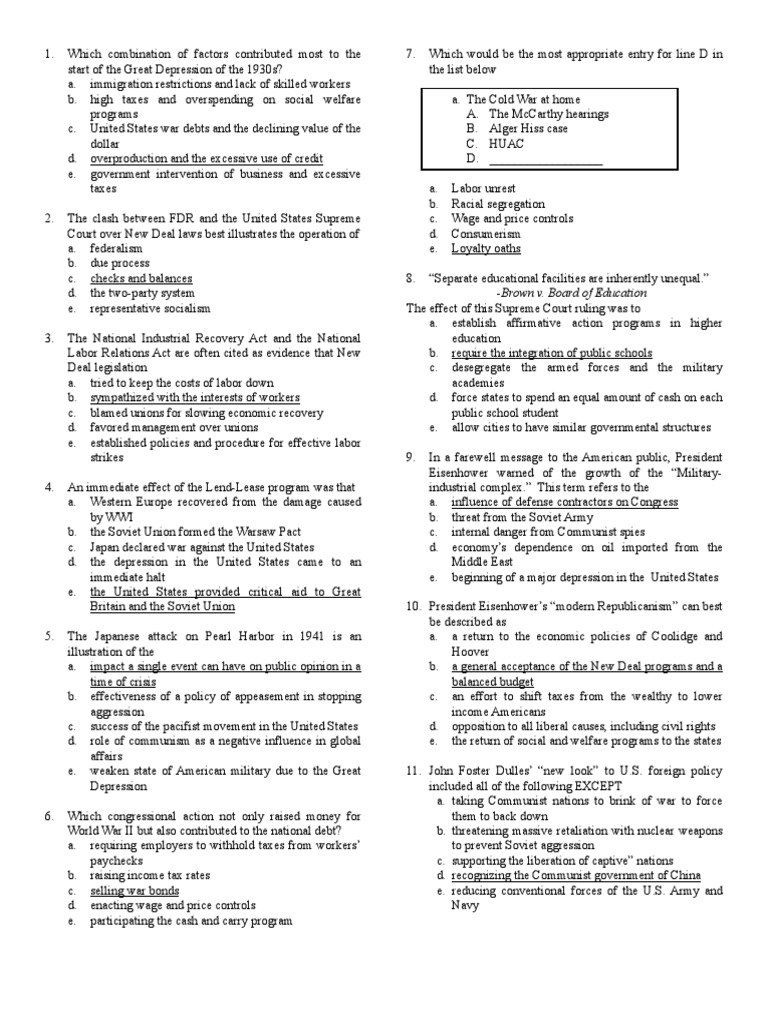
You’ve memorized the key events of the Roaring Twenties and can debate the causes of the Civil War for hours. Yet, your scores on APUSH practice questions feel stuck. You know the material, but translating that knowledge into points on test day feels like a completely different challenge—because it is. The APUSH exam isn’t just a test of what you know; it’s a test of what you can do with what you know.
Mastering the exam comes down to deliberately practicing the skills it demands. This guide breaks down exactly how to turn practice from a passive review into an active strategy for boosting your score.
At a Glance: Your Path to APUSH Practice Mastery
This article will equip you to:
- Dissect the four unique types of APUSH exam questions and understand the specific skills each one targets.
- Adopt a strategic, three-phase approach to practice, moving from untimed accuracy to timed performance.
- Use the “Mistake Autopsy” method to analyze your errors and turn them into your most valuable study tool.
- Go beyond right-or-wrong grading to mine every practice question for deeper content knowledge and historical thinking skills.
- Build a targeted study plan that shores up your specific weaknesses, whether in content or skills.
Why Practice Questions Are Your Most Powerful Study Tool
Reading your textbook and class notes builds your foundation of historical knowledge. But APUSH practice questions are where you learn to be a historian. The exam is designed to mirror the work of actual historians, who analyze evidence, make arguments, and evaluate different perspectives.
Think of it this way: reading about the Gilded Age gives you the facts. Answering a stimulus-based question about a political cartoon from that era forces you to analyze its point of view, its intended audience, and the historical context that produced it. These are the historical thinking skills—contextualization, comparison, causation, and continuity and change over time—that earn the high scores.
Effective practice isn’t about volume; it’s about strategy. It closes the gap between knowing historical facts and applying them under pressure.
The Anatomy of the APUSH Exam: Know Your Opponent
To win, you have to know the game. The APUSH exam consists of four distinct parts, each testing a different combination of skills. Your practice should reflect this.
Taming the Stimulus-Based Multiple-Choice (MCQ)
- What it is: 55 questions in 55 minutes. Each set of 3-4 questions is tied to a “stimulus”—a primary or secondary source like a text excerpt, a map, a political cartoon, or a data table.
- What it tests: Your ability to comprehend and analyze the provided source and connect it to broader historical knowledge. You’re rarely just identifying a fact; you’re interpreting evidence.
- Winning Strategy: Don’t jump straight to the questions. First, analyze the stimulus itself. Ask: Who created this? When? Why? What is their main point? Only then read the questions, which will now make much more sense in the context of the source. Eliminate answers that are factually true but irrelevant to the stimulus.
Nailing the Short-Answer Question (SAQ)
- What it is: Three questions in 40 minutes. You must answer the first two, and you choose between the third and fourth. Each question has three parts (a, b, c).
- What it tests: Precision, clarity, and the ability to provide a specific historical example to support a claim. There is no room for fluff.
- Winning Strategy: Use the ACE method for each part:
- Answer the prompt directly in your first sentence.
- Cite a specific piece of historical evidence (a person, event, law, concept).
- Explain how your evidence proves your answer. Keep it to 2-4 sentences total. The SAQ is a surgical strike, not a narrative essay.
Conquering the Document-Based Question (DBQ)
- What it is: One essay question in 60 minutes (including a 15-minute reading period). You’ll receive a prompt and seven historical documents.
- What it tests: Your ability to craft a complex historical argument (a thesis) and support it using evidence from the provided documents and your own outside knowledge. This is the ultimate test of a student historian.
- Winning Strategy: During the reading period, group the documents by theme or argument (e.g., “Documents supporting the policy,” “Documents opposing it”). For at least three documents, analyze the source itself using the HIPP method (Historical context, Intended audience, Purpose, Point of view). This analysis is crucial for earning the “sourcing” point. Your essay should drive your argument forward, using the documents as evidence, not just summarizing them.
Mastering the Long Essay Question (LEQ)
- What it is: One essay from a choice of three prompts in 40 minutes.
- What it tests: The same skills as the DBQ—thesis, contextualization, evidence, and analysis—but without the provided documents. Your success depends entirely on your ability to recall and organize specific evidence from the relevant historical period.
- Winning Strategy: Before you write a single word, spend 5-7 minutes brainstorming specific evidence (people, laws, movements, events) and creating a quick outline. A strong, historically defensible thesis is your road map. Each body paragraph should have a clear topic sentence and be packed with 2-3 pieces of that specific evidence you brainstormed.
A Blueprint for Effective Practice: From Accuracy to Mastery
Simply doing hundreds of questions without a plan leads to burnout, not improvement. Follow this three-phase process to make your practice deliberate and effective.
Phase 1: Build Your Foundation with Untimed Practice
Your first goal is accuracy, not speed. In this phase, you are learning the logic of the exam questions.
Start by sourcing high-quality materials. The questions written by the College Board are calibrated in a specific way, so they should be your primary resource. You can Practice with past APUSH exams to get the most authentic feel for the test’s tone, scope, and complexity.
Work through a section (e.g., one SAQ or a set of 15 MCQs) without a timer. For every single question, force yourself to explain why the correct answer is correct and why the incorrect options are wrong. This will reveal whether your mistakes are coming from content gaps or skill deficits.
Phase 2: Analyze Your Errors with the “Mistake Autopsy”
This is the most important step. A wrong answer is a gift—it’s a data point showing you exactly where you need to improve. Create a simple log to track your mistakes and identify patterns.
Sample Mistake Autopsy Log:
| Question # & Type | My Answer | Correct Answer | Why I Was Wrong (Category) | Actionable Next Step |
|---|---|---|---|---|
| Period 5 MCQ #14 | B | C | Misread the Stimulus: I focused on the date, not the author’s POV. | Practice HIPP on 3 political cartoons from this era. |
| Period 7 SAQ 2(b) | N/A | The New Deal | Content Gap: Couldn’t recall specific government responses to the Depression. | Review AMSCO Chapter 24; create a New Deal programs chart. |
| Period 3 LEQ | Thesis too vague | N/A | Skill Deficit (Argumentation): My thesis just restated the prompt. | Review thesis statement formulas; rewrite 2 LEQ theses. |
| Categorizing your errors is key. Are they mostly: |
- Content Gaps? You just didn’t know the information. (Solution: Targeted content review).
- Misread the Stimulus/Prompt? You rushed and missed a key word like “except” or “primary cause.” (Solution: Slow down, highlight key terms).
- Skill Deficit? You knew the content but couldn’t craft a thesis, source a document, or explain your evidence. (Solution: Drill that specific skill).
Phase 3: Build Stamina with Timed Drills
Once you’ve improved your accuracy, it’s time to add the pressure of the clock. This builds stamina and hones your time management skills.
Don’t start with a full 3-hour-and-15-minute exam. Begin with smaller chunks:
- Give yourself 25 minutes for 25 MCQs.
- Set a 40-minute timer for a full SAQ section.
- Try writing a full DBQ in the allotted 60 minutes.
As you get closer to the exam, integrate full-length timed practice tests. This will prepare you for the mental fatigue of test day and ensure your pacing is on point.
Case Snippet: Turning a Wrong Answer Into a Win
Let’s say a student answers an MCQ about the Populist Party (Period 6). The stimulus is an excerpt from William Jennings Bryan’s “Cross of Gold” speech. The student incorrectly chooses an answer related to the struggles of urban factory workers.
Using the Mistake Autopsy, they identify the error:
- My Answer: (B) The Populist movement primarily sought to protect industrial laborers from corporate excess.
- Correct Answer: (D) The Populist movement advocated for federal economic intervention to support struggling farmers.
- Why I Was Wrong (Category): Content Gap / Conceptual Confusion. “I confused the Populists (an agrarian movement) with the Progressives (who addressed urban and industrial problems later).”
- Actionable Next Step: “Create a T-chart comparing the key goals, supporters, and time periods of Populism vs. Progressivism.”
This single mistake, when properly analyzed, solidifies a crucial distinction for Periods 6 and 7, preventing similar errors in the future on MCQs, SAQs, or essays.
Quick Answers to Common Practice Questions
A few common questions often come up as students get serious about their APUSH prep.
Q: How many APUSH practice questions should I do?
A: Focus on quality over quantity. It is far more effective to do 50 MCQs and thoroughly analyze every single one than it is to passively click through 200 questions. A good goal is to complete and analyze 3-5 full practice exams in the months leading up to the test.
Q: Are older released exams (from before 2015) still useful?
A: Yes, but with a caveat. The APUSH exam was redesigned in 2015. Older exams have a different format (e.g., no stimulus-based MCQs). However, the content is still relevant. The essay and DBQ prompts from older exams are excellent for practicing argumentation and evidence-based writing, even if the scoring rubrics have changed slightly.
Q: What’s the biggest mistake students make with practice questions?
A: Simply grading their work and moving on. They see they got a 42/55 on the MCQ section and think, “Okay, I need to study more.” But they don’t dig into the why behind their 13 wrong answers. That analysis is where the real learning happens.
Q: The College Board is limiting public access to past exams. How does that affect my prep?
A: Starting in summer 2025, the College Board will only host the last three years of free-response questions publicly. While your teacher will still have access to more via AP Classroom, this makes it even more important to use high-quality, third-party practice materials and to work strategically with the official resources that are available.
Your Next Move: A Smarter Study Session
Don’t just “study for APUSH” tonight. Take direct, focused action. Use this mini-checklist for your very next session to put these principles into practice.
- Choose One Exam Section: Pick your weakest area—MCQ, SAQ, DBQ, or LEQ.
- Find a Single, High-Quality Prompt: Use a released exam or a trusted prep book.
- Complete It Untimed: Focus only on applying the correct skills and producing your best possible answer.
- Grade It Ruthlessly: Use the official scoring guidelines (for FRQs) or answer key.
- Perform the Autopsy: For any points you missed, fill out a row in your mistake log. Identify the root cause.
- Define Your Next Step: What one specific thing will you review or practice to fix that error type?
By trading passive review for this kind of active, analytical practice, you’ll transform your understanding of U.S. history into a top score on exam day.










