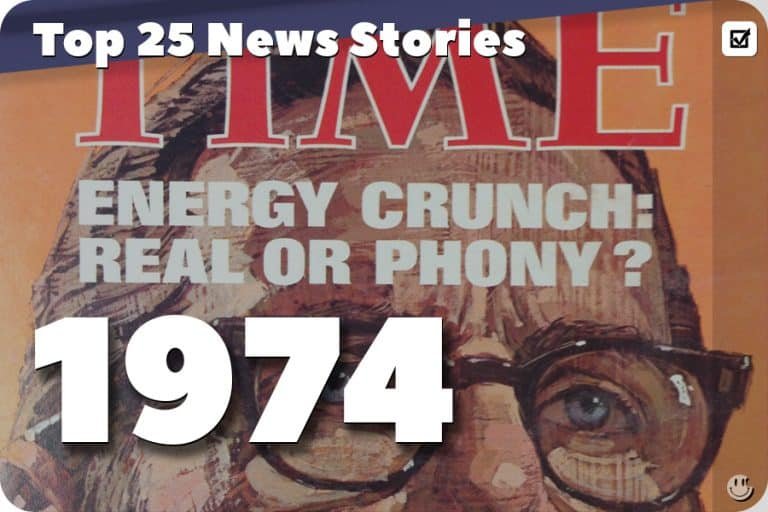
The torrent of 1974 headline news felt relentless, a year where the ground seemed to shift under everyone’s feet. It wasn’t just one story dominating the cycle; it was a cascade of political collapses, economic anxieties, and global realignments that fundamentally reshaped the world. From a president’s unprecedented resignation in Washington D.C. to a peaceful revolution in Portugal and the quiet beep of the first-ever barcode scan in Ohio, 1974 was a crucible of change.
At a Glance: What Defined 1974’s News Cycle
- Political Upheaval: The year is most remembered for the Watergate scandal culminating in President Richard Nixon’s resignation and the subsequent, controversial pardon by Gerald Ford.
- Global Power Dynamics: Dictatorships fell, new nuclear powers emerged, and long-simmering conflicts erupted, altering the international landscape from Europe to South America.
- Economic Crisis Hits Home: The term “stagflation” entered the public lexicon as the 1973 oil crisis fueled rampant inflation and rising unemployment, impacting household budgets worldwide.
- Seeds of the Future: While crises dominated the front pages, quiet breakthroughs in technology and monumental scientific discoveries laid the groundwork for the digital age and our modern understanding of human history.
- Cultural Touchstones: Iconic moments in sports and entertainment provided a much-needed escape and created legends that still endure today.
A Presidency in Crisis: The Watergate Climax
No story captured the world’s attention in 1974 more than the dramatic downfall of a U.S. president. The Watergate scandal, a slow-burning fire that had started with a “third-rate burglary” two years earlier, finally consumed the Nixon administration.
The year began with the walls closing in. By summer, the Supreme Court had unanimously ordered Nixon to turn over his secret Oval Office tape recordings, which provided the “smoking gun” evidence of his involvement in the cover-up. Facing certain impeachment by the House and conviction by the Senate, Richard Nixon made a historic choice.
On August 8, 1974, he addressed the nation and announced his resignation—the first and only time a U.S. president has ever done so. The next day, Vice President Gerald Ford was sworn in as the 38th President, famously declaring, “My fellow Americans, our long national nightmare is over.” But the story wasn’t finished. Just one month later, on September 8, President Ford granted Nixon a “full, free, and absolute pardon,” a move that proved deeply controversial but which Ford argued was necessary to heal the nation. This singular event reshaped American politics for a generation, cementing a deep-seated public mistrust in government that lingers to this day.
Global Maps Redrawn by Revolution and Conflict
While America was consumed by its constitutional crisis, the rest of the world was undergoing its own seismic shifts. The 1974 headline news from abroad told stories of falling empires, new ambitions, and violent confrontations.
The Carnation Revolution: A Dictatorship Topples in Portugal
On April 25, a nearly bloodless military coup in Portugal, known as the Carnation Revolution, overthrew the authoritarian Estado Novo regime, which had ruled for over four decades. Soldiers placed carnations in the muzzles of their rifles, creating an enduring symbol of peaceful revolution. This event not only brought democracy to Portugal but also triggered the rapid collapse of its colonial empire, leading to independence for countries like Angola and Mozambique in the following year.
Flashpoints and New Powers
Other international events sent shockwaves across the globe, highlighting the fragility of the post-war order.
- Turkey Invades Cyprus: On July 20, following a Greek-backed coup, Turkey launched a military invasion of the island nation of Cyprus. The conflict resulted in the partitioning of the island, a division that remains a source of tension in the Mediterranean today.
- India Joins the Nuclear Club: India conducted its first successful nuclear bomb test on May 18. Codenamed “Smiling Buddha,” the test surprised the world and officially made India the sixth nation to possess nuclear weapons, permanently altering the strategic balance in Asia.
- Leadership in Flux: In Israel, Prime Minister Golda Meir resigned in the political fallout from the 1973 Yom Kippur War. Meanwhile, in Argentina, the death of President Juan Perón led to his wife, Isabel Perón, assuming the presidency, making her the first female head of state in the Western Hemisphere.
These events were part of a larger narrative of a world in transition. To grasp the full scope of the year, it’s helpful to see how these political stories intersected with economic and cultural trends. Uncover 1974’s world-shaping facts for a broader look at the moments that defined the era.
The Economy Bites Back: Stagflation and the Energy Squeeze
For the average person, the most pressing headlines of 1974 were about the economy. The aftershocks of the 1973 oil embargo sent the global economy into a severe recession. This wasn’t a typical downturn; it was a phenomenon dubbed “stagflation”—the toxic combination of stagnant economic growth and runaway inflation.
In the U.S., the numbers told a grim story. Inflation soared to 11.04%, and by December, unemployment had hit 7.2%. The price of everyday goods skyrocketed; a gallon of milk cost around $1.50, and the average new house was priced at $38,000, figures that felt punishing at the time.
In response, governments scrambled to manage the crisis. The U.S. enacted the Emergency Highway Energy Conservation Act, which established a national speed limit of 55 mph to save gasoline. Congress also passed landmark legislation aimed at protecting citizens, including:
- ERISA (Employee Retirement Income Security Act): A sweeping law designed to protect American workers’ pension and retirement funds from corporate mismanagement.
- The Safe Drinking Water Act: Empowered the EPA to set national standards for public drinking water.
- The Equal Credit Opportunity Act: Prohibited credit discrimination on the basis of race, religion, national origin, sex, or marital status.
Beyond the Front Page: Discoveries That Rewrote Our Story
While political and economic crises screamed from the headlines, quieter events were unfolding that would have an even greater long-term impact on humanity. These were the breakthroughs in science and technology that began to shape the 21st century.
A Glimpse into the Dawn of Humanity and History
Two monumental archaeological finds in 1974 radically changed our understanding of the past.
- The Discovery of “Lucy”: On November 24, paleoanthropologist Donald Johanson and his team discovered the 3.2-million-year-old fossilized skeleton of a hominid in Ethiopia. Nicknamed “Lucy,” she was a member of the species Australopithecus afarensis and provided definitive proof that our ancestors walked upright long before the evolution of larger brains.
- The Terracotta Army: Farmers digging a well near Xi’an, China, stumbled upon one of the most stunning archaeological sites in history: a vast subterranean army of thousands of life-sized terracotta soldiers, horses, and chariots, buried to guard the tomb of China’s first emperor, Qin Shi Huang.
The Quiet Birth of the Modern World
Simultaneously, the building blocks of our digital and commercial future were being put in place, often with little fanfare.
| Milestone | Date | Significance |
|---|---|---|
| First Barcode Scan | June 26 | A pack of Wrigley’s Juicy Fruit gum was scanned at a supermarket in Troy, Ohio, launching the UPC system that revolutionized retail. |
| Altair 8800 | December | This microcomputer kit, featured on the cover of Popular Electronics, is widely considered to have sparked the personal computer revolution. |
| Rubik’s Cube Invented | N/A | Hungarian architect Erno Rubik created his “Magic Cube,” which would become one of the best-selling toys in history and a global cultural icon. |
Quick Answers to Key Questions About 1974 News
Q: What was the single biggest news story of 1974?
A: While debatable, the resignation of President Richard Nixon on August 8 is almost universally considered the biggest and most impactful news story of the year. It was a constitutional crisis of a scale never before seen in the United States and had profound, lasting effects on the nation’s political culture and public trust.
Q: Was 1974 all bad news?
A: Absolutely not. While crises like Watergate and stagflation dominated the headlines, 1974 was also a year of incredible discovery and progress. The discoveries of Lucy and the Terracotta Army were monumental, and technological seeds like the first barcode scan and the Altair 8800 computer were planted. Culturally, it was the year of Hank Aaron’s record-breaking home run and Muhammad Ali’s legendary “Rumble in the Jungle.”
Q: How did the 1974 energy crisis affect daily life?
A: The energy crisis had a direct and immediate impact. In the U.S., the most visible effect was the new national 55 mph speed limit. Gas prices shot up, and the threat of fuel shortages was a constant worry. This squeeze contributed directly to the high inflation that made everything from groceries to housing more expensive, forcing families to tighten their budgets significantly.
A Year of Endings and Beginnings
Looking back, the 1974 headline news paints a picture of a world at a turning point. It was a year that saw the dramatic end of a presidency, the final gasps of old European empires, and the painful reality of a new economic vulnerability.
Yet, amid the chaos, the future was being written. It was written in a lab in Hungary with a colorful puzzle cube, in a supermarket in Ohio with the beep of a laser scanner, and in the Ethiopian desert with the discovery of a distant human ancestor. The events of 1974 closed one chapter while simultaneously, and often silently, opening the next. The headlines captured the turmoil, but the quieter stories defined the world we would come to inherit.










