While the surface of 1959 America shimmered with post-war prosperity, the ground beneath was shifting, cracking open to reveal the fault lines of a new era. The 1959 major events in america were not just a collection of headlines; they were a series of seismic shocks that redrew the nation’s map, rocketed its ambitions toward the heavens, and forever altered its cultural soundtrack. From the addition of two new stars to the flag to the tragic silence of rock and roll’s pioneers, the year was a powerful, often contradictory, prelude to the turbulent decade ahead.
At a Glance: 1959’s American Transformation
- A Nation Redefined: See how the United States geographically and culturally transformed by admitting Alaska and Hawaii, completing the 50-state union we know today.
- The Space Race Gets Personal: Understand the human face of the cosmic competition as NASA introduces the “Mercury Seven,” America’s first astronauts, and successfully sends primates into space and back.
- Culture at a Crossroads: Explore the year’s cultural whiplash—from the birth of an American icon, the Barbie doll, to the shocking “Day the Music Died.”
- Innocence Challenged: Learn how events like the TV quiz show scandals and the lengthy steel strike revealed deeper anxieties simmering beneath the optimistic facade of the late 1950s.
The Union Expands: Alaska and Hawaii Join the Fold
In 1959, the physical map of the United States changed more dramatically than in any year since the early 20th century. The addition of two non-contiguous territories as states not only added stars to the flag but also fundamentally shifted America’s strategic and cultural identity.
Alaska: The 49th State’s Cold War Significance
On January 3, 1959, President Dwight D. Eisenhower officially declared Alaska the 49th state. This was more than a bureaucratic formality; it was a major strategic move in the Cold War. Positioned just across the Bering Strait from the Soviet Union, Alaska became America’s frontline Arctic territory.
Statehood solidified U.S. control over a vast, resource-rich landmass, providing critical locations for early-warning radar systems (like the DEW Line) and military bases. For Americans, it transformed the perception of “The Last Frontier” from a remote, icy possession into an integral part of the nation, forever tying America’s destiny to the polar north.
Hawaii: A Pacific Paradise Becomes the 50th State
The journey to statehood for Hawaii was longer and more complex, culminating in its official admission on August 21, 1959. Congress had approved the move in March, and a June plebiscite saw Hawaiians vote overwhelmingly in favor of joining the union.
Hawaii’s statehood was a landmark moment for several reasons:
- Cultural Integration: It was the first state with a majority non-white population, a significant step in a nation grappling with the burgeoning Civil Rights Movement.
- Geopolitical Pivot: It anchored American presence firmly in the Pacific, strengthening its economic and military ties to Asia during a period of rising global tensions.
- Political Compromise: The admission of Alaska (seen as likely Democratic) and Hawaii (thought to be Republican) in the same year was a classic example of political horse-trading to maintain the balance of power in Congress.
Reaching for the Heavens: America’s Space Race Kicks into High Gear
If statehood expanded America’s terrestrial borders, the space race aimed to shatter them entirely. After being repeatedly stunned by Soviet “firsts” like Sputnik, 1959 was the year the U.S. space program began to build serious, visible momentum.
The Mercury Seven: Naming America’s First Astronauts
On April 9, NASA held a press conference in Washington, D.C., to introduce the seven men selected for Project Mercury. Scott Carpenter, Gordon Cooper, John Glenn, Gus Grissom, Wally Schirra, Alan Shepard, and Deke Slayton were instantly transformed from anonymous military test pilots into national heroes.
This was a masterful stroke of public relations. It put a human face on the abstract, technological struggle with the Soviet Union. These men, embodying what Tom Wolfe would later call “The Right Stuff,” became symbols of American courage and ingenuity. Their selection wasn’t just about finding pilots; it was about selling the dream of space exploration to the American public and signaling to the world that the U.S. was in the race to win.
Monkeys in Space: The Unsung Primate Pioneers
Before risking the lives of the Mercury Seven, NASA had to prove a living being could survive the brutal forces of launch and the weightlessness of space. On May 28, they achieved a spectacular success. A Jupiter rocket launched two monkeys, a rhesus named Able and a squirrel monkey named Baker, 300 miles high on a suborbital flight.
They were recovered from the Atlantic Ocean, alive and well. This 15-minute flight was a monumental step, providing crucial biomedical data and proving that complex life forms could endure the journey. While the Soviets had sent a dog into orbit, the successful recovery of primates—biologically much closer to humans—was a vital American achievement. These American efforts were part of a much larger global competition. Explore 1959’s redefining moments to see the full picture of the international landscape that fueled the space race.
Culture in Transition: Innocence Lost and Icons Born
America’s cultural landscape in 1959 was a study in contrasts. It was a year of shocking tragedy that signaled the end of one era, the birth of a plastic icon that would define another, and the dawning realization that not everything on television was real.
February 3rd: The Day the Music Died
The sudden death of rock and roll pioneers Buddy Holly, Ritchie Valens, and J.P. “The Big Bopper” Richardson in a plane crash near Clear Lake, Iowa, was a profound shock. The event, later immortalized by Don McLean as “The Day the Music Died,” felt like more than just a tragic accident. It represented the symbolic end of rock’s first, exuberant chapter. The raw, rebellious energy of the 1950s seemed to vanish overnight, creating a void in American music that wouldn’t truly be filled until the arrival of The Beatles.
Barbie’s Debut: A New, Complicated Vision of Womanhood
On March 9, at the American International Toy Fair in New York City, the Mattel toy company introduced a doll unlike any other: Barbie. With her impossibly perfect figure, glamorous wardrobe, and independent, career-oriented “lifestyles,” Barbie was a departure from the baby dolls that had dominated the market.
She was an instant sensation, reflecting a post-war desire for glamour and aspiration. At the same time, she became a lightning rod for cultural debates about female body image and societal roles that continue to this day. Her birth in 1959 marks a pivotal moment in consumer culture and the construction of American femininity.
Shadows on the Small Screen
Two other cultural events revealed the anxieties lurking beneath the surface:
- The Twilight Zone: Premiering on October 2, Rod Serling’s anthology series used science fiction and fantasy to explore potent themes of nuclear paranoia, conformity, and social alienation—the very fears many Americans felt but rarely discussed.
- The Quiz Show Scandal: In November, Columbia University professor Charles Van Doren admitted to a congressional committee that his winning streak on the popular quiz show Twenty-One had been rigged. The confession shattered the public’s trust, proving that even the seemingly innocent world of television entertainment could be a source of profound deception.
Beyond the Headlines: Key Industrial and Labor Shifts
While statehood and space flights captured the imagination, critical shifts in the American economy and infrastructure were also underway.
| Event | Date(s) | Significance |
|---|---|---|
| United States Steel Strike | July 15-Nov. 7 | A 116-day strike involving 500,000 workers shut down the nation’s steel industry. President Eisenhower had to invoke the Taft-Hartley Act to force them back to work, highlighting major tensions between labor and management. |
| St. Lawrence Seaway Opens | April 25 | This massive engineering project connected the Great Lakes to the Atlantic Ocean, opening America’s industrial heartland to international shipping and transforming cities like Chicago and Detroit into global ports. |
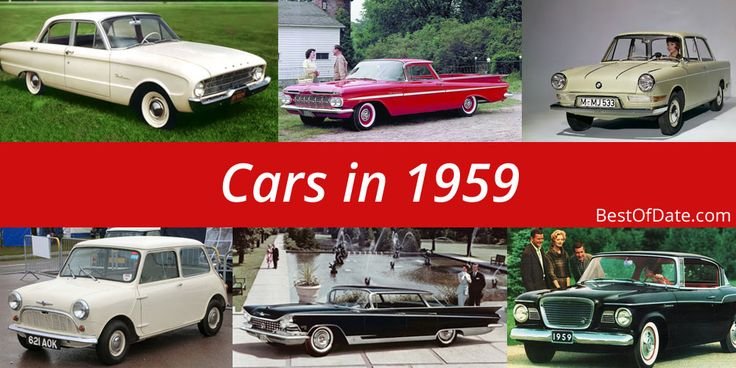
| Ford Falcon Launched | Fall 1959 | The launch of this compact car was Ford’s response to the growing popularity of smaller European cars like the Volkswagen Beetle. It signaled a major shift in consumer demand toward fuel efficiency and practicality. |
| The Edsel Is Discontinued | November 19 | Ford’s announcement that it was ending production of the Edsel after just two years marked one of the most famous product failures in American history, becoming a case study in flawed market research. |
Understanding 1959: Your Questions Answered
Why were Alaska and Hawaii admitted as states in the same year?
This was a calculated political compromise. At the time, national politicians believed Alaska would lean Democratic while Hawaii would lean Republican. Admitting them together was intended to maintain the delicate balance of power in the U.S. Senate, ensuring neither party gained an advantage.
Was America “winning” the Space Race in 1959?
Not by the metric of “firsts.” In 1959 alone, the Soviet Union’s Luna 1 became the first probe to fly past the Moon, and Luna 2 became the first man-made object to impact its surface. However, America’s achievements—like the Mercury Seven selection and the successful primate flight—were crucial for building the foundation of a program that would eventually win the race to land a man on the Moon. The U.S. was playing catch-up, but it was catching up fast.
What was the biggest cultural shock in America in 1959?
While “The Day the Music Died” was an emotional gut punch, the confession of Charles Van Doren in the quiz show scandal arguably had a more corrosive, long-term impact. It was a profound breach of trust that made millions of Americans cynical about the burgeoning medium of television and the very nature of celebrity and truth in the modern age.
How did the “Kitchen Debate” reflect American life in 1959?
During a July exhibition in Moscow, Vice President Richard Nixon and Soviet Premier Nikita Khrushchev engaged in an impromptu debate in a model American kitchen. Nixon’s argument centered on the superiority of American capitalism, evidenced by consumer goods like dishwashers and color TVs. This event perfectly captured the essence of American identity in 1959: a belief that prosperity, consumer choice, and technological convenience were not just features of its economy, but proof of its ideological supremacy.
1959’s Legacy: A Blueprint for a New Decade
The major events of 1959 in America were not endings, but powerful beginnings. The nation that entered 1960 was geographically larger, technologically bolder, and culturally more complex than the one that began 1959. The new states of Alaska and Hawaii pulled the country’s focus west and into the Pacific. The faces of the Mercury Seven gave a new focus to the nation’s scientific ambitions.
The cultural ruptures—the loss of musical innocence, the birth of Barbie, the erosion of trust in television—set the stage for the social upheavals of the 1960s. 1959 was the year the tidy, black-and-white certainties of the post-war era began to give way to the turbulent, full-color complexities of the future. It was the final, deep breath before the plunge.










