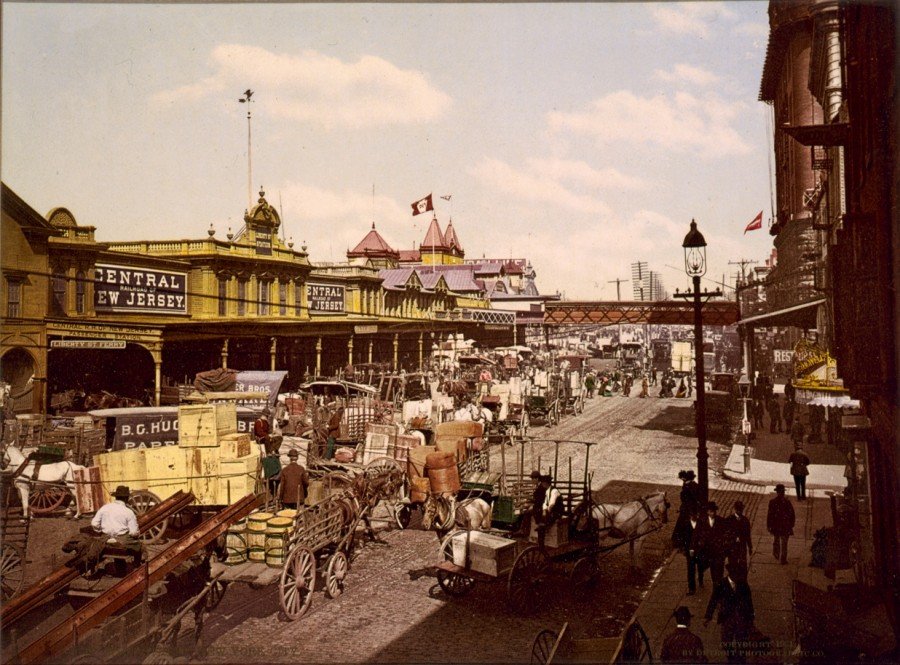
The story of 1900s US history is one of dramatic, often violent, transformation. The century opened with a nation buzzing with invention and grappling with the harsh realities of industrialization—a society convinced it could engineer a better future. Yet, this same nation would soon be pulled from its domestic focus into the grinding machinery of two global wars, events that would forge it into a reluctant superpower. Understanding this pivot from internal reform to international turmoil is key to grasping how modern America was born.
This period, stretching roughly from 1900 to 1949, saw the United States lurch between breathtaking progress and devastating crisis. It was an era of trust-busters and flappers, bread lines and victory gardens, a time when the very role of government and America’s place in the world were fundamentally redefined.
At a Glance: Your Guide to the Early 20th Century
This article will help you understand the core dynamics that shaped the first half of the American century. You’ll walk away with:
- A clear picture of the Progressive Era’s goals: Tackling corporate monopolies, political corruption, and social inequality.
- The timeline of America’s entry into two World Wars: From steadfast neutrality to decisive global intervention.
- Key legislative milestones: How constitutional amendments and landmark acts permanently altered American life.
- The boom-and-bust cycle: The connection between the soaring prosperity of the Roaring Twenties and the crushing despair of the Great Depression.
- The birth of a superpower: How the turmoil of 1900-1945 set the stage for America’s post-war dominance.
Wrestling with Modernity: The Progressive Era’s Ambitious Agenda
At the turn of the century, America was living with a Gilded Age hangover. Unfettered industrial growth had created immense wealth for a few but left cities overcrowded, factories dangerous, and politics riddled with corruption. The Progressive movement wasn’t a single, organized party; it was a widespread impulse to use logic, government, and expertise to solve these problems.
Muckrakers, Reformers, and the Fight for the Nation’s Soul
The first step was exposing the rot. Journalists, dubbed “muckrakers” by President Theodore Roosevelt, published searing investigative pieces that shocked the nation into action.
- Upton Sinclair’s The Jungle (1906): This novel’s stomach-churning descriptions of Chicago’s meatpacking industry led directly to the passage of the Pure Food and Drug Act and the Meat Inspection Act in the same year.
- Ida Tarbell’s The History of the Standard Oil Company (1904): Her meticulous exposé of John D. Rockefeller’s monopolistic practices fueled public demand for “trust-busting.”
- Jacob Riis’s How the Other Half Lives (1890): Through photojournalism, Riis revealed the squalid conditions of New York City’s tenements, spurring housing reform.
These exposés created the political will for a new generation of leaders to act, chief among them the president who took office after William McKinley’s assassination in 1901.
Theodore Roosevelt and the “Square Deal”
Theodore Roosevelt embodied the energy of the Progressive Era. He believed the federal government should act as a steward for the public good, promising a “Square Deal” for all Americans. His presidency was a whirlwind of action.
He became known as the “trust-buster” for using the Sherman Antitrust Act to break up powerful corporate monopolies, most notably J.P. Morgan’s Northern Securities railroad conglomerate. He championed conservation, setting aside millions of acres for national forests and parks. And after Sinclair’s exposé, he pushed through vital consumer protection laws that established the forerunner to the Food and Drug Administration (FDA).
Woodrow Wilson’s “New Freedom”: A Different Progressive Vision
Succeeding Roosevelt (after the one-term presidency of William Howard Taft), Woodrow Wilson, a Democrat, offered a different but equally ambitious progressive platform he called the “New Freedom.” Where Roosevelt focused on regulating big business, Wilson aimed to dismantle it to restore competition.
His administration oversaw a wave of foundational economic and political reforms:
- The Federal Reserve Act (1913): Created a central banking system to stabilize the nation’s currency and credit.
- The 16th Amendment (1913): Established a graduated federal income tax, providing a new and substantial revenue stream for the government.
- The 17th Amendment (1913): Mandated the direct election of senators by the people, not state legislatures, aiming to reduce the influence of corporate lobbyists.
These reforms fundamentally reshaped the relationship between the government, the economy, and the American people. For a complete overview of how these changes fit into the larger narrative, see the Full Guide to 20th Century US History.
The Great War: How Neutrality Gave Way to Global Conflict
While America was focused on domestic reform, Europe was spiraling toward war. When conflict erupted in 1914, President Wilson declared a firm policy of neutrality. Most Americans, separated by an ocean, wanted no part in what they saw as another bloody European squabble.
The Rocky Path to Intervention
Neutrality proved difficult to maintain. The U.S. had strong economic ties to the Allied powers, particularly Great Britain and France. But the critical turning point was Germany’s use of unrestricted submarine warfare.
The sinking of the British passenger liner Lusitania in 1915, which killed 128 Americans, outraged the public. After a brief pause, Germany resumed its attacks in 1917, sinking three American merchant ships in quick succession. This, combined with the discovery of the Zimmerman Telegram—a secret German proposal for a military alliance with Mexico against the U.S.—made the American position untenable. On April 6, 1917, Congress declared war on Germany.
The War’s Aftermath: A “Return to Normalcy” That Wasn’t
The American Expeditionary Forces helped tip the balance on the Western Front, leading to an armistice on November 11, 1918. But the transition back to peace was chaotic. Wilson’s idealistic vision for a post-war world, the Fourteen Points and a League of Nations, was rejected by a U.S. Senate wary of foreign entanglements.
The nation was further rocked by the devastating 1918 influenza pandemic, which killed an estimated 500,000 Americans. The post-war years were marked by labor strikes, racial violence, and a “Red Scare”—a nationwide fear of communists and radicals. It was in this climate of anxiety that Americans elected Warren G. Harding in 1920 on a promise of a “return to normalcy.”
A Decade of Contradictions: Jazz, Flappers, and Prohibition
The “Roaring Twenties” was a decade of profound social and economic change, a period when the modern America we recognize began to take shape.
Mass production, pioneered by Henry Ford and his Model T, made new consumer goods like automobiles and radios accessible to the middle class. A booming stock market created a sense of endless prosperity, while jazz music and new, liberated “flapper” fashions symbolized a break from Victorian traditions.
But beneath the surface, deep cultural tensions simmered:
- Prohibition: The 18th Amendment (1919) banned the manufacture and sale of alcohol. While intended as a moral reform, it backfired spectacularly, creating a massive black market controlled by organized crime figures like Al Capone.
- The Scopes Trial (1925): This famous courtroom battle over teaching evolution in Tennessee pitted modern, secular science against rural, religious fundamentalism.
- Women’s Suffrage: The ratification of the 19th Amendment in 1920 was a landmark victory, granting women the right to vote and reshaping the electorate.
This frenetic decade of credit-fueled growth came to a screeching halt on October 29, 1929—Black Tuesday—when the Wall Street stock market crashed, plunging the nation into the Great Depression.
The New Deal and the Remaking of American Government
The crash exposed the fragile foundations of the 1920s economy. President Herbert Hoover’s belief in rugged individualism proved inadequate for the scale of the crisis. By 1932, with unemployment soaring and banks failing, the country elected Franklin D. Roosevelt in a landslide.
FDR promised a “New Deal for the American people.” In his first 100 days, he rolled out a dizzying array of federal programs—the “alphabet soup” agencies like the Civilian Conservation Corps (CCC) and the Tennessee Valley Authority (TVA)—aimed at providing relief, promoting recovery, and instituting reforms.
Two of the New Deal’s most enduring legacies were:
- The Social Security Act (1935): For the first time, the federal government created a national safety net for the elderly, unemployed, and disabled.
- The Fair Labor Standards Act (1938): This act established a national minimum wage (initially 25 cents an hour), a 40-hour work week, and banned most child labor.
The New Deal didn’t fully end the Depression, but it fundamentally expanded the size and scope of the federal government, establishing its role in managing the economy and providing for the welfare of its citizens.
The Storm Gathers: America on the Brink of World War II
As America struggled with the Depression, the world stage was darkening. Fascist regimes rose in Italy and Germany, and imperial Japan began its aggressive expansion in Asia. Most Americans, disillusioned by World War I, were staunchly isolationist.
FDR, convinced that the U.S. could not remain aloof, skillfully navigated public opinion. He declared the U.S. the “arsenal of democracy,” providing critical military aid to Britain through the Lend-Lease Act while officially remaining neutral.
The debate ended abruptly on December 7, 1941, when Japan launched a surprise attack on the U.S. naval base at Pearl Harbor, Hawaii. The next day, FDR asked Congress for a declaration of war. The U.S. was once again embroiled in a global conflict, one that would demand a total mobilization of its industrial might and its people, from the soldiers on D-Day to “Rosie the Riveter” in the factories back home.
Practical Playbook: Key Legislative Shifts of the Early 20th Century
This table summarizes some of the most impactful laws and constitutional amendments from 1900 to 1945, showing the government’s expanding role in American life.
| Legislation/Amendment | Year Ratified/Passed | Core Purpose |
|---|---|---|
| Pure Food and Drug Act | 1906 | Prohibited sale of misbranded/adulterated food & drugs. |
| 16th Amendment | 1913 | Established a federal income tax. |
| 17th Amendment | 1913 | Mandated direct election of U.S. Senators. |
| Federal Reserve Act | 1913 | Created the central banking system of the U.S. |
| 18th Amendment | 1919 | Prohibited alcohol (Prohibition). |
| 19th Amendment | 1920 | Granted women the right to vote. |
| Social Security Act | 1935 | Created a safety net for retirees, unemployed, and disabled. |
| Fair Labor Standards Act | 1938 | Set a national minimum wage and 40-hour work week. |
| 21st Amendment | 1933 | Repealed the 18th Amendment (ended Prohibition). |
Quick Answers: Clearing Up Common Questions
Q: Was the Progressive Era successful?
A: It was a mixed bag. It achieved monumental successes in consumer protection, trust-busting, women’s suffrage, and political reform. However, it largely failed to address racial injustice; in fact, segregation became more entrenched under the Wilson administration, and the period saw a resurgence of the Ku Klux Klan.
Q: Why did the U.S. really enter World War I?
A: Germany’s unrestricted submarine warfare was the direct trigger. But powerful underlying factors included deep economic and cultural ties to the Allies (Britain and France) and President Wilson’s growing conviction that America needed a seat at the peace table to shape a new, more democratic world order.
Q: Did the stock market crash of 1929 cause the Great Depression?
A: The crash was the spark that lit the fire, not the sole cause. The Depression resulted from deeper systemic issues: a severe maldistribution of wealth, overproduction in industry, a fragile banking system built on speculation, and disastrous government policies like high tariffs that strangled international trade.
Q: How did World War II end the Great Depression?
A: Massive, sustained government spending on the war effort effectively created full employment. The U.S. government spent more money between 1941 and 1945 than it had in its entire prior history. Factories were converted to produce planes, tanks, and munitions, absorbing the millions of unemployed workers and finally pulling the nation out of the decade-long slump.
The first fifty years of the 20th century were a crucible for the United States. The nation transformed from an inward-looking republic focused on its own progressive experiments into a global military and economic juggernaut. The reforms of the Progressive Era, the trauma of the Great Depression, and the total mobilization for two world wars forged a new American government and a new sense of national identity. The decisions made and the institutions built during this tumultuous period laid the foundation for the Cold War, the Civil Rights Movement, and the complex challenges America would face in the second half of its most transformative century.










