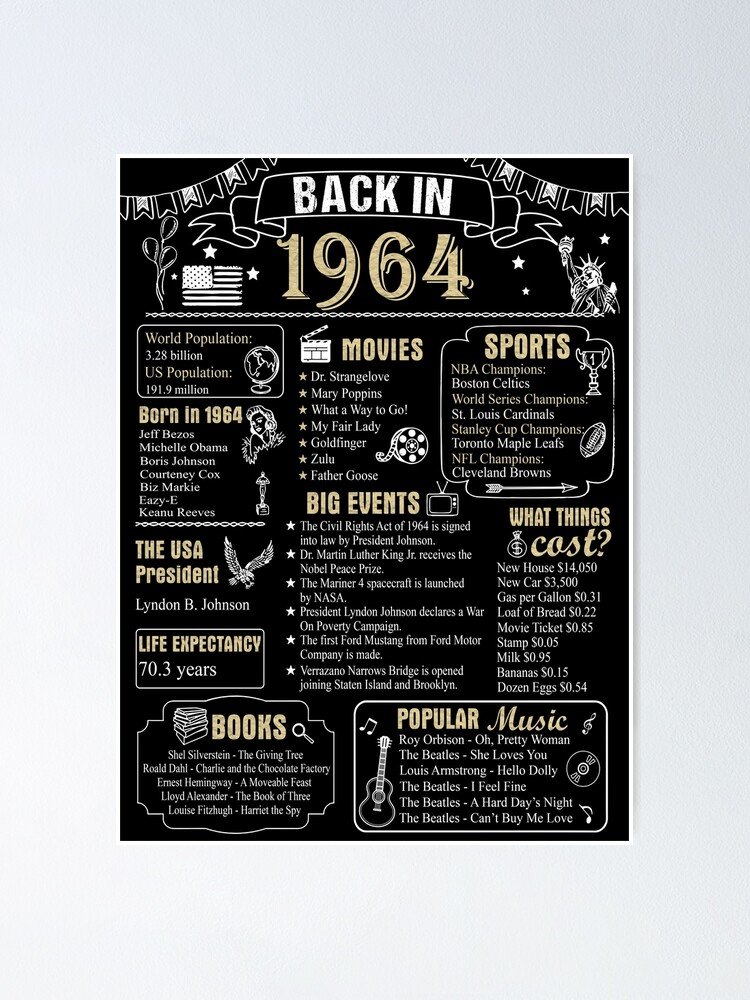
Here is the comprehensive pillar article on “1964 historical events,” written in the persona of a seasoned journalist.
It’s rare for a single year to feel like a complete hinge-point in history, but the 1964 historical events did just that. This was a year of seismic shifts—a time when the black-and-white certainties of the 1950s gave way to the vibrant, chaotic, and revolutionary colors of a new era. In just 366 days (it was a leap year), America and the world witnessed a convergence of social upheaval, cultural explosion, and escalating global tension that would define the rest of the 20th century.
From a frantic four-piece band from Liverpool landing at JFK to a president declaring an unconditional “war on poverty,” the year was a relentless barrage of news. It was the year a landmark civil rights bill was signed into law, even as activists were murdered in the Mississippi summer. It was the year a supposed naval skirmish in a faraway bay would drag America deeper into Vietnam. It was a year of incredible firsts and tragic lasts, and its echoes are still with us today.
1964: The Year in a Flash
Before we dive deep, here’s a quick snapshot of the monumental changes that made 1964 a year unlike any other:
- Civil Rights Act of 1964 Signed: President Lyndon B. Johnson signed the most sweeping civil rights legislation since Reconstruction, outlawing discrimination based on race, color, religion, sex, or national origin.
- The British Invasion Begins: The Beatles appeared on The Ed Sullivan Show, captivating 73 million Americans and launching a cultural phenomenon known as Beatlemania.
- Vietnam War Escalates: The Gulf of Tonkin incident provided the justification for Congress to grant President Johnson broad military powers, deepening U.S. involvement in Vietnam.
- War on Poverty Declared: In his State of the Union address, LBJ launched his ambitious “Great Society” programs aimed at eliminating poverty and racial injustice in America.
- Martin Luther King Jr. Wins Nobel Peace Prize: The civil rights leader was recognized for his nonviolent struggle against racial inequality, cementing his status as a global icon.
- Cassius Clay Becomes Muhammad Ali: The charismatic boxer won his first heavyweight title and announced his conversion to the Nation of Islam, adopting a new name and a powerful new public identity.
A Nation at a Crossroads: The Fight for Civil Rights and a “Great Society”
More than anything else, 1964 was defined by the struggle for equality. The Civil Rights Movement reached a critical apex, moving from protests in the streets to the halls of Congress, forcing a national reckoning with centuries of injustice.
The Civil Rights Act of 1964: A Legislative Landmark
The centerpiece of the year was the Civil Rights Act of 1964. After enduring a 75-day filibuster in the Senate—one of the longest in U.S. history—the bill was signed into law by President Johnson on July 2. This wasn’t just symbolic; it was a legislative hammer. The act outlawed segregation in public places, such as theaters, restaurants, and hotels, and banned discriminatory practices in employment and voter registration.
While it didn’t solve everything overnight, it provided the federal government with powerful tools to dismantle Jim Crow laws. The passage of the law was a testament to years of tireless, and often dangerous, activism by countless individuals. These What happened in 1964 were not just political maneuvers; they were hard-won victories paid for in blood, sweat, and tears.
The 24th Amendment and “Freedom Summer”
Earlier in the year, on January 23, the 24th Amendment to the Constitution was ratified. This amendment outlawed the poll tax—a fee charged to vote—in federal elections. For decades, Southern states had used poll taxes to disenfranchise poor Black citizens (and poor whites). Its abolition was another crucial step toward ensuring voting rights for all.
But progress came at a horrifying cost. The summer of 1964 became known as “Freedom Summer,” a massive voter registration drive in Mississippi organized by civil rights groups. On June 21, three young activists—James Chaney, Andrew Goodman, and Michael Schwerner—disappeared. Their bodies were discovered 44 days later, murdered by members of the Ku Klux Klan. Their deaths shocked the nation and highlighted the brutal resistance to change. Race riots also erupted in Harlem in July, underscoring the deep-seated anger and frustration over police brutality and economic inequality.
LBJ’s War on Poverty
Lyndon B. Johnson, thrust into the presidency after John F. Kennedy’s assassination, used his political capital to push an ambitious domestic agenda. In his State of the Union address on January 8, he declared an “unconditional war on poverty in America.” This wasn’t just rhetoric.
On August 20, he signed the Economic Opportunity Act, creating the Job Corps, VISTA, and the Head Start program. Later, on August 31, he signed the Food Stamp Act into law. These initiatives were the bedrock of his “Great Society” program, a vision he laid out on May 22 to end poverty and racial injustice. The defining Defining moments of 1964 were marked by this dual push for social and economic justice.
Yeah, Yeah, Yeah: Beatlemania and the Cultural Revolution
While America grappled with profound social issues, a cultural tsunami was rolling in from across the Atlantic. It arrived with four charming, mop-topped young men from Liverpool, and nothing would ever be the same.
The Beatles Conquer America
The British Invasion began in earnest on February 7, 1964, when The Beatles landed at New York’s JFK Airport to the screams of thousands of fans. Two days later, on February 9, they made their legendary debut on The Ed Sullivan Show. An astounding 73.7 million people tuned in—nearly 40% of the entire U.S. population. It was a cultural ignition point.
The band’s domination was absolute.
- Chart History: On April 4, The Beatles held the top five spots on the Billboard Hot 100 chart, a feat that has never been repeated.
- First #1 Hit: “I Want to Hold Your Hand” began a seven-week run at #1 on February 1.
- Album Success: Their album Meet the Beatles! hit #1 on February 15 and stayed there for 11 weeks.
The Beatles were more than a band; they were a phenomenon that signaled a massive generational shift in music, fashion, and attitude. If you want to See what happened in 1964, just look at the television, radio, and record charts from that year.
Culture in Flux: Mustangs, Oscars, and Pirate Radio
The cultural energy of 1964 went far beyond The Beatles.
- The Ford Mustang: On March 9, the first Ford Mustang rolled off the assembly line. Officially introduced on April 17 for a base price of $2,368, the stylish and affordable “pony car” became an instant icon of American freedom and youth.
- Sidney Poitier’s Historic Oscar: On April 13, Sidney Poitier became the first Black man to win the Academy Award for Best Actor for his role in Lilies of the Field. It was a landmark moment for representation in Hollywood.
- New Sounds and Shows: The year kicked off on January 1 with the premiere of the iconic British music show Top of the Pops. On March 30, the game show Jeopardy! debuted on NBC. And on March 28, the pirate station Radio Caroline began broadcasting rock music from a ship in international waters, challenging the BBC’s staid monopoly.
- Dr. Strangelove: Stanley Kubrick’s brilliant Cold War satire, Dr. Strangelove or: How I Learned to Stop Worrying and Love the Bomb, premiered on January 29, perfectly capturing the nuclear anxiety of the era with dark, absurdist humor.
Cold War Tensions Escalate and Borders Redraw
Beneath the soundtrack of pop music, the drums of war were beating louder. The Cold War chess match between the U.S. and the Soviet Union entered a dangerous new phase, while nations around the globe shook off the last vestiges of colonialism.
The Gulf of Tonkin Incident
In early August, the course of American history was altered by events in the Gulf of Tonkin off the coast of North Vietnam. The U.S. claimed that on August 2 and 4, the destroyer USS Maddox was attacked without provocation by North Vietnamese torpedo boats. While the first incident was real, the second is now widely believed to have never happened.
Regardless, the reports were all President Johnson needed. On August 7, a nearly unanimous Congress passed the Gulf of Tonkin Resolution, granting Johnson the authority to “take all necessary measures” to repel attacks and prevent further aggression. This resolution became the legal justification for a massive escalation of the Vietnam War, a conflict that would divide the nation and define a generation. Many Key moments from 1964 from this period directly led to larger conflicts.
A New World Order
The geopolitical landscape was shifting everywhere.
- A Change in the Kremlin: On October 14, Nikita Khrushchev was ousted as leader of the Soviet Union and replaced by the more hardline Leonid Brezhnev.
- China Joins the Nuclear Club: Just two days later, on October 16, China successfully detonated its first atomic bomb, dramatically altering the global balance of power.
- Independence Movements: The wave of decolonization continued. Malawi (July 6), Malta (September 21), and Zambia (October 24) all gained independence from Britain. In another part of Africa, anti-apartheid leader Nelson Mandela was sentenced to life in prison in South Africa on June 12, a stark reminder of the brutal struggles still being fought.
- The Warren Commission: On September 24, the Warren Commission released its report on the assassination of President Kennedy, concluding that Lee Harvey Oswald acted alone. The findings were immediately controversial and have fueled conspiracy theories ever since.
A Year of Firsts: Technology, Sports, and Modern Life Take a Leap
The pace of innovation in 1964 was breathtaking. Breakthroughs in computing, transportation, and public health set the stage for the modern world we know today.
The Dawn of the Digital Age
On April 7, IBM announced the System/360, a revolutionary family of mainframe computers that helped standardize computer architecture and ushered in a new era of data processing. At Dartmouth College on May 1, the first program written in the beginner-friendly BASIC programming language was successfully run, a key step in making computing accessible to more people. This was one of the most 1964 important events in the history of personal computing.
Connecting the World
- Japan’s Bullet Train: On October 1, just in time for the Tokyo Olympics, Japan launched the Shinkansen, or “bullet train.” It was the world’s first high-speed rail line, connecting Tokyo and Osaka and symbolizing Japan’s stunning post-war recovery.
- The Verrazano-Narrows Bridge: New York City opened the world’s longest suspension bridge on November 21, connecting Brooklyn and Staten Island.
- Mariner 4 to Mars: On November 28, NASA launched the Mariner 4 probe. Seven months later, it would become the first spacecraft to fly by Mars and send back close-up images of another planet.
Other Notable Events of 1964
The year was packed with other milestones.
- Surgeon General’s Report: On January 11, U.S. Surgeon General Luther Terry released a landmark report definitively linking smoking to lung cancer and other diseases. It was the first major government-led effort to curb smoking.
- Nike’s Humble Beginning: On January 25, the company that would become Nike was founded as Blue Ribbon Sports by Bill Bowerman and Phil Knight.
- The Champ is Here: On February 25, a brash young boxer named Cassius Clay defeated Sonny Liston to become the heavyweight champion of the world. On March 6, he announced he had joined the Nation of Islam and changed his name to Muhammad Ali.
- Great Alaska Earthquake: The most powerful earthquake ever recorded in North America, a magnitude 9.2, struck Alaska on March 27, causing widespread devastation and killing 139 people.
Understanding 1964: Frequently Asked Questions
What was the single most important event of 1964?
While many events had massive consequences, the passage of the Civil Rights Act of 1964 arguably had the most profound and lasting impact on American society. It legally dismantled the entire system of Jim Crow segregation and laid the groundwork for future progress in equality, though the fight was far from over.
How did 1964 set the stage for the rest of the 1960s?
1964 was the catalyst for the decade’s biggest themes. The Gulf of Tonkin Resolution greenlit the Vietnam War, which would come to dominate American life. The Civil Rights Act’s passage intensified the struggle for equality, leading to the Voting Rights Act of 1965 and the rise of more radical movements. Beatlemania opened the floodgates for the counterculture that would define the late ’60s.
Was 1964 a good year for America?
It was a year of extreme contradictions. There were moments of incredible hope and progress, such as the Civil Rights Act and LBJ’s War on Poverty. But it was also a year of deep-seated violence, political division, and the beginning of a disastrous war. It was a turbulent, essential, and transformative year, but whether it was “good” depends entirely on your perspective. Exploring the Key moments of 1964 shows a mixture of triumph and tragedy.
Why 1964 Still Matters
Looking back at 1964 is like looking at the DNA of our modern world. The debates we have today about racial justice, the role of government, presidential war powers, and the influence of media and culture were all powerfully shaped by the events of that single, pivotal year.
The War on Poverty’s legacy lives on in social safety net programs. The Civil Rights Act remains the legal foundation for equality and anti-discrimination law. The Gulf of Tonkin Resolution serves as a constant cautionary tale about the rush to war. The technological leaps, from mainframes to space probes, built the foundation for the digital, interconnected world we inhabit.
1964 wasn’t just a collection of dates and headlines. It was a year that forced a confrontation with the old and an embrace of the new, setting the country—and the world—on an irreversible and turbulent course into the future. It was the year the modern era truly began.










