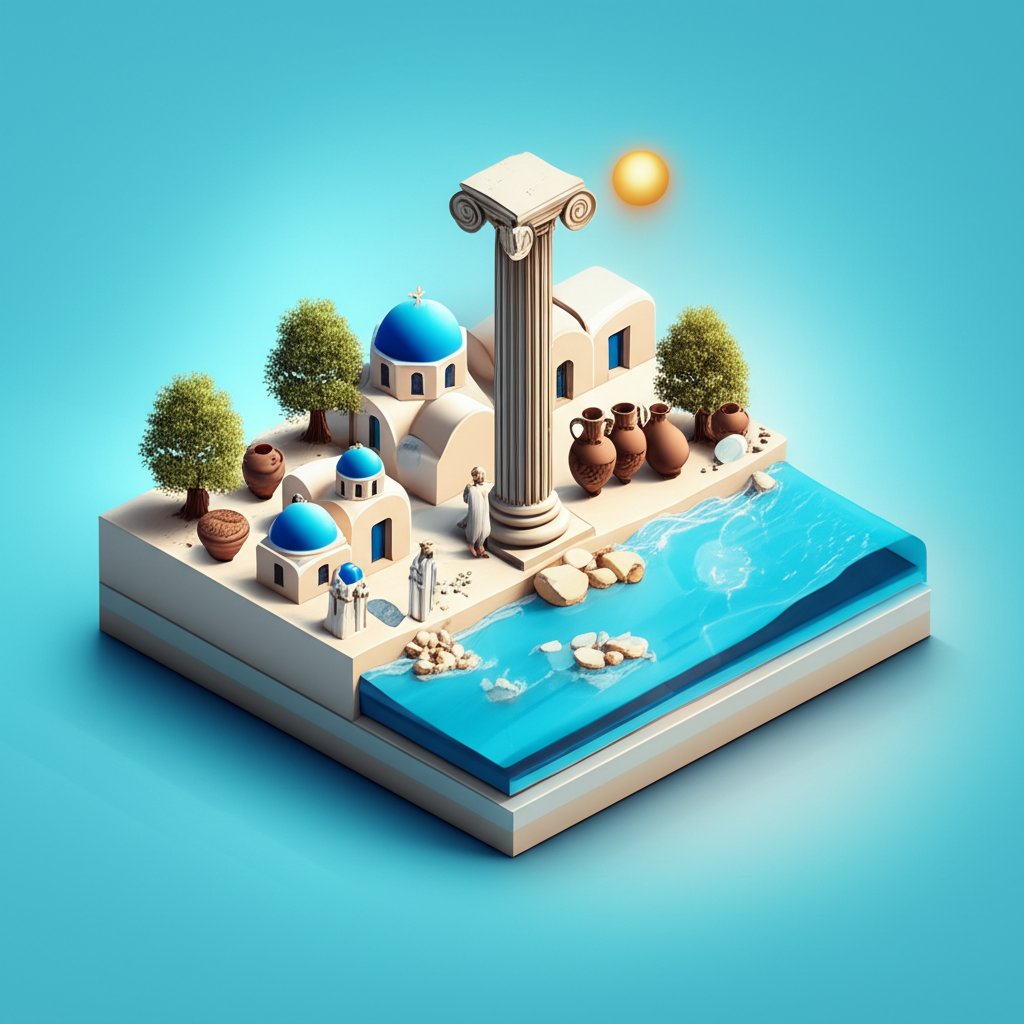
Beyond the iconic white-washed villages and sun-drenched beaches, a deeper look at Greece facts reveals a country of incredible contrasts. You find the bedrock of Western thought living alongside myths of mountain-dwelling gods, and a coastline so vast it defies easy comprehension. This isn’t just a vacation spot; it’s a living museum where every stone and shoreline has a story stretching back millennia.
Understanding these layers—from the origins of democracy to the geological wonders that shape its thousands of islands—transforms how you see this remarkable corner of the world. It’s the difference between simply seeing the Parthenon and understanding the revolutionary ideas born in its shadow.
At a Glance: Key Insights into Greece’s Identity
- Foundations of the Modern World: Discover how ancient Greek concepts in democracy, philosophy, and science are still deeply embedded in our daily lives.
- A Landscape of Extremes: Learn why Greece’s geography, from the world’s deepest gorge to thousands of unique islands, offers more diversity than almost anywhere else in Europe.
- Living Traditions: Uncover cultural nuances, from the importance of name days over birthdays to superstitions that have survived for centuries.
- Navigating Like a Local: Get practical tips on everything from the best time to eat dinner to why your choice of footwear matters at ancient sites.
- Myths vs. Reality: Clarify common misconceptions about Greek history, its language, and its famous landmarks.
The Blueprint for Western Civilization

It’s impossible to overstate Greece’s impact on the world. The ideas forged in its ancient city-states became the foundational pillars of modern Western society. While many know the headlines, the details are where the most fascinating truths lie. These aren’t just historical trivia; they are the operating system running in the background of our governments, schools, and even our entertainment.
Where Democracy Was Born and Philosophy Thrived
The word “democracy” itself is a Greek export, born from demos (the people) and kratos (power). In 5th-century BC Athens, this wasn’t a theoretical concept but a radical, real-world experiment in governance. While it was limited—excluding women, slaves, and foreigners—it planted the seed for the idea that citizens should rule themselves.
At the same time, thinkers like Socrates, Plato, and Aristotle were pioneering a new way of understanding the world. They moved beyond mythological explanations to use logic and reason.
- Socrates gave us the Socratic method—a way of questioning assumptions to find truth, still used in law schools today.
- Plato explored justice, beauty, and equality in his writings, founding the Academy in Athens, one of the first institutions of higher learning.
- Aristotle, Plato’s student, created a framework for understanding everything from biology to ethics, and his work dominated Western thought for over a thousand years.
These ancient endeavors in governance and thought offer more than just a history lesson; they provide a lens through which we can understand our own world. For a broader look at the country’s unique contributions, these Surprising facts about Greece offer even more context.
The Everyday Life That Forged an Empire of Ideas
Life in ancient Greece was a complex tapestry woven from over 1,000 independent city-states, or poleis. Each had its own laws, government, and identity. Athens was the intellectual and cultural hub, while Sparta was a militaristic society famed for its disciplined warriors.
A stark reality of this period was the prevalence of slavery. In some city-states, slaves made up as much as 40% of the population, performing the manual labor that allowed citizens the freedom to pursue politics, art, and philosophy. This inconvenient truth is a critical part of understanding the economic engine that powered Greece’s “Golden Age.”
But it wasn’t all serious. The Greeks also gave us the first Olympic Games in 776 BC, held in Olympia to honor Zeus. Athletes competed completely naked, a practice meant to celebrate the human form and ensure no cheating. Even the simple yo-yo was invented here around 500 BC, proving that the human need for play is timeless.
A Land of Astonishing Geographical Diversity
Many Greece facts focus on its history, but its geography is equally compelling. The country’s official name is the Hellenic Republic, but its landscape is a dramatic collection of towering mountains, impossibly blue seas, and thousands of islands, each with a distinct character.
More Coastline Than You Can Imagine
Greece has a coastline of 13,676 kilometers (8,498 miles)—the longest in the entire Mediterranean Basin. To put that in perspective, it’s longer than the entire coastline of the contiguous United States. This is due to the thousands of islands and the intricate, jagged shape of the mainland.
This vast coast is spread across more than 6,000 islands and islets, though only 227 are inhabited. This unique geography has shaped Greece’s history, making it a seafaring nation from its earliest days. Its merchant marine fleet today still accounts for a staggering 20% of the world’s total.
The mainland is just as dramatic. It’s home to Mount Olympus, the mythical home of the 12 gods and the country’s highest peak. You can also find Vikos Gorge, which the Guinness Book of World Records lists as the deepest gorge in the world in proportion to its width.
An Island for Every Taste
With thousands of islands, it’s impossible to generalize. Each one offers a unique experience, shaped by its history and geography.
| Island | Defining Feature | Best For… |
|---|---|---|
| Crete | The largest Greek island, with diverse landscapes from beaches to mountains. | Travelers seeking variety: history, hiking, and beaches. |
| Santorini | The world’s only inhabited caldera, famous for its cliffside villages. | Romantic getaways and unforgettable sunsets. |
| Ikaria | A designated “Blue Zone,” known for the remarkable longevity of its residents. | Health-conscious travelers and a relaxed pace of life. |
| Hydra | Completely car-free; transportation is by donkey, water taxi, or on foot. | A quiet, authentic escape from modern life. |
| This diversity means you can have radically different vacations within the same country, from the bustling resort towns of Mykonos to the untouched tranquility of smaller, lesser-known islands. |
A Practical Guide to Experiencing Greek Culture
Understanding a few key cultural and practical Greece facts can dramatically improve your experience, helping you connect more deeply with the place and its people.
Navigating Ancient Sites and Modern Etiquette
Greece has more archaeological museums than any other country, and its ancient sites are national treasures. Respecting them is paramount.
- Footwear is Functional: It’s illegal to wear high heels at many major monuments, including the Odeon of Herodes Atticus at the Acropolis. The sharp heels can damage the ancient marble. Opt for comfortable, flat-soled shoes.
- Go Early or Late: Sites like the Acropolis can be overwhelmingly crowded and hot, especially in summer. Arrive right when they open or in the late afternoon to avoid the worst of the crowds and heat.
- Respect the Rules: Never touch the ancient stones or monuments. Stay on designated paths and don’t take any “souvenirs” (even small rocks).
- Understand the Meal Schedule: Lunch is the main meal of the day, often eaten around 2 p.m. or later. Dinner is a lighter affair and rarely starts before 9 p.m. Trying to find a restaurant for dinner at 6 p.m. might leave you dining alone.
Living Traditions: From Name Days to the Evil Eye
Greek culture is a rich blend of ancient traditions and modern life.
- Name Days Over Birthdays: For many Greeks, their name day (the feast day of the saint they are named after) is a more significant celebration than their birthday. If you learn a Greek friend’s name day, wishing them well (“Chronia Polla!”) is a thoughtful gesture.
- The “Mati” (Evil Eye): The belief in the evil eye—a curse caused by a malevolent glare—is still widespread. You’ll see blue eye-shaped charms everywhere, meant to ward it off. Some Greeks may also make a quiet “ftou, ftou” spitting sound to repel bad luck.
- Smashing Plates: While this tradition is now mostly reserved for special performances at tourist-oriented tavernas, it originated as a way to show appreciation (kefi) and celebrate with abandon.
Quick Answers to Common Questions
Let’s clear up some common questions and misconceptions with these quick Greece facts.
Q: Is Greece the true birthplace of democracy?
A: Yes, the concept of democracy (demokratia) originated in Athens around the 5th century BC. However, it was a “direct democracy” and was limited to a select group of adult male citizens. It was a groundbreaking start, but it looked very different from the representative democracies we have today.
Q: Why is the Greek national anthem so long?
A: The “Hymn to Liberty” has 158 verses, making it the longest national anthem in the world. It was written by Dionysios Solomos in 1823, inspired by the Greek War of Independence. In practice, only the first few stanzas are ever sung.
Q: What’s the story behind the nine stripes on the Greek flag?
A: The nine blue and white stripes are said to represent the nine syllables in the Greek phrase “Eleftheria i Thanatos,” which means “Freedom or Death.” This was the motto of the Greek War of Independence against the Ottoman Empire.
Q: Is it true that Athens is the oldest capital in Europe?
A: Yes. Athens has a recorded history spanning over 3,400 years, making it one of the world’s oldest cities and Europe’s oldest capital. Its history is palpable, with ancient monuments standing alongside modern buildings. It also holds the record for the highest temperature ever recorded in Europe: a scorching 48°C (118.4°F) in 1977.
Q: Are Kalamata olives the only type of Greek olive?
A: While Kalamata olives are the most famous, Greece produces dozens of olive varieties. The country is the world’s third-largest producer of olive oil, and Greeks have the highest per-capita consumption on the planet. Olive oil isn’t just an ingredient; it’s the foundation of their cuisine and a cornerstone of the healthy Mediterranean diet.
From the philosophical debates in the ancient agora to the serene, car-free life on the island of Hydra, Greece offers a journey through time and terrain. The true beauty of the Hellenic Republic lies not just in its stunning vistas but in the enduring power of its ideas and the incredible diversity of its lands. Armed with a deeper understanding, you can appreciate it not just as a destination, but as a source from which so much of our world flows.










