
The story of the Tudor dynasty wasn’t written in peaceful council chambers; it was forged in the blood of the battlefield and the drama of the royal bedchamber. The house of tudor family tree, at first glance, seems like a simple progression of monarchs, but it’s actually a riveting tale of ambition, survival, and revolution. It begins with a Welsh nobleman of minor standing and ends with a queen so iconic she defined an era, leaving a legacy that fundamentally reshaped England’s political and religious landscape.
Understanding this family’s journey is to understand how a single obsession—the need for a male heir—could trigger a break with the most powerful church in the world and pit sister against sister for the throne.
At a Glance: Tracing the Tudor Bloodline
This deep dive into the Tudor family tree will help you:
- Pinpoint the start: See how Henry Tudor’s tenuous claim to the throne was solidified by his victory at the Battle of Bosworth Field in 1485.
- Map the key players: Follow the lineage from Henry VII and Elizabeth of York through their famous children and grandchildren.
- Uncover the succession crises: Understand the pivotal moments, from the death of an heir apparent to a king’s desperate quest for a son.
- Connect the dots to the Stuarts: Discover how a Tudor princess’s marriage to a Scottish king ultimately determined England’s next royal house.
- Identify the rival claims: Learn about the other branches of the family tree that constantly threatened the reigning Tudor monarch.
The Unlikely Union That Forged a Dynasty
Before the Tudors, England was fractured by the Wars of the Roses, a decades-long civil war between two rival branches of the royal family: the House of Lancaster (symbolized by the red rose) and the House of York (the white rose). The house of tudor family tree grows directly from the ashes of this conflict.
Henry Tudor: A Long-Shot Claimant
Henry Tudor’s claim to the throne was, frankly, weak. It came through his mother, Margaret Beaufort, a descendant of the Lancastrian line. But after years of war had eliminated most other contenders, Henry became the Lancastrian’s last hope.
In 1485, he returned from exile, challenged the Yorkist King Richard III at the Battle of Bosworth Field, and won. Crowned King Henry VII, his first and most crucial act was a strategic marriage.
Elizabeth of York and the Tudor Rose
To truly end the civil war, Henry VII married Elizabeth of York, the eldest daughter of the Yorkist King Edward IV. This union was a masterstroke of political symbolism. It physically united the warring houses, merging the red and white roses to create a new emblem for a new dynasty: the Tudor Rose.
Their children represented a healed and unified England:
- Arthur, Prince of Wales: The heir, whose future was meant to secure the dynasty.
- Margaret Tudor: The eldest daughter, whose marriage would link England and Scotland.
- Henry, Duke of York: The “spare,” living in his older brother’s shadow.
- Mary Tudor: The youngest daughter, who would become Queen of France.
For a time, the plan worked perfectly. Henry VII ruled over a peaceful and increasingly prosperous kingdom, his family tree branching out to form powerful alliances across Europe.
Henry VIII: The King Who Remade the Family Tree

The carefully planned future of the Tudor dynasty shattered in 1502 when Arthur, Prince of Wales, died suddenly just months after his wedding. This single event set in motion a chain reaction that would lead to religious reformation, political turmoil, and a series of royal marriages that have fascinated historians for centuries.
A Prince’s Death Changes Everything
Arthur’s death promoted his younger brother, Henry, to the position of heir apparent. To preserve the critical alliance with Spain, a plan was hatched for the young Henry to marry his brother’s widow, Catherine of Aragon. This required a special dispensation from the Pope, as marrying one’s brother’s wife was forbidden by canon law—a detail that would come back to haunt them.
Understanding the full scope of these early alliances is crucial. You can Explore the Tudor family tree in its entirety to see how these connections played out over generations. When Henry VIII took the throne in 1509, he married Catherine, and for over two decades, their marriage was the foundation of the English court. But it failed to produce the one thing Henry believed he needed above all else: a son.
The Great Matter: An Obsession for a Son
Catherine of Aragon endured multiple pregnancies, but only one child survived infancy: a daughter, Mary, born in 1516. As the years passed with no male heir, Henry VIII grew desperate. He became convinced his marriage was cursed by God for having married his brother’s wife.
His obsession, combined with his infatuation with the charismatic Anne Boleyn, led him to seek an annulment from the Pope. When the Pope refused, Henry took the unprecedented step of breaking England away from the Roman Catholic Church, declaring himself the Supreme Head of the Church of England.
This act, known as the English Reformation, was driven entirely by Henry’s dynastic needs. He annulled his marriage to Catherine and married Anne, hoping she would give him the son he craved.
The consequences of this decision are starkly illustrated by the fates of his six wives:
| Wife | Children with Henry | Outcome | Dynastic Impact |
|---|---|---|---|
| Catherine of Aragon | Mary I | Divorced/Annulled | Set the stage for the English Reformation. Her daughter Mary remained a Catholic figurehead. |
| Anne Boleyn | Elizabeth I | Executed | Failed to produce a male heir. Her daughter Elizabeth would become the dynasty’s greatest monarch. |
| Jane Seymour | Edward VI | Died | Succeeded. Gave Henry his long-awaited male heir, securing the direct line of succession. |
| Anne of Cleves | None | Divorced/Annulled | A brief, failed political match with no impact on the family tree. |
| Kathryn Howard | None | Executed | A young, tragic figure with no children. |
| Katherine Parr | None | Survived Henry | Acted as a stabilizing stepmother to Henry’s three children. |
| By the time Henry VIII died in 1547, he had his male heir, but he had also created a deeply fractured family and a kingdom divided by religion. The competing claims of his three children would dominate England for the next half-century. |
Three Children, Three Faiths, One Crown
The second half of the Tudor period was a chaotic tug-of-war for the soul of England, played out between the three surviving children of Henry VIII. Each represented a different path for the nation, and their order of succession was a direct result of their father’s tumultuous marital history.
Edward VI: The Protestant Son
Jane Seymour’s son, Edward VI, ascended the throne as a boy of nine. Raised as a staunch Protestant, his brief reign, guided by his regents, pushed England further toward religious reform. But Edward was sickly. As he lay dying in 1553, his advisors, fearing a return to Catholicism under his half-sister Mary, concocted a desperate plan. They convinced Edward to bypass both Mary and Elizabeth in his will and name a different successor.
Lady Jane Grey: The Nine-Day Queen
The chosen heir was Lady Jane Grey. Her claim was legitimate, but distant. She was the granddaughter of Henry VIII’s younger sister, Mary Tudor. This attempt to divert the succession failed spectacularly. The English people, believing in the divine right of Henry’s trueborn children, rallied to Mary. Lady Jane Grey’s reign lasted only nine days before she was imprisoned and later executed.
Mary I: The Catholic Daughter
The daughter of Catherine of Aragon, Mary I, took the throne to popular acclaim. A devout Catholic, she immediately set about reversing the Protestant reforms of her father and brother. She reinstated Catholicism and, in a deeply unpopular move, married Prince Philip of Spain.
Her reign is remembered for the “Marian Persecutions,” where nearly 300 Protestants were burned at the stake for heresy, earning her the name “Bloody Mary.” Despite two phantom pregnancies, she died childless in 1558, leaving the throne to the very woman she had long distrusted: her half-sister, Elizabeth.
Elizabeth I: The Protestant Survivor
Anne Boleyn’s daughter, Elizabeth I, had spent her youth navigating treacherous political waters. Once declared illegitimate and imprisoned by her own sister, she ascended the throne in 1558 and proved to be one of England’s most capable monarchs.
She established a religious settlement that brought stability, faced down the Spanish Armada, and presided over a cultural “golden age.” Yet one question haunted her entire 45-year reign: succession. Known as the “Virgin Queen,” she never married and had no children, leaving the future of the house of tudor family tree in doubt.
Tracking Rival Claims to the Tudor Throne
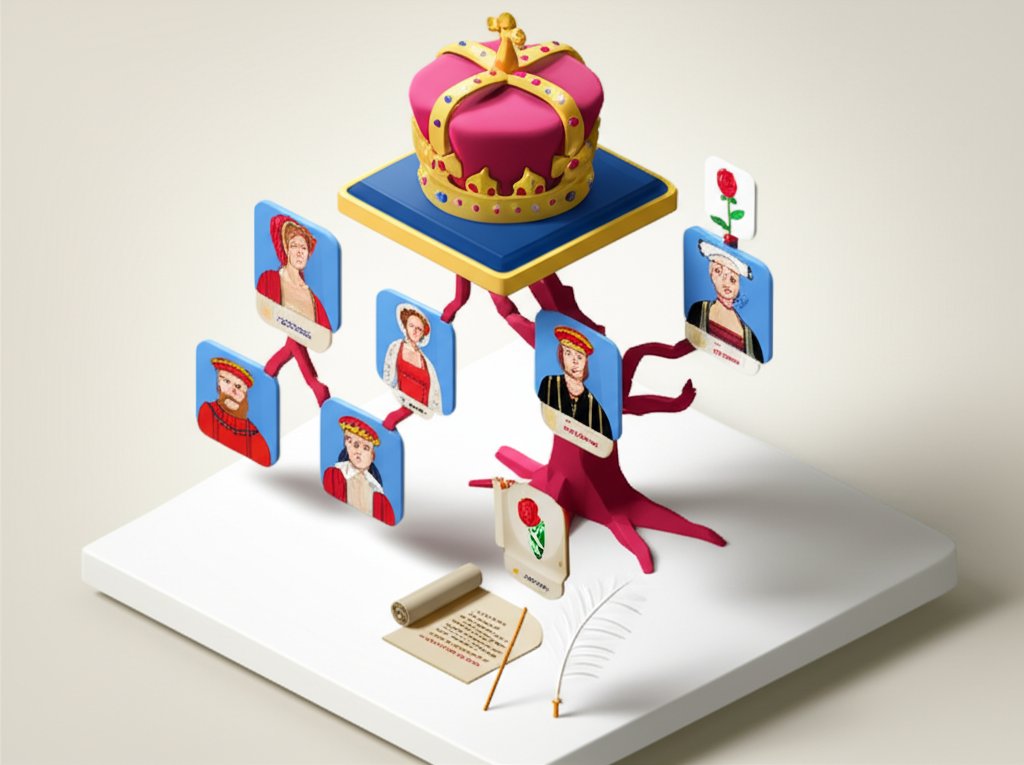
Elizabeth’s refusal to name an heir meant that other branches of the family tree were a constant source of intrigue and threat. Two lines, in particular, held significant claims.
- The Scottish Line (The Stuarts): This line descended from Henry VIII’s older sister, Margaret Tudor, who had married King James IV of Scotland. Her granddaughter, Mary, Queen of Scots, was a Catholic with a powerful claim. For many English Catholics, Mary was the rightful queen, not Elizabeth. After Mary fled Scotland and was imprisoned in England, she became the focus of numerous plots against Elizabeth and was eventually executed in 1587. It was her son, James VI of Scotland, who Elizabeth ultimately, if tacitly, allowed to succeed her.
- The Suffolk Line (The Greys): This line came from Henry VIII’s younger sister, Mary Tudor, who had married Charles Brandon, Duke of Suffolk. Her granddaughters were the three Grey sisters: Lady Jane (the Nine-Day Queen), Catherine, and Mary. After Jane’s execution, Catherine Grey was seen by some as a potential Protestant heir. However, she angered Elizabeth by marrying without royal permission and was imprisoned, dying without her claim ever being realized.
The Tudor story ends where it began: with a question of succession. When Elizabeth I died in 1603, the direct Tudor line died with her.
Quick Answers to Your Tudor Dynasty Questions
Q: Why is it called the “House of Tudor”?
The name comes from Henry VII’s paternal grandfather, Owen Tudor, a Welsh courtier whose original name was Owain ap Maredudd ap Tewdwr. “Tewdwr” was anglicized to Tudor, giving the dynasty its name.
Q: Did Henry VII really have a strong claim to the throne?
No, it was very weak. It was based on his mother’s descent from a legitimized (but barred from the throne) branch of the Lancastrian family. He truly won the crown through military victory and secured it through his marriage to Elizabeth of York, the heir of the rival house.
Q: Were all of Henry VIII’s children considered legitimate?
It’s complicated. Both Mary and Elizabeth were declared illegitimate by Acts of Parliament after their mothers’ marriages were annulled. However, a later Act of Succession in 1543 restored them to the line of succession behind their brother Edward, though without technically re-legitimizing them.
Q: How are the Tudors and Stuarts related?
King James I of England (who was also James VI of Scotland) was the great-grandson of Henry VIII’s older sister, Margaret Tudor. When Elizabeth I died without children, the throne passed to him, peacefully uniting the crowns of England and Scotland under the House of Stuart.
The End of a Dynasty and a Lasting Legacy
The House of Tudor ruled for only 118 years, but its impact was immense. The family tree tells a story of how personal desires directly shaped national destiny. Henry VIII’s desperate need for a son led to a religious revolution that still defines England today. Elizabeth I’s refusal to marry created a decades-long succession crisis that ended with the unification of Great Britain under a Scottish king.
From the bloody fields of Bosworth to the glorious court of the Virgin Queen, the house of tudor family tree is a powerful testament to how five monarchs navigated war, rebellion, and intrigue to leave an indelible mark on world history. The dynasty that began by uniting two warring roses ended by uniting two rival kingdoms.










