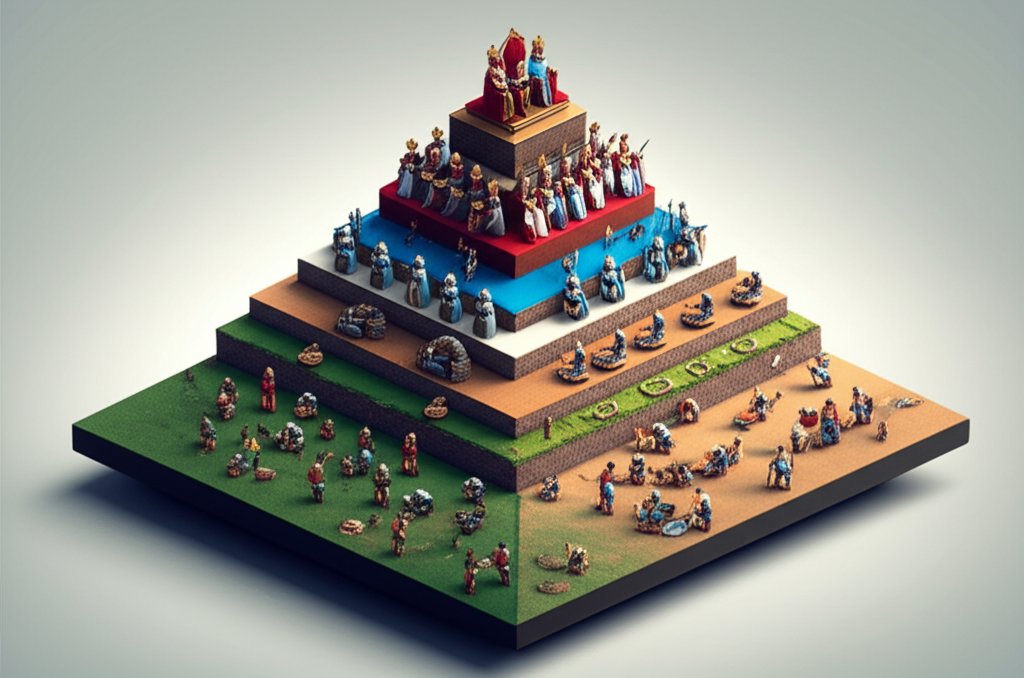
The concept of a career ladder is a modern invention; for most people, the medieval times hierarchy was a fixed cage where you lived and died in the station you were born into. This rigid structure, often justified as God’s divine will, dictated every aspect of life, from your daily meal and the clothes you wore to your legal rights and obligations. Understanding this pyramid of power isn’t just an academic exercise—it’s the key to unlocking why medieval society functioned the way it did.
At a Glance: What You’ll Uncover
- The Three Estates: Go beyond rich vs. poor to understand the medieval worldview of “those who pray, those who fight, and those who work.”
- The Power of Land: Discover how land ownership, not just money, was the ultimate measure of power and the bedrock of the feudal system.
- Sub-Ranks and Nuances: Break down the specific tiers within the nobility and clergy, from a mighty duke down to a local parish priest.
- The Myth of Meritocracy: Learn why social mobility was so rare and the few, treacherous paths that existed for someone to rise above their birth.
- Cracks in the Foundation: Pinpoint the key events, like the Black Death and the rise of merchant guilds, that began to challenge and ultimately dismantle the medieval hierarchy.
The Three Orders: A Divinely Ordained Structure
Medieval society saw itself not as a collection of individuals, but as a unified Christian body with three distinct parts, each with a vital function. This framework, known as the “three estates” or “three orders,” was the ideological backbone of the medieval times hierarchy. It provided a simple, powerful justification for a deeply unequal world.
- The First Estate (Those Who Pray): The Clergy. Tasked with the salvation of everyone’s soul, the Church held immense spiritual and temporal power. They were major landowners, operated their own court system (canon law), and influenced kings and peasants alike.
- The Second Estate (Those Who Fight): The Nobility. The secular rulers, from the king down to the knights, were responsible for justice and defense. Their power was rooted in the control of land, granted by a higher lord in exchange for military service.
- The Third Estate (Those Who Work): The Commoners. This vast majority—over 90% of the population—supported the other two estates with their labor. They farmed the land, produced goods, and paid the taxes and tithes that funded the castles and cathedrals.
This structure was seen as a reflection of heavenly order, a “Great Chain of Being” stretching from God down to the lowest peasant. While this system defines the era, it’s just the top level. To truly grasp how it worked, we need to explore the intricate layers within each group. For a broader overview of how these groups interacted, you can Explore medieval social classes.
Deconstructing the Ruling Classes: Nobility and Clergy
Power in the medieval world wasn’t a single block; it was a complex pyramid of obligation and privilege. Within the First and Second Estates, everyone had a specific place.
The Tiers of Nobility: From King to Knight
The nobility was a military aristocracy. Their entire existence was built on the feudal contract: land in exchange for armed support. Status was everything, and it was clearly defined.
- King/Monarch: At the apex, the king was theoretically the ultimate owner of all land in the realm. In practice, his power depended heavily on the loyalty of his most powerful nobles. A weak king could easily be challenged by an “overmighty” subject like a powerful duke.
- High Nobility (Dukes, Earls, Barons): These were the king’s direct vassals, or tenants-in-chief. They held vast tracts of land (fiefs) and wielded immense regional power, administering justice, minting coins, and raising their own armies from the knights sworn to them.
- Lower Nobility (Knights): Initially just professional mounted soldiers, knights evolved into the lowest rung of the aristocracy. In return for their military service, a lord would grant them a manor—a self-sufficient estate with its own peasant labor. This grant of land, known as a subinfeudation, made them lords in their own right, albeit on a small scale.
Case Snippet: The Second Son’s Dilemma
Consider the second son of a Baron. Under the rule of primogeniture, his older brother inherits the title and lands. What are his options? He can’t farm, as that’s beneath his station. He could become a household knight for a wealthier lord, hoping to win land and a title through valor in battle. Alternatively, his family might secure him a powerful position in the Church, like a bishopric, turning noble influence into ecclesiastical power. This demonstrates how the system forced individuals into pre-defined roles.
The Hierarchy of the Church
The Church mirrored the secular hierarchy with its own rigid structure. Its influence was arguably even more pervasive, touching every person’s life from baptism to burial.
| Church Rank | Role & Responsibilities | Typical Background |
|---|---|---|
| Pope | The head of the Western Church; held supreme authority in matters of faith and wielded immense political power over monarchs. | High-ranking Cardinal |
| Cardinal | “Princes of the Church,” they advised the Pope and elected his successor. Often held major archbishoprics. | High Nobility or influential clergy |
| Archbishop | Governed a large ecclesiastical province (a group of dioceses). Answerable only to the Pope. | High Nobility |
| Bishop | Managed a diocese (a collection of parishes), ordained priests, and administered cathedral lands. A major feudal lord in his own right. | Lower Nobility |
| Priest | Administered a local parish, conducted mass, heard confessions, and performed sacraments for the common people. | Often from the commoner class |
| Monks/Nuns | Lived in monasteries or convents under a specific rule (e.g., Benedictine). Preserved knowledge by copying manuscripts and managed vast agricultural lands. | All classes, but leaders were noble |
| The upper echelons of the clergy were almost exclusively drawn from the nobility, living lives of wealth and power indistinguishable from their secular counterparts. This fusion of religious and worldly power was a defining feature of the medieval times hierarchy. |
The World of the Workers: The Third Estate
The Third Estate was not a uniform mass of poor laborers. It contained its own complex social strata, from the relatively prosperous town merchant to the unfree serf bound to the land.
Peasants: The Unsung Engine of the Economy
Life for the vast majority revolved around the agricultural calendar. Yet, not all peasants were equal.
- Freemen (Yeomen): Some peasants were free. They might own a small piece of land (an allod) or rent land for a fixed payment. They had more legal rights than serfs and could, in theory, leave the manor, though economic reality often made this impossible.
- Serfs (Villeins): The majority of peasants were serfs. They were not property like slaves, but they were legally tied to the land they worked. They could not leave, marry, or even have their children inherit their tools without the lord’s permission. In return for a small plot to farm for their own families, they owed the lord labor service on his personal lands (the demesne) several days a week, plus a share of their own harvest.
The Rise of the Middle Class: Merchants and Artisans
As trade revived in the High Middle Ages, towns and cities became centers of a new kind of wealth based on commerce, not land. This gave rise to a “middle class” of burghers or bourgeoisie.
- Merchants: Traders who built commercial networks across Europe, dealing in goods like wool, wine, and spices. The most successful could become wealthier than many land-poor knights.
- Artisans: Skilled craftsmen like blacksmiths, weavers, carpenters, and stonemasons. To protect their interests, they formed guilds. These powerful organizations controlled prices, set quality standards, and regulated who could practice a trade, creating their own mini-hierarchies of master, journeyman, and apprentice.
The growing economic power of this class was a direct challenge to the feudal order. They sought legal and political independence from feudal lords, often receiving town charters from kings who saw them as a valuable source of cash taxes and a counterbalance to the powerful nobility.
A Quick Guide to Your Place in the System
How can you quickly determine someone’s place in the medieval times hierarchy? Think of it as a simple decision tree based on birth and function.
- Were you born into a family that controls significant land and has a title?
- Yes: You are part of the Nobility (Second Estate). Your life is about warfare, politics, and managing your estates.
- If not, did you take holy vows and join the Church?
- Yes: You are part of the Clergy (First Estate). If from a noble family, you might become a bishop. If a commoner, you’ll likely be a parish priest or monk.
- If not, do you live in a chartered town and practice a trade?
- Yes: You are part of the Middle Class (Third Estate). Your life is governed by your guild and the pursuit of commerce.
- If not, do you live in the countryside and work the land?
- Yes: You are a Peasant (Third Estate). The key question now is freedom:
- Are you tied to the land by law? You are a serf.
- Can you leave the manor (even if you can’t afford to)? You are a freeman.
Quick Answers to Common Questions
Q: Was the king really all-powerful?
No. A medieval king’s power was a constant negotiation. He depended on his major barons for military support. If he pushed them too far with taxes or unpopular policies, they could (and often did) rebel. The Magna Carta in 1215 is a famous example of powerful nobles forcing a king to accept that even he was not above the law.
Q: Did women have any power in this hierarchy?
Women’s power was largely determined by their class and was exercised indirectly. A noblewoman could wield significant influence by managing a castle while her husband was away at war or acting as a regent for an underage son. Matrimonial alliances were key tools of diplomacy. In towns, some widows could take over their husband’s business and guild membership. Peasant women, however, had the fewest rights, yet their labor in the fields and home was essential for survival.
Q: How did the Black Death disrupt the social order?
The plague of the mid-14th century was a catastrophic event that killed 30-50% of Europe’s population. This created a massive labor shortage. Suddenly, serfs and free peasants were in demand. They could demand higher wages and better conditions, and if a lord refused, they could flee to another manor where the lord was desperate for workers. This dramatically weakened the bonds of serfdom and accelerated the shift from a labor-based economy to a cash-based one, fundamentally shaking the medieval times hierarchy.
Q: Were knights just violent thugs?
While their primary role was military, the Church and nobility developed the code of chivalry to civilize this warrior class. Chivalry promoted virtues like courage, loyalty, and the protection of the weak (at least, the weak of their own class). While often more of an ideal than a reality, it created a distinct cultural identity for the knightly class that separated them from common soldiers.
The Unraveling of a Rigid World
The medieval times hierarchy, which seemed so permanent for centuries, was not static. The growing wealth of towns, the intellectual challenges posed by universities, and widespread peasant discontent, like the English Peasant’s Revolt of 1381, all created pressure on the old feudal bonds. The system built on land and loyalty was slowly giving way to one based on money and national identity. While the titles and trappings of the nobility would persist for centuries, the absolute social and economic foundation they rested on was beginning to crack, paving the way for the modern world.










