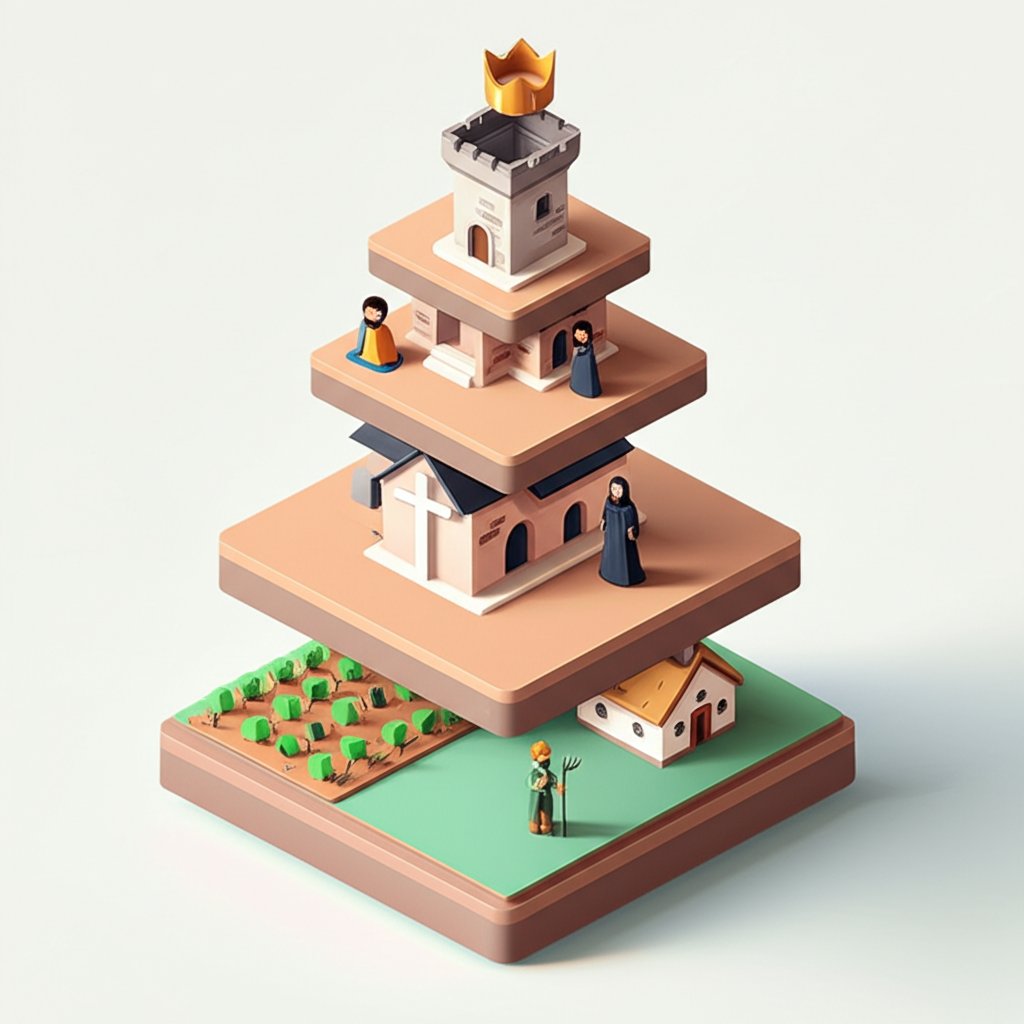
Imagine a world where your entire life—your job, your home, your rights, even whom you could marry—was decided the moment you were born. This wasn’t a fantasy; it was the reality for nearly everyone living under the rigid framework of the three main social classes of medieval Europe. This system, often called the Three Estates, wasn’t just a way to organize society; it was a divinely ordained structure that shaped every aspect of daily existence for centuries after the fall of the Roman Empire.
This wasn’t a ladder you could easily climb. It was a set of distinct, self-contained worlds. Understanding these divisions isn’t just a history lesson; it’s a look into the DNA of Western society, revealing the ancient roots of power, privilege, and inequality.
The Medieval Social Order: At a Glance
Before we dive deep, here’s the basic blueprint of medieval society. Think of it as a pyramid with a king at the very top, divinely appointed to rule over all.
- The First Estate (Those Who Pray): The Clergy. This group included everyone from the Pope and powerful bishops down to humble village priests and monks. They were the spiritual guides of society, but also major landowners and a political force in their own right.
- The Second Estate (Those Who Fight): The Nobility. Comprising kings, lords, and knights, this was the warrior class. They controlled the land, held all the political power, and were expected to provide military protection in exchange for loyalty and service from the lower classes.
- The Third Estate (Those Who Work): The Commoners. This was everybody else—a massive group that made up over 90% of the population. It ranged from peasants and serfs tied to the land to a growing class of merchants and artisans in the towns. They were the engine of the medieval economy.
The World They Inherited: Why This System Arose
After the Roman Empire crumbled in 476 AD, Europe became a patchwork of fragmented, often warring, territories. Chaos was the norm. In this power vacuum, two institutions rose to provide structure: the feudal system and the Catholic Church.
Feudalism was essentially a deal. A king or powerful lord would grant a piece of land, called a fief, to a lesser noble (a vassal). In return, the vassal pledged military service and loyalty. This created a complex web of obligations that cascaded down the social pyramid. The king owned all the land, but he couldn’t manage it alone. He needed warriors to defend it, and those warriors needed people to work it.
This practical arrangement was reinforced by a powerful religious idea: the Great Chain of Being. The Church taught that God had created a natural, unchangeable hierarchy for the entire universe, from God himself down to angels, humans, animals, and even rocks. Questioning your place in society was akin to questioning God’s divine plan.
The First Estate: Those Who Pray
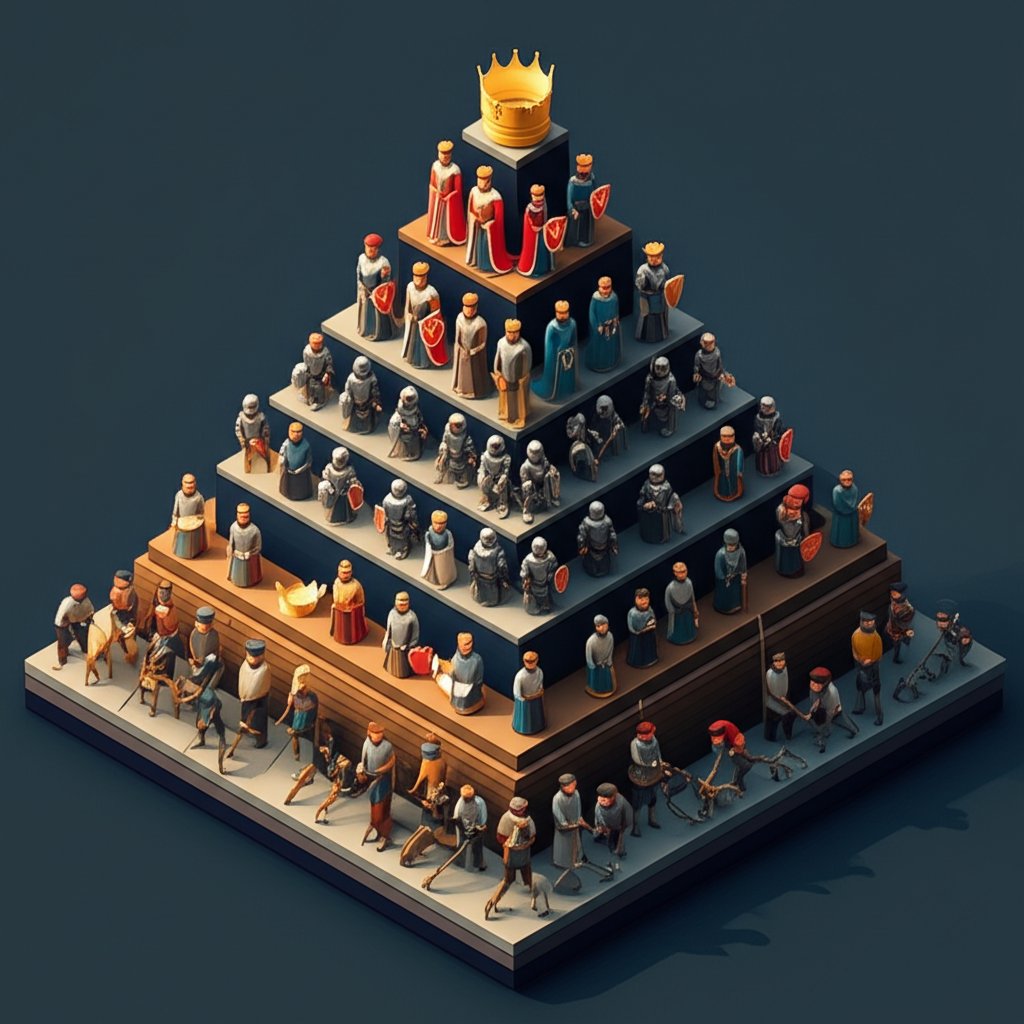
In an age of faith, the clergy held immense power that went far beyond the church walls. They were not just spiritual leaders; they were administrators, educators, and one of the largest landowners in Europe.
The Power of the Church
The Catholic Church was the single most dominant institution of the medieval period. Its influence was absolute, touching every person from the king to the lowliest serf. The clergy administered the sacred rites—baptism, marriage, last rites—that marked the path from birth to death.
They also held the keys to salvation, and with them, the power of discipline. The threat of excommunication, being cast out of the Church, was a terrifying fate that even kings sought to avoid.
A Class Divided: Upper and Lower Clergy
The clergy was not a monolithic group. A vast gulf separated its upper and lower ranks.
- Upper Clergy: Bishops and abbots were often younger sons of noble families. They lived lives of immense wealth and privilege, controlling vast tracts of land and wielding significant political influence. They advised kings, collected taxes (in the form of a tithe, or 10% of a person’s income), and administered their own courts of law.
- Lower Clergy: Parish priests, monks, and nuns came from more humble backgrounds. The village priest was a central figure in peasant life, though he was often barely more educated than his flock. Monks and nuns lived in monasteries and convents, dedicating their lives to prayer, work, and, crucially, the preservation of knowledge by painstakingly copying ancient texts.
The Second Estate: Those Who Fight
The nobility was the military and political ruling class. Their identity was built on land ownership, lineage, and the code of chivalry. At the top sat the king, who in theory held absolute power, but in practice often had to negotiate with his powerful nobles.
Life as a Lord of the Manor
Below the king were the great lords—dukes, counts, and barons—who were granted huge estates. They lived in fortified castles, which served as both a home and the administrative center of their territory. Their primary duty was to raise an army for the king when called upon.
A lord’s life was a mix of governance and leisure. They oversaw their lands, dispensed justice, and collected taxes from the peasants. But they also enjoyed a life of luxury unimaginable to the common person, filled with lavish feasts, tournaments, and hunting expeditions with trained falcons. To get a better sense of this layered world, you can Explore Medieval Social Structure and the intricate relationships that defined it.
The Path of the Knight
Knights were the lowest rank of the nobility, but they were the backbone of the medieval army. Typically the sons of nobles, they began training as young boys, first as pages and then as squires, before being “dubbed” knights.
Their lives were governed by the code of chivalry, which idealized virtues like courage, honor, and courtesy. While the reality was often far more brutal, this code shaped the aristocratic culture of the era. In exchange for their military service, a knight might be granted a small fief of his own, enough to support his family and his expensive military equipment.
The Third Estate: Those Who Work
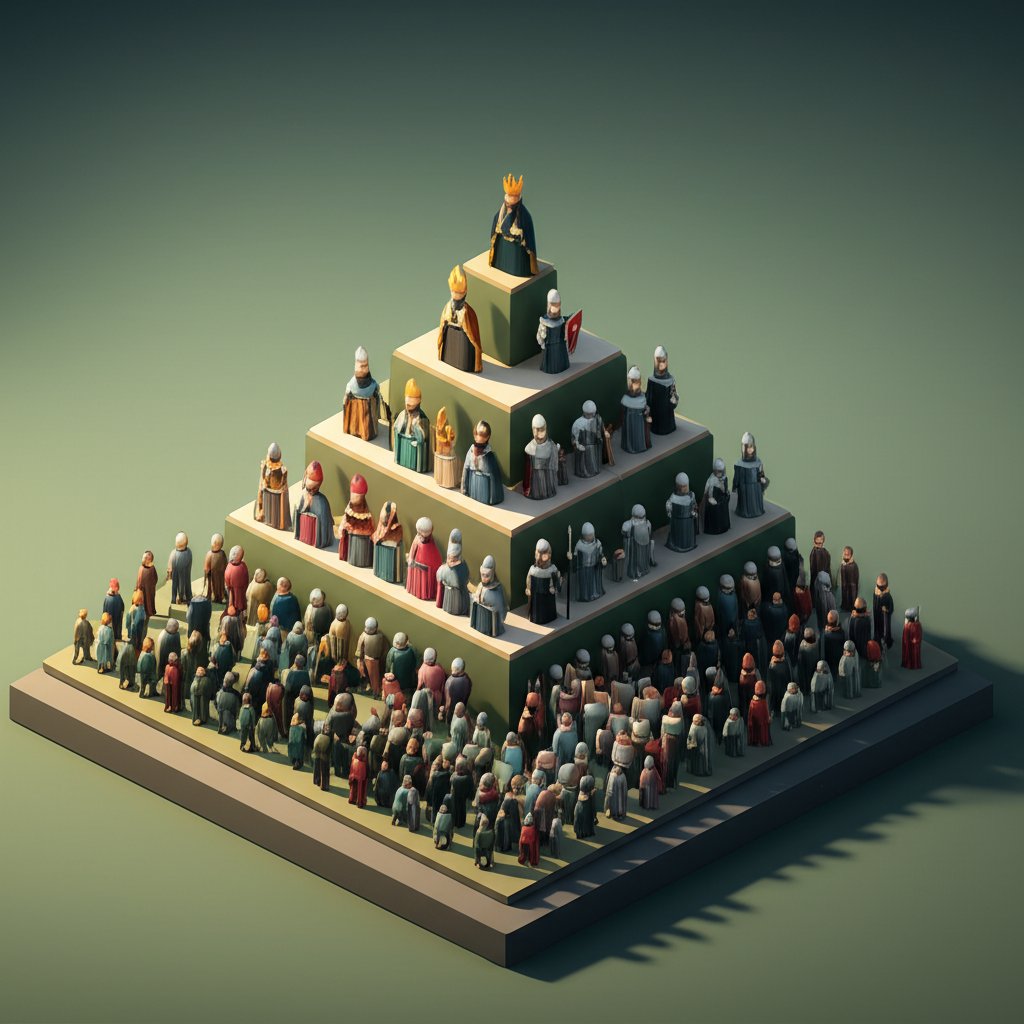
This massive, diverse group formed the base of the social pyramid. They were the farmers, the builders, the makers—the people whose labor funded the lavish lifestyles of the nobility and the grandeur of the Church. For most of history, this group was simply “the peasantry.” But over time, a new and dynamic force emerged within it.
The Vast Majority: Peasants and Serfs
More than 90% of the medieval population were peasants. Their lives were defined by relentless agricultural labor, working the lord’s land from sunup to sundown.
There was a key distinction within this group:
- Peasants: Some were “free” peasants who might own a small plot of land or rent it from the lord. They had more rights than serfs but were still subject to the lord’s authority and taxes.
- Serfs: Most were serfs. A serf was not a slave—they could not be bought or sold—but they were tied to the land. They couldn’t leave the manor, own property, or even get married without the lord’s permission. In exchange for a small plot to farm for their own family, they owed the lord labor service, a share of their crops, and various fees.
Life was short and hard. Their homes were simple one-room huts of wood and mud, often shared with livestock. Their diet was meager, consisting mostly of dark bread, porridge, and whatever vegetables they could grow.
The Rise of the Middle Class
As towns and cities began to grow, a new group of commoners gained prominence: the burghers, or the middle class. They were not defined by land, but by their trade or craft.
- Merchants and Traders: These individuals formed vast trade networks, bringing silks from the East, wool from England, and wine from France to burgeoning city markets. The most successful could become incredibly wealthy, sometimes even rivaling the nobility.
- Artisans and Craftsmen: Skilled workers like blacksmiths, carpenters, weavers, and bakers were the heart of urban production. They organized themselves into guilds—powerful associations that set prices, ensured quality standards, and protected their members’ interests.
The growth of this class was a quiet revolution. Their wealth was based on cash, not land, which slowly began to disrupt the feudal order. This shift in the Explore medieval Europe hierarchy was accelerated dramatically by the Black Death in the mid-14th century, which created labor shortages and gave surviving workers more economic leverage.
Could You Climb the Social Ladder?
For most, the class you were born into was the one you died in. The idea of social mobility was largely foreign, and the system was designed to be rigid. However, the walls between the classes were not entirely impenetrable.
There were a few, narrow paths upward:
- The Church: The clergy was technically open to all, making it one of the only avenues for a bright, ambitious peasant boy to rise to a position of power.
- Exceptional Military Service: A common soldier who displayed extraordinary bravery could, on rare occasions, be knighted on the battlefield.
- Commerce and Trade: A successful merchant could accumulate enough wealth to buy land and marry into the lower echelons of the cash-strapped nobility.
Cracks in the Foundation
Despite its rigidity, the system faced challenges. The Peasants’ Revolt in England in 1381, sparked by a hated poll tax, showed that the Third Estate was not always passive. Though brutally suppressed, the uprising sent a shockwave through the ruling classes.
Furthermore, the Church’s own teachings on the equality of all souls before God subtly undermined the earthly hierarchy. As cities grew and the merchant class gained power, the old feudal bonds based on land and loyalty began to fray, paving the way for a new kind of society. Gaining a clearer picture of these dynamics is key to Understanding medieval hierarchy and its eventual transformation.
Gender Roles: A Different World for Men and Women
Across all three classes, medieval society was deeply patriarchal. Women had few legal rights and were considered subordinate to men—first their fathers, then their husbands. However, their roles and influence varied significantly by class.
| Class | Role of Men | Role of Women |
|---|---|---|
| Nobility | Expected to be skilled warriors, leaders, and managers of their estates. Their primary duty was to fight for their king or lord. | Responsible for managing the vast household, overseeing servants, and raising children. When their husbands were away at war, noblewomen often ran the entire estate. Marriages were strategic alliances. |
| Middle Class | Ran the family business, whether as a merchant or a master craftsman. They participated in city governance and guild leadership. | Often worked alongside their husbands in the family shop or trade. A widow could legally inherit and run her husband’s business, giving them a degree of economic independence rare for the time. |
| Peasantry | Performed the heavy agricultural labor: plowing, planting, and harvesting. They also owed labor service to the lord. | Worked in the fields alongside men, especially during peak seasons, while also being solely responsible for childcare, cooking, weaving cloth, and tending the family’s small garden. |
Common Questions About Medieval Social Classes
Q: What were the “three orders” of medieval society?
The three orders were a simple model used in the Middle Ages to describe their social structure: Oratores (those who pray), Bellatores (those who fight), and Laboratores (those who work). This corresponds to the Clergy, the Nobility, and the Commoners.
Q: Could a peasant really become a knight?
It was extremely rare, but not impossible. The most likely scenario was for a commoner serving as a man-at-arms to be knighted for exceptional bravery in a specific battle. However, the costs of armor, a warhorse, and training made it a nearly insurmountable barrier for someone without a noble patron.
Q: Was the “middle class” a real concept in the Middle Ages?
They wouldn’t have used the term “middle class,” but the group we identify as such—merchants, master artisans, and wealthy town-dwellers (burghers)—was a very real and growing force, especially in the High and Late Middle Ages. They existed outside the traditional feudal structure of lord and peasant and their economic power was a major catalyst for social change.
The Enduring Legacy of the Three Estates
The rigid, three-tiered social structure of medieval Europe did not vanish overnight. It slowly eroded as new economic realities, intellectual currents like the Renaissance, and political upheavals began to reshape the continent.
But its echo can still be heard. The concepts of class, the tension between inherited wealth and earned merit, and the struggle for social mobility are all themes that grew out of this ancient system. By understanding the three estates, we gain a clearer view of the deep historical forces that have shaped our modern world, reminding us that the way society is organized is never permanent and is always ripe for change.










