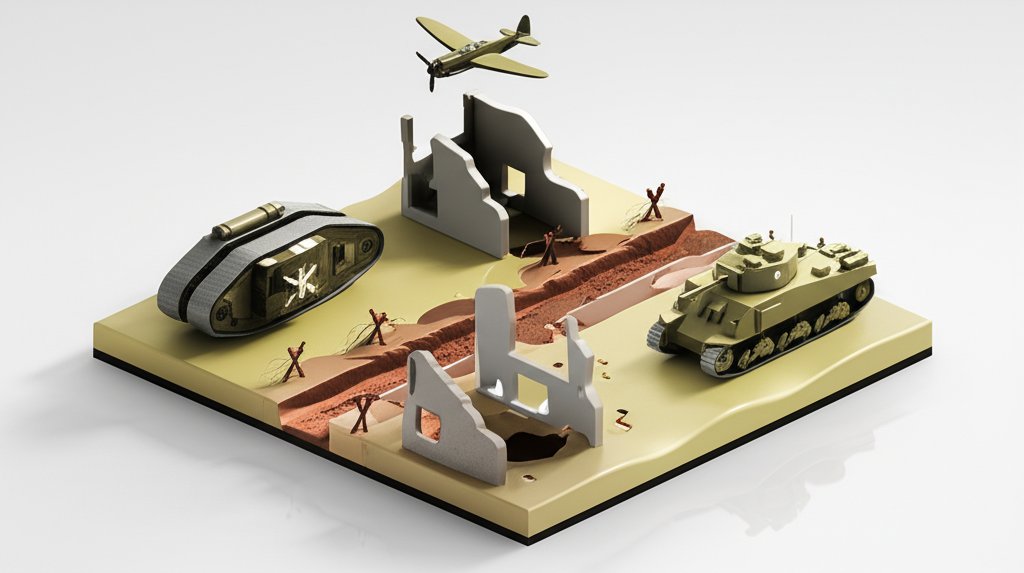
The stark difference in the fight between world war 1 vs world war 2 can be captured in two images: a soldier in 1916, huddled in a muddy trench, waiting for a whistle to send him into a hail of machine-gun fire; and a paratrooper in 1944, descending from the sky behind enemy lines to sow chaos before a massive armored invasion. In just two decades, the very nature of combat underwent a revolution, moving from a static, grinding war of attrition to a dynamic, multi-domain war of movement and technology.
This wasn’t just about better guns or bigger bombs. It was a fundamental shift in military thinking, strategy, and the technologies that enabled them. Understanding this evolution is key to grasping how these conflicts redefined the 20th century and continue to influence global military doctrine today.
At a Glance: The Evolution of Modern Combat
Before we dive deep, here’s what you need to know about the transformation of warfare between the two global conflicts:
- From Static to Dynamic: Warfare broke out of the trenches. WWI was defined by static defensive lines, whereas WWII was a war of movement, maneuver, and encirclement.
- The Rise of Air Power: Aircraft evolved from fragile reconnaissance tools in WWI to a decisive strategic and tactical force in WWII, capable of winning battles and crippling nations.
- A New King of the Seas: The battleship, the undisputed ruler of the waves in WWI, was dethroned by the aircraft carrier, which could project power hundreds of miles beyond the horizon.
- Combined Arms Doctrine: WWII saw the mastery of “combined arms”—the synchronized use of infantry, armor, artillery, and air power. This was the engine behind the German Blitzkrieg.
- The Battlefield Expanded: The lines blurred between the front lines and the home front, as strategic bombing and ideological warfare targeted civilian populations and infrastructure on an unprecedented scale.
From Stalemate to Blitzkrieg: The Revolution on Land
The ground combat of World War I was a brutal lesson in the supremacy of defense. The combination of barbed wire, machine guns, and massed artillery created a “no man’s land” that was nearly impossible to cross, leading to the infamous stalemate of trench warfare. Armies measured progress in yards, at the cost of hundreds of thousands of lives.
The core problem was that offensive tactics hadn’t caught up with defensive technology. Generals still relied on massive infantry assaults, which were tragically ineffective against entrenched machine guns.
World War II’s Answer: The “Lightning War”
Frustrated by the memory of this deadlock, German military theorists developed a radical new approach: Blitzkrieg, or “lightning war.” This wasn’t just about using tanks; it was a sophisticated doctrine of combined arms.
Here’s how it worked in practice, like during the 1940 invasion of France:
- Concentration of Force: Instead of attacking all along the line, armored divisions (Panzers) were concentrated at a single weak point (Schwerpunkt).
- Air Support: Dive bombers, like the terrifying Ju-87 “Stuka,” acted as flying artillery, smashing enemy strongpoints and communication lines just ahead of the armored spearhead.
- Breakthrough & Exploitation: Once the tanks broke through, they didn’t stop to fight pockets of resistance. They drove deep into the enemy’s rear, cutting supply lines and surrounding entire armies.
- Encirclement: Motorized infantry followed close behind the tanks to mop up the encircled and now-disorganized enemy forces.
This doctrine turned the tank from a slow-moving infantry support weapon of WWI into the decisive offensive tool of WWII.
The Evolution of the Tank
The contrast between the tanks of each war perfectly illustrates this tactical shift.
| Feature | World War I Tank (e.g., British Mark IV) | World War II Tank (e.g., German Panzer IV) |
|---|---|---|
| Primary Role | Trench-crosser, infantry support | Armored spearhead, anti-tank combat |
| Speed | ~4 mph (walking pace) | ~25 mph (on-road) |
| Armament | Machine guns or small cannons in side sponsons | Turret-mounted, high-velocity cannon |
| Communication | Pigeons, hand signals | Two-way radio in every vehicle |
| Impact | Psychological novelty, limited tactical success | Decisive weapon, core of offensive doctrine |
| The simple addition of a radio in every tank was a game-changer. WWI tanks were effectively blind and deaf once they went into battle. WWII tank commanders could coordinate movements on the fly, responding to threats and opportunities in real time. |
Ruling the Waves: The Shift in Naval Power
In World War I, naval power meant one thing: massive, heavily armored battleships known as “Dreadnoughts.” The main goal was to seek a decisive fleet-on-fleet engagement, as seen in the Battle of Jutland (1916), where the British and German fleets pounded each other with enormous guns. While U-boats posed a deadly threat to merchant shipping, the battleship remained the undisputed symbol of naval might.
The Aircraft Carrier Takes Center Stage
By World War II, this had completely changed. The rise of naval aviation made the aircraft carrier the new queen of the seas. A single carrier could launch dozens of aircraft armed with bombs and torpedoes, projecting force over a vast area.
The Battle of Midway in 1942 is the classic example. The American and Japanese fleets never fired their main guns at each other; in fact, they never even saw each other. The entire battle was fought by their carrier-launched aircraft. The US Navy, by sinking four of Japan’s best carriers, permanently shifted the balance of power in the Pacific. This dramatic change in naval strategy was just one of many fundamental distinctions between the two conflicts. To understand the full scope of their differences, from political causes to human cost, you can Explore WWI vs WWII differences.
The Sky Becomes a Battlefield: The Ascent of Air Power
If the tank defined the new way of war on land, the airplane defined it everywhere else. The difference in aviation between the two wars is perhaps the most staggering.
WWI’s Nascent Air Forces: Eyes in the Sky
In WWI, aircraft were a novelty. Made of wood and fabric, their roles were limited:
- Reconnaissance: Flying over the trenches to spot enemy positions and direct artillery fire. This was their most important job.
- Dogfighting: Early fighter pilots in their biplanes engaged in duels that were more chivalrous spectacle than strategically decisive.
- Limited Bombing: Small, hand-dropped bombs had minimal impact on the course of the ground war.
WWII’s Decisive Air Armies
In WWII, air power became a co-equal branch of the military, capable of winning or losing the war on its own. Its role expanded into three critical domains:
- Tactical Air Power: This is air power in direct support of ground troops. The Stuka dive-bombers of the Blitzkrieg are the prime example, acting as precision artillery on call.
- Strategic Bombing: This was a new and brutal concept: long-range bombers flying deep into enemy territory to destroy factories, oil refineries, railways, and cities themselves. The goal was to cripple the enemy’s ability and will to fight.
- Air Superiority: This was the fight to control the sky. As the Battle of Britain proved, if you couldn’t achieve air superiority, you couldn’t mount a successful invasion or protect your homeland from attack. Control of the air enabled everything else.
The Unseen Front: Intelligence and Technology
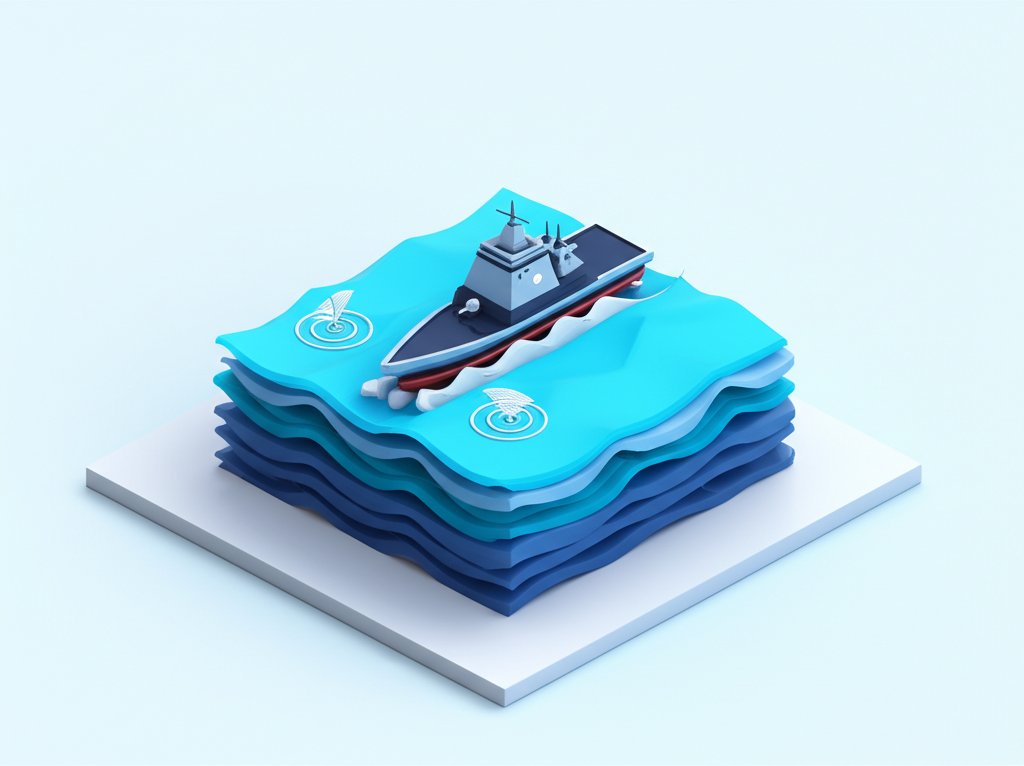
Beyond the visible clash of armies, a hidden war was being fought with radio waves, codes, and scientific breakthroughs.
WWI: Simpler Signals and Ciphers
WWI intelligence relied heavily on traditional espionage, reconnaissance patrols, and rudimentary signals intelligence. Breaking codes happened—the interception of the Zimmermann Telegram was a major coup that helped bring the US into the war—but it wasn’t a systematic, war-winning enterprise.
WWII: The High-Stakes Game of Radar, Sonar, and Code-Breaking
WWII was a war of technology. The side that could innovate faster often gained a temporary, but critical, edge.
- Radar (Radio Detection and Ranging): This British invention was the secret weapon of the Battle of Britain. It allowed the outnumbered Royal Air Force to “see” incoming German bomber formations from far away, scramble their fighters efficiently, and meet them at the right time and place.
- Sonar (Sound Navigation and Ranging): This was radar’s underwater cousin. Allied warships used sonar to detect and hunt German U-boats, a critical tool in winning the long and brutal Battle of the Atlantic.
- Cryptography: The effort to break enemy codes was a massive, industrial-scale operation. The Allied success in breaking Germany’s “unbreakable” Enigma machine cipher (codenamed ULTRA) gave commanders an unprecedented window into German plans. Historians estimate that ULTRA may have shortened the war in Europe by as much as two years.
- The Atomic Bomb: The Manhattan Project represents the ultimate technological game-changer. The use of nuclear weapons on Hiroshima and Nagasaki not only ended the war in the Pacific but also ushered in a new, terrifying age of potential global annihilation, setting the stage for the Cold War.
Quick Answers: Clearing Up Common Questions
Q: Was World War II just a continuation of World War I?
A: No. While WWI’s unresolved issues and the harsh Treaty of Versailles certainly created the conditions for WWII, the second conflict was fundamentally different. It was driven by aggressive, expansionist ideologies like Fascism and Nazism and was fought with entirely new military doctrines and technologies that made it a true “world” war in scope and movement.
Q: Were tanks really that important in WWI?
A: They were a revolutionary idea but not a decisive weapon. Early tanks were mechanically unreliable, painfully slow, and often misused in penny-packet assaults. They showed potential and terrified German soldiers, but they failed to break the stalemate of the trenches in the way their WWII successors broke entire countries.
Q: Did poison gas use disappear after WWI?
A: On the conventional battlefields between major powers, yes. The fear of massive and immediate retaliation with the same weapons created a powerful deterrent. However, chemical agents were used by Italy in Ethiopia and, most horrifically, were employed as a tool of genocide in the gas chambers of the Holocaust.
Q: What was the single biggest technological leap between the wars?
A: While radar and the atomic bomb are strong contenders, the most transformative leap was arguably the maturation and integration of the internal combustion engine and the radio. This combination powered the tanks, planes, and ships of WWII and, crucially, allowed them to be coordinated in real time. This duo was the engine of Blitzkrieg and the foundation of modern mobile warfare.
From Attrition to Annihilation
The journey from the trenches of the Somme to the nuclear dawn over Hiroshima was more than just a technological progression; it was a complete reimagining of warfare. World War I was a horrifying industrial war of attrition, where victory was about out-producing and out-lasting the enemy in a static meat grinder.
World War II became a war of maneuver and annihilation, driven by speed, coordination, and technology. The goal was no longer just to push the enemy back but to shatter his armies, destroy his industrial capacity, and break his national will. This brutal evolution in combat set the stage for the superpower standoff of the Cold War and laid the foundations of the military doctrines that still shape our world today.










