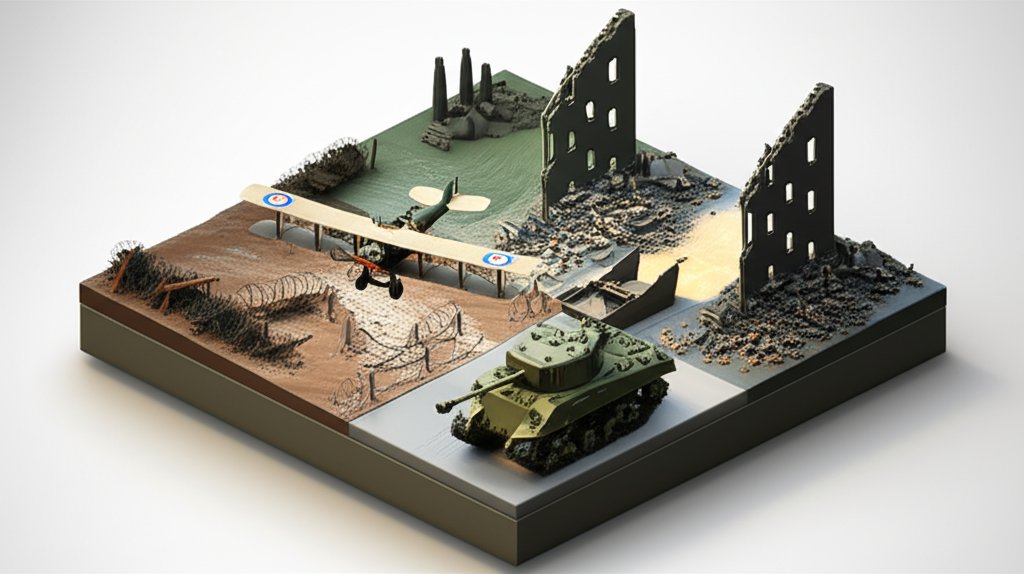
At first glance, they can blur together—two catastrophic global conflicts that defined the 20th century. When we compare ww1 vs ww2, we often think of grainy black-and-white footage, sprawling battlefields, and a world torn apart. Yet, these two wars were profoundly different beasts, separated by a generation but worlds apart in their causes, conduct, and consequences.
World War I was the “war to end all wars,” a brutal, grinding conflict that shattered empires and introduced industrial-scale slaughter. World War II, in many ways its monstrous offspring, was a war of ideology and annihilation, fought on a truly global scale with terrifying new technologies. Understanding the distinction isn’t just an academic exercise; it’s about grasping how the first war’s unresolved trauma directly fueled the second, creating a chain reaction that still shapes our modern world.
At a Glance: The Core Differences
For those short on time, here’s the essential breakdown of what set the two world wars apart.
- The Cause: WWI ignited from a complex web of alliances, nationalism, and imperial rivalries, sparked by a single assassination. WWII was a direct result of the unresolved issues of WWI, fueled by aggressive ideologies like Nazism and Japanese militarism.
- The Fighting Style: WWI is defined by static trench warfare, a horrifying meat grinder of attrition. WWII was a war of movement, featuring advanced tanks, aircraft, and naval fleets, characterized by tactics like Germany’s Blitzkrieg (“lightning war”).
- The Technology: While WWI introduced tanks, chemical weapons, and primitive aircraft, WWII saw these technologies perfected and combined with radar, code-breaking computers, and the atomic bomb.
- The Global Scope: WWI was primarily a European conflict with battles in its colonies. WWII was a truly global war, with major fronts across Europe, North Africa, Asia, and the Pacific Ocean.
- The Human Cost: The scale of death in WWII dwarfs that of WWI. WWI caused an estimated 16 million deaths, mostly soldiers. WWII claimed between 70 and 85 million lives, the majority of whom were civilians, due to strategic bombing, massacres, and the Holocaust.
The Spark vs. The Slow Burn: How Each War Began
You can’t understand a conflict without knowing why the first shots were fired. Here, the two wars diverge dramatically. One was a domino effect nobody could stop; the other was a deliberate march to conquest.
WWI: A Tangle of Treaties and a Single Gunshot
Think of early 20th-century Europe as a room filled with gas leaks. Nations were bound by a complex, almost nonsensical, web of mutual defense pacts. The prevailing forces of M.A.I.N.—Militarism, Alliances, Imperialism, and Nationalism—had created a powder keg.
- Militarism: European powers were locked in an arms race, building massive armies and navies.
- Alliances: A promise to defend one nation meant you were suddenly at war with another. The two main camps were the Central Powers and the Allied Powers.
- Imperialism: Competition for colonies and resources bred deep-seated rivalries.
- Nationalism: Intense pride and ethnic tensions, particularly in the Balkan region, created constant friction.
The spark that lit this fuse was the assassination of Archduke Franz Ferdinand of Austria-Hungary on June 28, 1914, by a Serbian nationalist. Austria-Hungary declared war on Serbia. Russia, allied with Serbia, mobilized its troops. Germany, allied with Austria-Hungary, declared war on Russia. France and Britain were then pulled in, and within weeks, the continent was ablaze. It was a tragic, almost automatic, slide into catastrophe.
WWII: The Unfinished Business of the Great War
If WWI was an accident waiting to happen, WWII was a calculated crime. Its roots lie directly in the bitter soil of the first war’s end.
The Treaty of Versailles (1919), which officially ended WWI, was designed to punish Germany. It imposed crippling war reparations, stripped Germany of its colonies and territory, and forced it to accept full blame for the war. This “war guilt clause” created a deep and lasting resentment among the German people.
This economic despair and national humiliation created fertile ground for extremist ideologies. In Italy, Benito Mussolini’s fascism rose. In Germany, Adolf Hitler and the Nazi Party promised to restore German greatness. Meanwhile, in Asia, an expansionist Japanese Empire sought to dominate the Pacific.
Unlike WWI’s sudden trigger, the start of WWII was a series of escalating aggressions that the world watched with growing dread:
- Japan’s invasion of Manchuria (1931).
- Italy��s invasion of Ethiopia (1935).
- Germany’s re-militarization and annexation of Austria and parts of Czechoslovakia (1936-1938).
Western powers, haunted by the memory of WWI, pursued a policy of appeasement, giving in to Hitler’s demands in the hope of avoiding another war. The final straw came on September 1, 1939, when Germany invaded Poland. This time, Britain and France drew the line, and the world was once again at war. This fascinating contrast between World War 1 vs World War 2 highlights how history doesn’t just repeat, it often rhymes with devastating consequences.
Lines in the Sand: Who Fought Who?
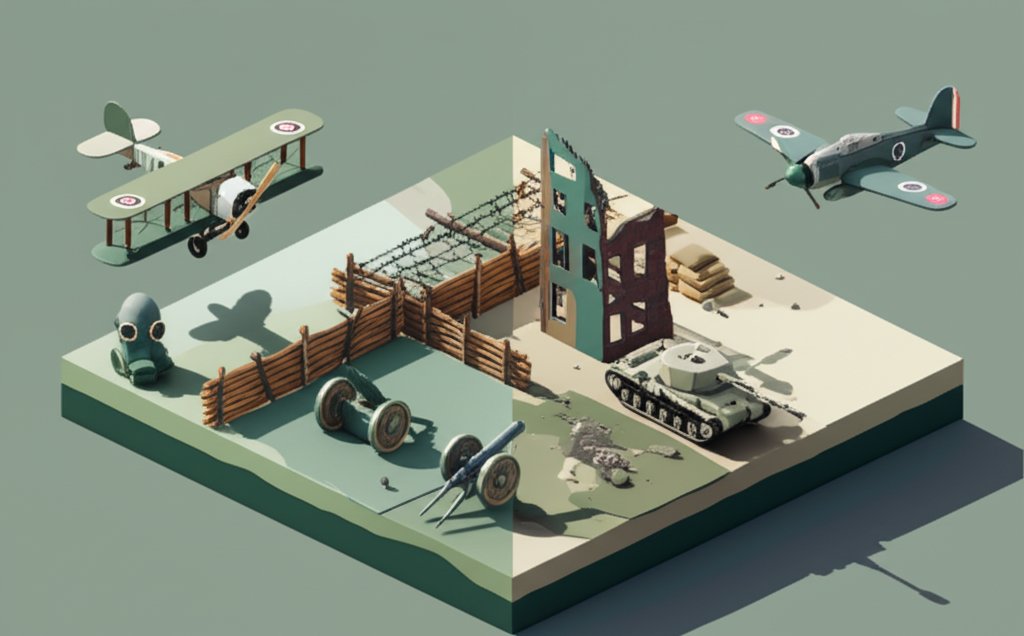
The cast of characters in each war was slightly different, with allegiances shifting in the 20 years between them.
The Alliances of World War I
The two opposing sides were:
- The Central Powers: Led by Germany and Austria-Hungary, they were later joined by the Ottoman Empire and Bulgaria. Their central geographic location gave them their name.
- The Allied Powers (The Entente): Originally a core of France, Great Britain, and Russia. They were later joined by many other nations, including Italy (which switched sides), Japan, and, crucially, the United States in 1917.
The Alliances of World War II
The conflict was primarily between:
- The Axis Powers: A formal military alliance between Germany, Italy, and Japan. They were united by their aggressive, expansionist ideologies.
- The Allied Powers: The “Big Three” were Great Britain, the United States, and the Soviet Union. They were joined by France, Canada, China, and numerous other countries united against Axis aggression.
Notably, the Soviet Union initially signed a non-aggression pact with Nazi Germany in 1939, only to be betrayed and invaded by Hitler in 1941, at which point it joined the Allies. This ideological flexibility demonstrates the pragmatic and desperate nature of the alliances in WWII.
Mud and Steel vs. Lightning and Atoms: A Revolution in Warfare
Perhaps the most dramatic difference when examining ww1 vs ww2 is how the fighting was done. The battlefield of 1918 was almost unrecognizable compared to that of 1944.
WWI: The Static Horror of the Trenches
World War I was defined by trench warfare. After the initial German advance into France was halted, both sides dug in, creating a vast, static network of trenches stretching for 475 miles from the Swiss border to the North Sea.
Life in the trenches was a nightmare of mud, disease, and constant shelling. The military strategy was one of attrition—generals would order massive frontal assaults “over the top,” sending waves of soldiers across No Man’s Land directly into machine-gun fire, often for gains of only a few hundred yards.
This war introduced several new technologies, but they were often used crudely:
- Machine Guns: Perfected for defense, they made frontal assaults nearly suicidal.
- Artillery: Massive cannons could pound enemy lines for days on end, but rarely achieved a decisive breakthrough.
- Poison Gas: A horrifying new weapon that caused agonizing death, but its effectiveness was limited by wind and gas masks.
- Tanks: Introduced by the British, they were slow, clumsy, and mechanically unreliable, though they showed future promise.
- Aircraft: Used primarily for reconnaissance, their role in combat was just beginning.
WWII: A War of Motion and Technology
World War II was a war of movement. Technology had not just improved; it had fundamentally changed strategy. The goal was no longer to just outlast the enemy but to overwhelm and encircle them.
Germany’s Blitzkrieg, or “lightning war,” perfectly encapsulated this new approach. It involved a coordinated, fast-moving attack using:
- Air Power: Dive bombers (like the Stuka) would terrorize and disrupt enemy defenses.
- Armored Divisions: Concentrated columns of advanced, fast tanks (Panzers) would punch through the front lines.
- Motorized Infantry: Soldiers in trucks and half-tracks would follow close behind to secure the captured territory.
This was a three-dimensional war. Naval battles were decided by aircraft carriers launching planes hundreds of miles from their targets. Submarines, or U-boats, hunted in “wolf packs” to strangle supply lines. In the air, massive bombing campaigns leveled entire cities. The entire dynamic of world war one vs world two was about speed and combined-arms tactics.
The technological leap was immense:
- Aircraft: Advanced from flimsy biplanes to long-range bombers like the B-17 and swift, deadly fighters like the Spitfire and Messerschmitt Bf 109.
- Tanks: Evolved from slow-moving novelties into the decisive weapon on the ground, with legendary models like the German Tiger and the Soviet T-34.
- Radar and Sonar: Gave the Allies a critical edge in detecting enemy planes and submarines.
- Code-breaking: Allied efforts at Bletchley Park to crack Germany’s Enigma code were instrumental in winning the war.
- The Atomic Bomb: The war culminated in the ultimate weapon, used by the U.S. against Hiroshima and Nagasaki, ushering in the nuclear age.
The Unthinkable Human Cost
While both wars were tragic, the scale and nature of death in WWII were unprecedented in human history.
In World War I, an estimated 16 million people died. The vast majority of these were soldiers killed in combat. Civilian deaths were significant, but they were often a byproduct of the fighting—starvation, disease, or being caught in the crossfire.
In World War II, the death toll skyrocketed to an estimated 70 to 85 million people. What’s more shocking is that for the first time in a major conflict, civilians were the primary victims, outnumbering military deaths perhaps two to one.
This was due to several factors:
- Strategic Bombing: Both sides targeted industrial and civilian centers to destroy morale and war-making capacity.
- Ideological Brutality: The war on the Eastern Front between Nazi Germany and the Soviet Union was a war of extermination, with immense cruelty on both sides.
- The Holocaust: This was not a byproduct of war but a central goal of the Nazi regime. The systematic, state-sponsored genocide of six million Jews, along with millions of other minorities, is a crime unique to this conflict.
The sheer destructiveness of WWII was on another level. The war left Europe in ruins, with one study estimating that 70% of its industrial infrastructure was destroyed.
The Aftermath: Reshaping the World Order
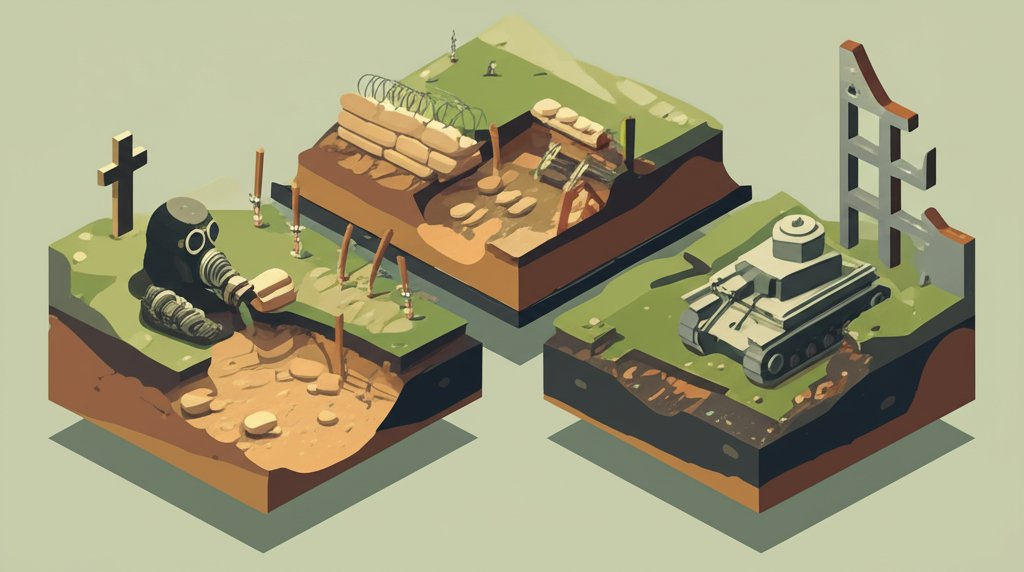
The end of each war redrew the map of the world, but in vastly different ways.
WWI’s Legacy: A Flawed Peace and Fallen Empires
The end of WWI saw the collapse of four massive empires: the German, the Austro-Hungarian, the Ottoman, and the Russian. In their place, new countries were carved out, and a new international body, the League of Nations, was created to prevent future wars.
However, the peace was built on a shaky foundation. The punitive Treaty of Versailles sowed the seeds of future conflict, and the League of Nations proved powerless to stop the aggression of the 1930s because it had no military force to back its decisions.
WWII’s Legacy: A New Superpower Era and the Cold War
WWII ended with the total, unconditional surrender of the Axis powers. The old European powers, like Britain and France, were victorious but financially and militarily exhausted. The world that emerged was dominated by two new, ideologically opposed superpowers: the democratic, capitalist United States and the communist Soviet Union.
The “peace” that followed was the Cold War, a 45-year global standoff between these two blocs. A new, more robust international body, the United Nations (UN), was formed with the authority to deploy peacekeeping forces. The war also accelerated the end of colonialism, as weakened European empires could no longer maintain control over their colonies in Africa and Asia.
Common Questions, Answered
Let’s tackle some of the most frequent questions people have about these two conflicts.
Was WWII just a continuation of WWI?
In many ways, yes. Most historians agree that the harsh terms of the Treaty of Versailles and the failure to create a stable post-WWI order were direct causes of WWII. French Marshal Ferdinand Foch famously said of the treaty in 1919, “This is not peace. It is an armistice for 20 years.” He was almost exactly right.
Which war was more “brutal”?
This is subjective, but both were brutal in different ways. The day-to-day conditions of trench warfare in WWI—the constant shelling, mud, rats, and disease—were arguably a unique form of prolonged misery. However, the sheer scale of civilian slaughter, the genocidal horrors of the Holocaust, and the destructive power of the atomic bomb make WWII the deadliest and arguably most brutal conflict in human history.
Why did the US enter each war so late?
In both wars, the United States initially maintained a policy of isolationism, preferring to stay out of what it viewed as European conflicts.
- In WWI, the U.S. entered in 1917 after Germany’s unrestricted submarine warfare (which sank American ships) and the Zimmermann Telegram, a secret German proposal to Mexico to attack the U.S.
- In WWII, the U.S. entered in 1941 only after the Japanese Empire launched a direct surprise attack on the American naval base at Pearl Harbor.
Two Wars, One Story
To see WWI and WWII as separate, isolated events is to miss the tragic narrative that connects them. The Great War was a continental slaughter born of old-world arrogance and tangled alliances. It ended not with a stable peace, but with a ceasefire that festered for two decades, breeding resentment and radical ideologies that would erupt into a second, even more terrible global conflagration.
Understanding the differences between them—the static trenches vs. the lightning-fast blitz, the collapsed empires vs. the new superpowers, the tragic blunder vs. the ideological crusade—is to understand the most violent and transformative half-century in the history of humankind. They are not just chapters in a history book; they are the crucible in which our modern world was forged.










