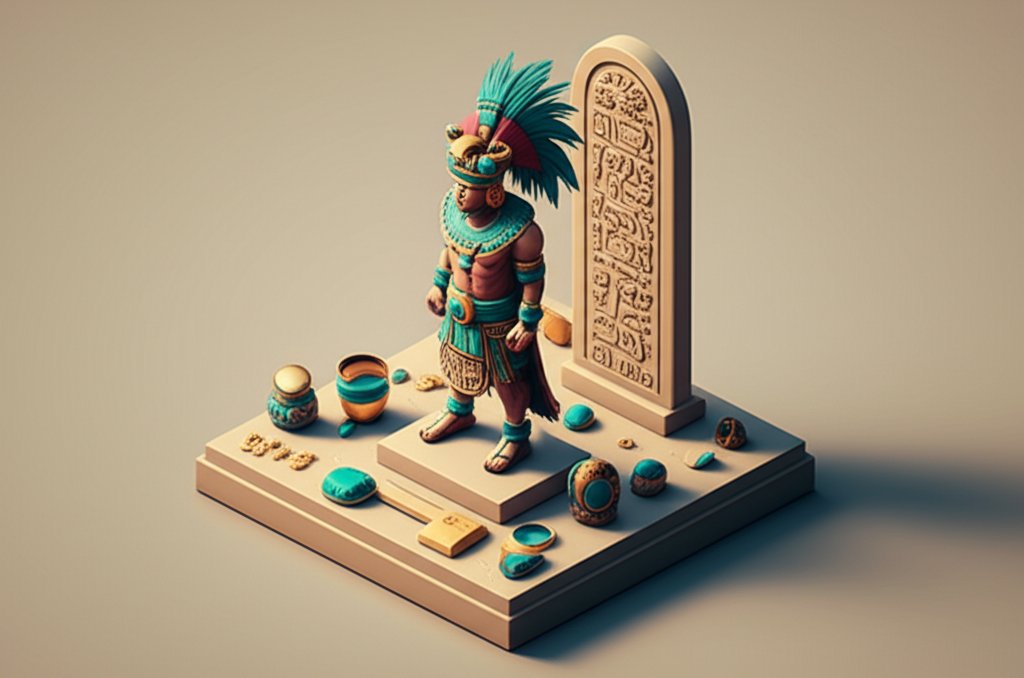
The image of ancient Maya leaders is often one of serene priests atop towering pyramids, but the reality was far more demanding and perilous. These rulers, known as k’uhul ajaw or “holy lords,” were not just figureheads; they were the absolute center of political, military, and spiritual life in their city-states. To fail in any one of these domains was to risk not just losing a war, but losing the divine mandate that legitimized their entire dynasty, often with fatal consequences.
Understanding these multifaceted rulers requires looking beyond the stone carvings and seeing them as executives of complex societies, balancing cosmic duties with the brutal pragmatism of statecraft. They were expected to be fierce warriors, shrewd politicians, and living conduits to the gods—a job description with impossibly high stakes.
At a Glance: The Maya Ruler’s Playbook
This article breaks down the essential functions and strategies of Maya rulership. You’ll learn:
- How leaders used religious rituals and monumental construction to prove their divine right to rule.
- Why military victory was a non-negotiable part of a king’s responsibilities.
- The economic levers, like controlling trade routes, that leaders used to centralize power.
- What happened during a succession crisis and how new dynasties were established.
- The symbolic importance of regalia, from jaguar-pelt thrones to elaborate feathered headdresses.
- Key differences between famous rulers and how they embodied the ideal of the divine warrior-king.
The Divine Mandate: Ruling by the Gods’ Will
A Maya ruler’s primary source of authority was not derived from popular consent but from a direct, inherited connection to the gods. This divine sanction was the bedrock of their power, and it required constant, public reinforcement. Without it, their political and military authority would crumble.
Maya leaders were seen as intermediaries between the mortal world and the supernatural realm. This unique position gave them both immense power and a heavy burden. They were responsible for ensuring the cosmos remained in balance, crops grew, and the kingdom was protected from divine wrath.
How They Proved Their Divinity
Maintaining this sacred status was an active, lifelong performance involving complex rituals and grand architectural projects.
- Public Bloodletting Rituals: The most potent rituals involved the ruler publicly shedding their own blood. The king, often accompanied by his wife, would use stingray spines or obsidian blades to perforate their tongue, ears, or other body parts. This blood was collected on paper and burned as an offering, believed to open a portal to the supernatural world. These acts were not seen as self-harm but as a sacred duty to nourish the gods and demonstrate the ruler’s unique ability to communicate with them.
- Monumental Construction: When a new dynasty took power or a ruler achieved a major victory, they often commissioned the construction of massive temple-pyramids, palaces, and stelae (carved stone monuments). These weren’t just public works projects; they were physical manifestations of power and legitimacy. The Temple of the Inscriptions at Palenque, commissioned by K’inich Janaab’ Pakal I (“Pakal the Great”), is a prime example. It served as a grand testament to his long reign and, ultimately, as his magnificent tomb, forever linking his lineage to the city’s sacred landscape.
- Overseeing the Calendar and Ceremonies: Maya rulers were the chief arbiters of the intricate Maya calendar. They presided over major ceremonies tied to agricultural cycles and astronomical events. By managing time itself, they reinforced their role as the guarantors of cosmic order.
While these principles of divine rulership were foundational, the specific ways leaders embodied them varied. Discover influential Mayan leaders to see how figures like Pakal of Palenque and Jasaw Chan K’awiil I of Tikal used these strategies to define their reigns.
The Warrior’s Burden: Military Prowess as a Prerequisite

The Maya lowlands were a mosaic of competing city-states, and warfare was a constant reality. Conflict was not just for defense but also for expansion, tribute, and capturing high-status individuals for sacrifice. Consequently, every ancient Maya leader was expected to be a capable military commander.
A ruler’s legitimacy was directly tied to their success on the battlefield. A king who could not protect his city or expand its influence was seen as weak and having lost favor with the gods. This perception could easily lead to a loss of public support and even overthrow.
The King’s Role in Warfare
- Leading the Charge: Kings didn’t just plan battles from a safe distance; they were often on the front lines. Numerous stone carvings and murals depict rulers in full military regalia—cotton armor, shields, and weapons like spears and obsidian-bladed clubs—capturing rival lords.
- The Goal of “Star Wars”: Major military campaigns, often timed to celestial events like the movements of Venus, were known as star wars. These were all-out conflicts aimed at conquering a rival city-state, overthrowing its dynasty, and installing a new ruler loyal to the victor.
- Captives as Political Capital: A key objective of Maya warfare was the capture of elites from enemy cities. These captives were a powerful symbol of the victor’s might. They were often publicly humiliated, tortured, and ultimately sacrificed in rituals that further enhanced the king’s divine and military prestige.
Case Snippet: The Rise and Fall of 18 Rabbit
Uaxaclajuun Ub’aah K’awiil, popularly known as “18 Rabbit,” was the 13th ruler of Copan. He was a prolific builder, erecting many of the stelae that make the city famous today. For years, he was a loyal vassal of the superpower Calakmul. However, his reign ended in disaster in 738 CE when he was captured and sacrificed by the king of the much smaller city of Quiriguá, likely with the backing of Calakmul. His defeat was a catastrophic blow to Copan’s prestige and a stark reminder that even a powerful, divinely sanctioned king was only as secure as his last military outcome.
The Architect of Power: Economic and Political Control

While divinity and military strength were the public faces of power, a Maya ruler’s authority was cemented through shrewd political and economic management. They stood at the apex of a rigid social hierarchy and used their position to monopolize resources and consolidate control.
Levers of Political and Economic Domination
| Strategy | Description | Example |
|---|---|---|
| Monopolizing Trade Routes | Rulers controlled the flow of high-value goods like jade, obsidian, quetzal feathers, and cacao. This not only enriched the royal court but also allowed them to reward loyal nobles and deny resources to rivals. | Yax K’uk Mo’, the founder of the Copan dynasty, strategically established his city to control the vital Motagua River trade route, a primary source of jade. |
| Managing Resources | The king owned all land and controlled access to essential resources, from farmland to quarries. This ensured the populace remained dependent on his authority for their livelihood. | Tribute in the form of food, textiles, and labor flowed from commoners to the ruling elite, funding the state’s activities and the lavish lifestyle of the court. |
| Diplomatic Alliances | Rulers used strategic marriages and alliances to build networks of power. The marriage of a princess from one city to the king of another could seal a military pact or secure a trade relationship. | The influence of the central Mexican metropolis Teotihuacan was spread through figures like Siyaj K’ak’, a warlord who installed new, Teotihuacan-aligned dynasties in cities like Tikal and Uaxactun. |
| Hereditary Succession | Power was typically passed down from father to eldest son. This practice ensured dynastic continuity, but it was also a major point of vulnerability. If a king died without a clear heir, it could trigger a succession crisis or a civil war. | In some cases, powerful women could rule. Lady Six Sky of Naranjo is a famous example of a queen who held power as regent for her young son and led military campaigns. |
| A council of high-ranking nobles often advised the king, but ultimate authority rested with the k’uhul ajaw. His ability to balance the demands of the nobility, manage the economy, and project strength was key to a long and successful reign. |
Quick Answers to Common Questions
A clear understanding of ancient Maya leaders requires addressing some common misconceptions.
Q: Did the Maya have an emperor who ruled a single, unified empire?
A: No. The Maya world was never a single, unified empire like the Aztecs or Inca. It was a collection of independent and semi-independent city-states (polities), each with its own hereditary ruler. At times, powerful cities like Tikal or Calakmul would dominate their neighbors, creating spheres of influence and demanding tribute, but they never consolidated the entire Maya region under one emperor.
Q: Were all Maya rulers men?
A: While the vast majority of rulers were men, powerful women could and did hold supreme authority. The most famous example is Lady Six Sky (Wak Chanil Ajaw) of Naranjo, who ruled as regent for her son. Inscriptions show her performing the duties of a king, including standing over a captive, a traditional pose for victorious male rulers. This demonstrates that while patriarchal, the system allowed for female leaders under certain circumstances.
Q: What happened when a ruler was defeated in battle?
A: The consequences were severe. A defeated king was often captured, taken back to the victorious city, and publicly sacrificed. This was the ultimate demonstration of the victor’s power and the defeated ruler’s loss of divine favor. The defeat of a king could lead to the end of his dynasty and the installation of a new ruling line loyal to the conquerors.
Q: How was a new king inaugurated?
A: The coronation was a critical ceremony to affirm the new ruler’s divine sanction. The king-to-be would sit on a jaguar-pelt cushion, a symbol of royalty and power. A high priest would then place an elaborate ceremonial headdress on his head, completing his transformation into the k’uhul ajaw. This event was recorded on stone monuments to legitimize his reign for all time.
The Divine Ruler’s Final Mandate
The power of ancient Maya leaders extended even beyond death. Their burial practices were designed to ensure their successful journey through the underworld (Xibalba) and their eventual rebirth as a god, further solidifying their dynasty’s divine connection.
Rulers were not buried in common cemeteries. They were interred in magnificent tombs, often built deep within the core of major temples or pyramids.
Key Elements of a Royal Tomb:
- Location: Placed in a sacred, central location, such as within a funerary temple. Pakal the Great’s tomb lies at the bottom of the Temple of the Inscriptions, and Jasaw Chan K’awiil I was buried in Temple I at Tikal.
- Grave Goods: The body was accompanied by a wealth of offerings for the journey through the underworld. These included intricate jade masks, jewelry, pottery filled with food and drink (like maize), and other precious items.
- Sacrificial Victims: In some cases, servants or captives were sacrificed and buried with the ruler to serve them in the afterlife.
These grand tombs served as a final, enduring statement of the ruler’s power and divinity, transforming their resting place into a sacred ancestral shrine for generations to come. For these divine warrior-kings, death was not an end but the final act in cementing their legacy.










