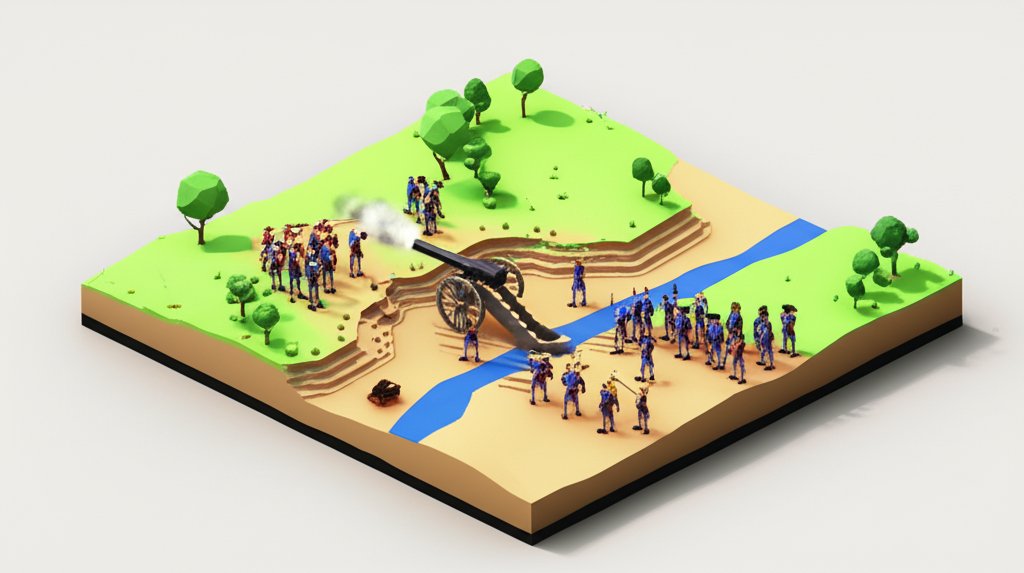
It’s one of history’s great ironies: a meticulously planned military campaign, designed by British high command to be the final, decisive blow, instead becomes the turning point of the American Revolution for the colonists. The British strategy for 1777 was brilliant on paper—a three-pronged pincer movement to sever New England from the other colonies. Yet, its catastrophic failure at Saratoga didn’t just hand the Americans a victory; it fundamentally altered the DNA of the war.
At a Glance: What You’ll Learn
- The Anatomy of a Failed Strategy: Unpack why the British master plan to control the Hudson was doomed by poor communication and competing egos.
- Key Decisions Beyond the Generals: Discover how actions by figures like Benedict Arnold and Daniel Morgan decisively shaped the battlefield, often in defiance of orders.
- The Diplomatic Domino Effect: Understand the step-by-step process of how this specific victory unlocked the crucial Franco-American alliance.
- Saratoga vs. Other Battles: Clarify why this conflict, and not others like Trenton or Yorktown, is almost universally seen as the war’s true pivot point.
- Actionable Insights: Pinpoint the strategic lessons in logistics, leadership, and alliance-building that emerged from the Saratoga campaign.
The British Gamble: A Flawed Master Plan
To grasp why Saratoga was so pivotal, you first have to appreciate the sheer ambition of the British plan. General John “Gentleman Johnny” Burgoyne proposed a grand strategy to isolate the troublesome New England colonies by seizing control of the Hudson River Valley. It was a classic “divide and conquer” approach.
The plan looked formidable on a map:
- Main Thrust: General Burgoyne would lead his primary force of over 7,000 British regulars, German mercenaries (Hessians), and Native American allies south from Canada.
- Supporting Thrust: A smaller force under Colonel Barry St. Leger would move east from Lake Ontario down the Mohawk Valley.
- Final Link: General William Howe, the overall British commander in America, would march his large army north from New York City.
All three forces were meant to converge on Albany, New York. Had it worked, the British would have controlled the Hudson, cutting off the flow of men and supplies from New England, the heart of the rebellion.
Where the Strategy Crumbled
A plan is only as strong as its execution, and here, the British strategy fell apart due to hubris, miscommunication, and a critical lack of centralized command.
- Howe’s Detour: General Howe, for reasons still debated by historians, chose to pursue his own objective: capturing the American capital of Philadelphia. He took his army by sea, leaving Burgoyne completely unsupported from the south. He believed the rebellion would collapse if he took its capital, fundamentally misreading the decentralized nature of the American cause.
- St. Leger’s Defeat: The western pincer was blunted before it even got close. American forces, led by none other than Benedict Arnold, successfully defended Fort Stanwix and routed St. Leger’s force at the Battle of Oriskany.
- Burgoyne’s Isolation: This left Burgoyne’s army alone, deep in hostile territory, with a supply line stretching hundreds of miles back to Canada. The dense American wilderness was a nightmare for a conventional European army dragging a massive baggage train.
| The Plan (On Paper) | The Reality (On the Ground) |
| —————————————————- | ———————————————————————————————- |
| Three British armies converge on Albany. | Only one army (Burgoyne’s) ever came close. |
| The Hudson River Valley is secured. | American forces fortified and controlled key positions like Bemis Heights. |
| New England is isolated from the other colonies. | The American war effort remained coordinated. |
| A quick, decisive end to the rebellion is achieved. | The campaign ended in the surrender of an entire British army, inspiring the Americans. |
Beyond the Generals: Battlefield Decisions That Tipped the Scales
While General Horatio Gates received the official credit for the victory, key moments at Saratoga were driven by the initiative—and often, the insubordination—of his field commanders. These actions demonstrate how individual leadership at critical moments can outweigh a grand strategy.
Benedict Arnold’s Audacious Charge
By October 7, 1777, the situation was tense. Burgoyne, desperate and low on supplies, launched a reconnaissance-in-force against the American left flank at Bemis Heights. General Gates, a notoriously cautious commander, wanted to remain behind his defensive works.
Benedict Arnold, who had been stripped of his command after a feud with Gates, saw the opportunity. Defying orders, he rode onto the battlefield, rallying the American troops. He led a furious charge that shattered the British lines and, most critically, led the assault that captured the Breymann Redoubt—a key fortified position anchoring the British flank. Arnold was severely wounded in the leg at the height of his success, but his leadership had broken the back of the British position.
Daniel Morgan’s Riflemen and Unconventional Warfare
Another crucial element was the performance of Colonel Daniel Morgan and his Provisional Rifle Corps. These were expert marksmen, primarily from the frontiers of Pennsylvania and Virginia, armed with long rifles.
Instead of fighting in tight formations like the British, Morgan’s men used the woods for cover, employing guerrilla tactics. They specifically targeted officers and artillerymen, which had a devastating psychological and practical effect. At the Battle of Freeman’s Farm on September 19, their sharpshooting inflicted heavy casualties, particularly among the British officer corps, sowing chaos and stalling Burgoyne’s initial advance. This unconventional approach was something the British army was ill-equipped to counter.
The Ripple Effect: How Victory Unlocked a Global Alliance
The surrender of over 6,000 of King George’s soldiers was shocking news, but its greatest impact wasn’t felt in America or London—it was in Paris.
Convincing a Skeptical France
France had been secretly providing aid to the Americans for some time, eager for any chance to weaken its old rival, Great Britain. But they were unwilling to commit to a formal, open alliance without proof that the colonists had a realistic chance of winning. They needed to see a decisive victory, not just a series of small-scale raids and escapes.
Saratoga was that proof. When news of Burgoyne’s surrender reached Benjamin Franklin, America’s envoy in Paris, it completely changed the diplomatic landscape. The victory demonstrated that the Continental Army could stand up to and defeat a major British force in a conventional campaign. This single, overwhelming victory was the proof of concept Franklin needed. For a complete look at the battle that secured this aid, see this guide to Saratoga’s Turning Point.
In February 1778, France signed the Treaty of Alliance and the Treaty of Amity and Commerce with the United States. The American Revolution had officially gone global.
The Tangible Impact of French Support
The French alliance was not merely symbolic. It provided the Continental Army with three things it desperately needed to win the war:
- Money and Supplies: France provided crucial loans, gunpowder, cannons, and uniforms when American resources were at their lowest.
- Military Expertise: Officers like the Marquis de Lafayette and Baron von Steuben brought professional European military experience that helped train the Continental Army into a more formidable fighting force.
- Naval Power: This was the game-changer. The French Navy challenged the Royal Navy’s dominance of the seas, preventing the British from easily resupplying or reinforcing their armies by water. It was the French fleet’s blockade of Chesapeake Bay in 1781 that trapped General Cornwallis at Yorktown, leading to the final, war-ending surrender.
Quick Answers to Common Questions about Saratoga
Here are a few common points of confusion cleared up.
Q: Why isn’t a battle like Trenton or Yorktown considered the turning point?
A: Trenton (1776) was a crucial morale boost, a “turn of the tide,” but it didn’t fundamentally change the strategic situation or bring in foreign allies. Yorktown (1781) was the decisive, war-ending battle, but it was the result of the strategic shift that Saratoga initiated. A turning point is the pivot—the moment the ultimate outcome becomes possible, even probable. Saratoga was that pivot because it secured the French alliance, without which Yorktown would have been impossible.
Q: Did Horatio Gates really deserve the credit for the victory?
A: This is a long-standing debate. As the commanding general, Gates got the official accolades. He was a capable administrator who organized the army and chose the strong defensive ground at Bemis Heights. However, many historians argue that the tactical victories, especially on October 7, were driven by the aggressive and brilliant leadership of Benedict Arnold and the effectiveness of subordinates like Daniel Morgan. Gates’s primary contribution may have been staying out of their way at the critical moment.
Q: How could the surrender of just one army change the whole war?
A: It wasn’t just about the numbers. The surrender of Burgoyne’s army was a profound psychological blow to the British and a massive boost for the Americans. It proved that the rebellion wasn’t just a rabble of farmers; it was an army capable of defeating a professionally led British force. Most importantly, it was the “hard data” that convinced other European powers, namely France, that betting on America was a viable geopolitical strategy.
From Saratoga’s Fields to Final Victory
The road from the victory at Saratoga to the final peace treaty was still long and difficult, filled with hardship at places like Valley Forge. But the path forward was now clear. The win at Saratoga transformed a colonial rebellion into a global conflict that the British Empire could not afford to win.
It provided the tangible military support, the international legitimacy, and the national hope required to see the fight through to the end. Every cannon fired at Yorktown, every dollar spent funding the Continental Army in its final years, and every diplomatic maneuver that led to American independence can be traced back to the moment when General Burgoyne handed his sword to General Gates in the fields of upstate New York. That is why it remains the undisputed turning point of the American Revolution.










