
Trying to grasp a short history of the united states can feel like tracing a single thread through a vast, complex tapestry. It’s a story of audacious gambles, profound contradictions, and relentless expansion that transformed a handful of rebellious colonies into a global superpower. Understanding this journey isn’t about memorizing dates; it’s about dissecting the pivotal decisions and foundational principles that fueled its rise from a fragile republic to a nation of unparalleled influence.
This isn’t just an academic exercise. The strategic choices made—from drafting the Constitution to acquiring vast territories—offer timeless lessons in governance, economics, and national identity. We’ll unpack the key phases of this transformation, focusing on the moments that truly defined America’s trajectory.
At a Glance: Your Key Takeaways
- Foundational Principles: Discover how the Declaration of Independence and the Constitution created a framework for a new kind of nation, balancing liberty with a strong central government.
- The Engine of Expansion: Understand the key decisions, like the Louisiana Purchase and the Monroe Doctrine, that drove territorial and ideological growth.
- Internal Conflict as a Catalyst: See how the Civil War, while a national trauma, ultimately forged a stronger, more centralized federal government, setting the stage for industrial might.
- From Isolation to Intervention: Pinpoint the late 19th-century events, particularly the Spanish-American War, that marked America’s definitive entry onto the world stage.
- The 20th Century Ascent: Trace how two World Wars and the Cold War solidified the U.S. role as a dominant economic and military power.
From Colonial Grievance to a New Republic
Before the United States existed, there were 13 British colonies, a patchwork of settlements stretching along the Atlantic coast. Populated by English, Dutch, German, and other European settlers, these colonies developed distinct economies. New England thrived on shipbuilding and fishing, the Middle Colonies on diverse farming and industry, and the South on vast plantations powered by the brutal institution of slavery.
The relationship with Great Britain frayed after the 1750s. Burdened by war debt, the British crown imposed a series of taxes and acts—the Stamp Act, the Currency Act—that the colonists saw as an assault on their autonomy. The rallying cry, “no taxation without representation,” wasn’t just a slogan; it was a fundamental rejection of being governed by a distant power in which they had no voice.
This tension culminated in acts of open defiance like the Boston Tea Party (1773). The response from Britain was punitive, leading the colonies to convene the First Continental Congress in 1774. By April 1775, the first shots of the American Revolution were fired at Lexington and Concord.
The Blueprint for a Nation
The Declaration of Independence, adopted on July 4, 1776, did more than sever ties; it articulated a radical philosophy: that governments derive their power from the consent of the governed. After a grueling seven-year war, the Treaty of Paris (1783) officially recognized the United States as an independent nation.
But winning the war was only the first step. The initial governing document, the Articles of Confederation, proved too weak. In 1787, delegates drafted the U.S. Constitution, a brilliant and controversial document that established a three-branch federal system—legislative, executive, and judicial—designed to balance power and prevent tyranny. With George Washington’s inauguration as the first president in 1789, the American experiment truly began.
Forging a Continental Power: Expansion and Ideology
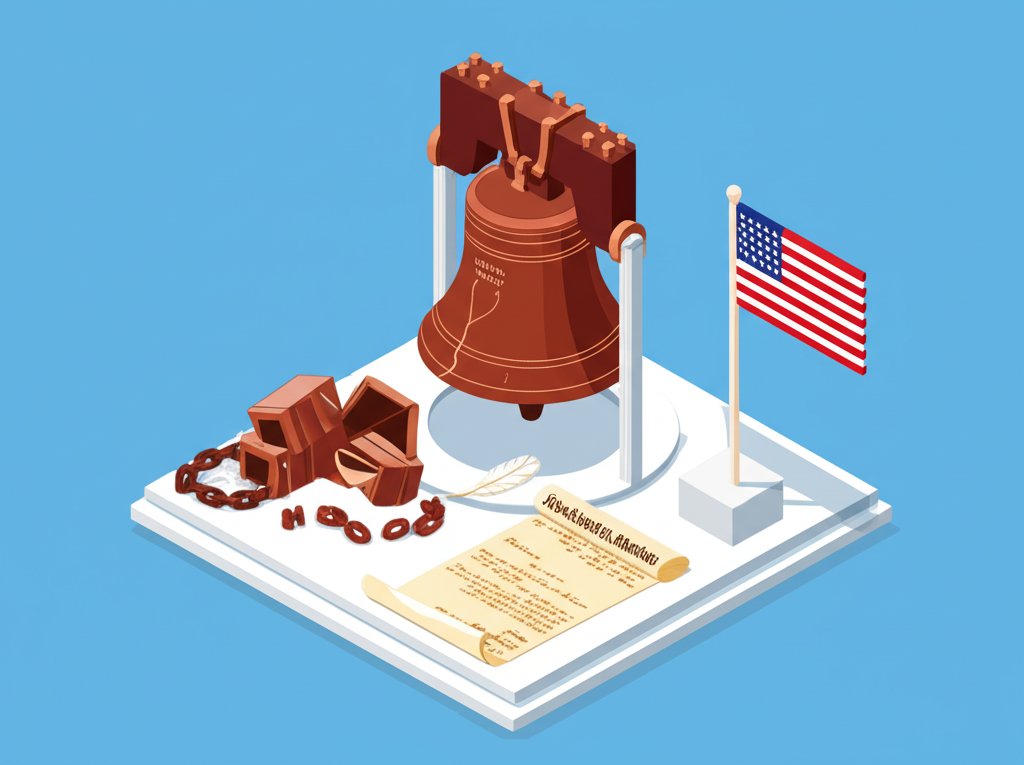
The young republic was ambitious. Its leaders didn’t just see a collection of states; they envisioned a continent-spanning nation. This vision drove a century of expansion, diplomacy, and conflict.
The Louisiana Purchase: A Game-Changing Acquisition
In 1803, President Thomas Jefferson faced a monumental decision. Napoleon Bonaparte, needing funds for his European wars, offered to sell the entire Louisiana Territory—a vast expanse of over 800,000 square miles—for $15 million. The Constitution didn’t explicitly grant the president power to acquire new territory, but Jefferson seized the opportunity.
- The Gamble: He risked political backlash for overstepping his constitutional authority.
- The Payoff: The Louisiana Purchase instantly doubled the size of the U.S., gave it control of the vital Mississippi River and the port of New Orleans, and provided immense natural resources for future generations. It was arguably the most significant real estate deal in history.
The Monroe Doctrine: A Declaration of Hemispheric Intent
By the 1820s, many Latin American nations had won their independence from Spain and Portugal. President James Monroe, in his 1823 message to Congress, issued a bold warning to European powers: the Western Hemisphere was no longer open to colonization.
This policy, known as the Monroe Doctrine, was largely a bluff at the time; the U.S. lacked the military might to enforce it. Yet, it was a profound statement of intent. It established the U.S. as a self-proclaimed protector of the Americas and a rising power with its own sphere of influence.
The Crucible of Civil War and the Rise of Industry
The nation’s growth was shadowed by its “original sin”: slavery. The conflict between the industrializing, free-labor North and the agrarian, slave-holding South was an irreconcilable divide. The election of Abraham Lincoln in 1860, who opposed the expansion of slavery, was the final trigger. Seven Southern states seceded, forming the Confederacy, and the Civil War began in April 1861.
The war (1861-1865) was the deadliest in American history, a brutal conflict that tested the very idea of the Union. Key moments like Lincoln’s Emancipation Proclamation in 1862 reframed the war as a fight for human freedom. The Union’s victory in 1865 preserved the nation, but at an immense cost.
From Reconstruction to Industrial Juggernaut
The post-war era, known as Reconstruction, aimed to reunify the country and integrate newly freed African Americans into society. Constitutional amendments were passed to abolish slavery (13th), grant citizenship (14th), and provide voting rights to Black men (15th). However, the effort was largely abandoned by the 1870s, and Southern states implemented segregationist “Jim Crow” laws that would persist for nearly a century.
Despite these deep social failures, the late 19th century saw an explosion of industrial growth. Known as the “Gilded Age,” it was a period of incredible innovation.
| Era | Key Developments | Impact on National Power |
|---|---|---|
| Founding (1776-1800) | Constitution, stable government, sound financial system. | Established a credible, functioning republic. |
| Expansion (1800-1860) | Louisiana Purchase, Monroe Doctrine, westward migration. | Created a vast, resource-rich continental nation. |
| Industrial (1865-1900) | Railroads, steel, electricity, mass production. | Built the economic engine for global influence. |
| Between 1860 and 1890, the U.S. Patent Office issued nearly 450,000 patents for inventions like the telephone and the light bulb. This industrial might created immense wealth and turned the U.S. into an economic powerhouse. |
Stepping onto the World Stage

For most of the 19th century, the U.S. focused inward. But by the 1890s, its industrial and agricultural output was so massive it needed foreign markets. This economic impulse, combined with a sense of “manifest destiny” and competition with European empires, pushed the U.S. toward a more assertive foreign policy.
The turning point was the Spanish-American War in 1898. A brief, decisive conflict, it resulted in the U.S. gaining control over Cuba, Puerto Rico, Guam, and the Philippines. This acquisition of overseas territories marked a pivotal moment in the U.S. transition from a regional power to a global one, a complex journey detailed in America’s global influence story. America was now an imperial power, with interests and responsibilities that spanned the globe.
The 20th Century: War, Depression, and Superpower Status
The 20th century cemented America’s global dominance through a series of world-shaking events.
- World War I (1914-1918): Though the U.S. entered the war late (1917), its industrial production and manpower tipped the balance in favor of the Allies. President Woodrow Wilson played a leading role in the post-war peace negotiations, though his vision for a League of Nations was ultimately rejected by his own country.
- The Great Depression and World War II (1929-1945): The economic collapse of 1929 was a devastating blow. Franklin D. Roosevelt’s “New Deal” programs reshaped the role of the federal government. The true end to the Depression, however, was the massive industrial mobilization for World War II. The U.S. became the “arsenal of democracy,” and its entry into the war after the 1941 attack on Pearl Harbor was decisive. The war ended in 1945 after the U.S. dropped atomic bombs on Hiroshima and Nagasaki, ushering in the nuclear age and leaving the U.S. as the world’s preeminent military and economic power.
- The Cold War (1947-1991): The post-war era was defined by a global ideological struggle against the Soviet Union. This “Cold War” involved proxy wars (like Korea and Vietnam), a nuclear arms race, and a competition for influence across the globe. It also spurred massive investment in science and technology, leading to the Space Race and the creation of the internet.
By the time the Soviet Union collapsed in 1991, the United States stood alone as the world’s sole superpower.
Quick Answers to Common Questions
Q: Was the American Revolution supported by all colonists?
A: No. Historians estimate that the colonial population was roughly divided into thirds: Patriots who supported independence, Loyalists who remained loyal to the British Crown, and a significant portion who remained neutral or apathetic, hoping to avoid the conflict altogether.
Q: Why didn’t the Constitution abolish slavery from the start?
A: The framers of the Constitution made a pragmatic, and deeply tragic, compromise. Southern states would not have ratified the document and joined the Union without protections for the institution of slavery. This decision postponed the crisis, leading directly to the Civil War 74 years later.
Q: Was America’s rise to a world power inevitable?
A: Not at all. A short history of the united states is filled with moments where a different decision could have led to a vastly different outcome. Factors like geographic isolation, abundant natural resources, and a stable political framework provided immense advantages, but key choices—from the Louisiana Purchase to entering the World Wars—were critical turning points that were not guaranteed.
Your Guide to Understanding America’s Trajectory
To truly grasp how the U.S. rose to prominence, focus on these key developmental pillars:
- A Stable Foundation: The Constitution provided an enduring and adaptable framework for government and commerce, allowing for stability even during periods of intense political strife.
- Relentless Territorial Growth: Westward expansion provided the land, resources, and demographic scale necessary to become a continental power.
- Industrial and Technological Supremacy: An embrace of innovation and free-market capitalism built an economic engine unparalleled in world history, particularly in the 20th century.
- Strategic Global Engagement: While often reluctant, the U.S. decisively intervened in global conflicts (WWI, WWII, Cold War) at moments when its power could reshape the international order in its favor.
From a rebellious colonial outpost to a global hegemon, the American journey is a compressed and potent story of transformation. It’s a history marked by both inspiring ideals of liberty and deep-seated conflicts over its meaning. Understanding these foundational steps is essential to making sense of the nation’s role in the world today.










