
To grasp the story of the United States is to grapple with a paradox: a nation born from an anti-colonial revolt that became a global superpower, founded on ideals of liberty that coexisted with centuries of slavery and conflict. It’s a tale of breathtaking speed, relentless expansion, and constant reinvention. Providing a short history of the USA isn’t just about listing dates and battles; it’s about understanding the forces and fault lines that shaped a continental nation and, eventually, the world.
From the first peoples who crossed a long-vanished land bridge to the complex challenges of the 21st century, the American journey is one of profound contradictions and extraordinary change. It’s a story of innovation and industry, of social upheaval and the enduring struggle to live up to its founding creed.
At a Glance: The American Timeline
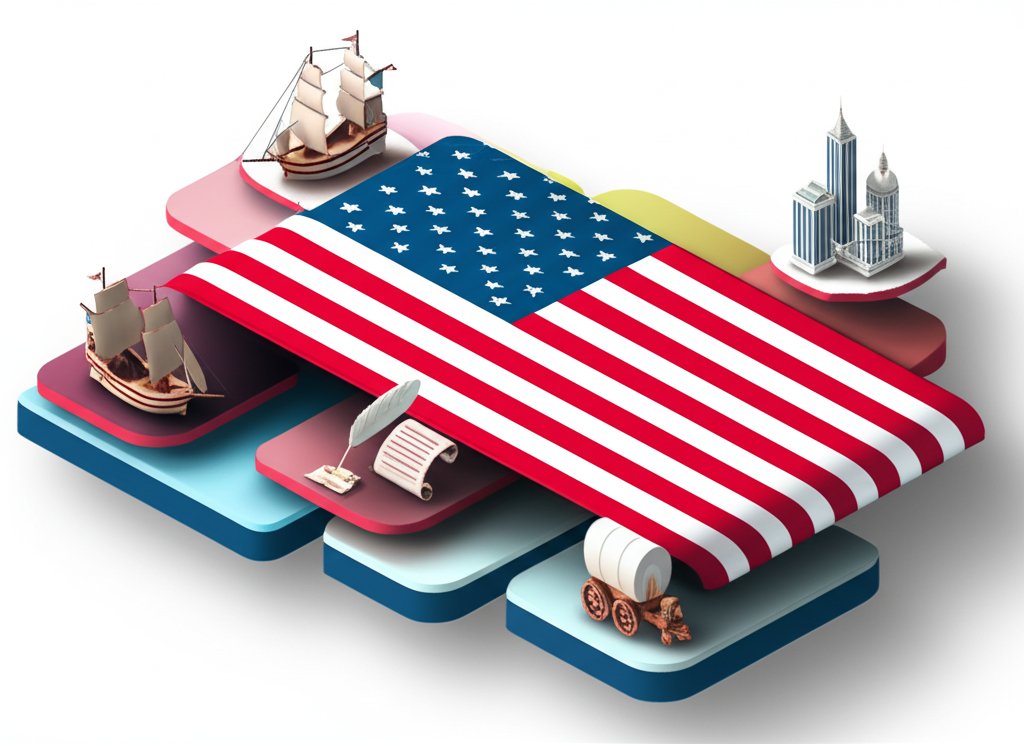
To navigate this sprawling history, it helps to see the major chapters. Here’s a bird’s-eye view of the key eras that define the United States:
- Pre-Columbian Era (c. 30,000 BCE–1492): Diverse and sophisticated Indigenous civilizations thrive across the continent for millennia, from the mound-builders of Cahokia to the pueblo dwellers of the Southwest.
- Colonial Period (1492–1763): European powers, primarily Spain, France, and England, compete to establish colonies, leading to conflict, trade, and the tragic displacement of Native peoples. The Thirteen Colonies take root on the Atlantic coast.
- Revolutionary Era (1763–1789): Growing tensions over taxes and representation boil over into the American Revolution, resulting in independence from Great Britain and the creation of a new government under the Constitution.
- Expansion and Division (1789–1865): The young nation doubles in size and pushes westward under the banner of “Manifest Destiny.” The unresolved issue of slavery deepens the divide between North and South, culminating in the Civil War.
- Industrialization and World Power (1865–1945): Following the war, America experiences explosive industrial growth, mass immigration, and social reform. It emerges from two world wars as a dominant economic and military force.
- The Cold War Era (1945–1991): The US leads the Western world in a decades-long ideological struggle against the Soviet Union, while grappling with major social change at home, including the Civil Rights Movement.
- The Modern Era (1991–Present): As the sole remaining superpower, the US navigates new global challenges like terrorism, economic crises, and a rising tide of political polarization.
Before ‘America’: The Continent’s First Peoples
Long before European ships dotted the horizon, the land we now call the United States was home to hundreds of distinct and thriving cultures. The story begins with the migration of people from Eurasia across the Beringia land bridge, possibly as early as 30,000 years ago. These early inhabitants, known as Paleo-Indians, adapted and diversified over millennia.
They weren’t a monolith. In the Midwest, the Adena and Hopewell cultures built vast earthen mounds for ceremony and burial. The Mississippian culture gave rise to Cahokia, a sprawling city near modern-day St. Louis that, at its peak in the 12th century, had a population of around 20,000—larger than London at the time.
In the arid Southwest, the Ancestral Puebloans (once known as the Anasazi) constructed remarkable cliff dwellings and stone pueblos. In the Northeast, powerful political alliances formed, most notably the Iroquois Confederacy, a sophisticated union of five (later six) nations that was established in the mid-15th century. These societies were the original inhabitants, whose lives would be irrevocably altered by the arrival of outsiders.
A New World: Colonial Beginnings and Rivalries
European colonization kicked off in the late 15th century, driven by a thirst for wealth, religious zeal, and national glory. Spain was first, establishing the earliest permanent European settlement at St. Augustine, Florida, in 1565. But it was the English who would ultimately dominate the Atlantic coast.
After a few false starts—like the mysterious disappearance of the Roanoke colony in 1587—the Virginia Company found a foothold. On May 14, 1607, they established Jamestown. The colony nearly failed but was saved by the lucrative cultivation of tobacco, a cash crop pioneered by John Rolfe. This economic success created a voracious demand for labor, and in 1619, a pivotal and tragic year, two things happened: the first enslaved Africans arrived in Virginia, and the House of Burgesses, North America’s first representative government, convened.
This set a pattern: the pursuit of freedom and profit entwined with the brutal institution of chattel slavery. Other colonies sprang up with different motives:
- New England: Settled by religious dissenters. The Separatist Pilgrims landed at Plymouth in 1620, and the Puritans founded the Massachusetts Bay Colony in 1630, building an economy on fishing, timber, and shipbuilding.
- The Middle Colonies: Originally New Netherland, the Dutch settlement was seized by the English in 1664 and renamed New York. This region became a diverse melting pot.
- The Southern Colonies: Maryland was founded as a haven for Catholics, and the Carolinas were established for commercial agriculture, heavily reliant on enslaved labor.
Life in the colonies was a mix of opportunity and hardship. The population grew rapidly, but this expansion inevitably led to violent conflicts with Native American tribes, such as the Pequot War (1637-1638) and King Philip’s War (1675-1676), which devastated communities on both sides.
The Spark of Revolution: Forging a Nation
By the mid-18th century, the Thirteen Colonies had developed their own distinct identities yet felt a growing sense of common cause. The turning point was the Seven Years’ War (known as the French and Indian War in America), which ended in 1763. Britain won, but the victory came with a mountain of debt.
To pay for it, Parliament decided to tax the colonies directly. Acts like the Sugar Act (1764) and the Stamp Act (1765) were met with fierce resistance. Colonists rallied under the cry, “No taxation without representation,” arguing that a distant parliament had no right to tax them.
Tensions escalated with events like the Boston Massacre (1770) and the Boston Tea Party (1773). Britain responded with the Coercive Acts (dubbed the “Intolerable Acts” by the colonists), which closed Boston’s port and curtailed local government. In response, the First Continental Congress met in 1774 to coordinate a unified resistance. The fuse was lit.
On April 19, 1775, the “shot heard ’round the world” was fired at Lexington and Concord, igniting the American Revolutionary War. The Second Continental Congress appointed George Washington to lead the Continental Army and, on July 4, 1776, adopted the Declaration of Independence—a radical assertion of natural rights and self-governance.
The war was long and grueling. A crucial turning point came in 1777 with the American victory at Saratoga, which convinced France to enter the war as an American ally. The final major battle at Yorktown in 1781, where a combined American and French force trapped the British army under Lord Cornwallis, sealed the victory. The 1783 Treaty of Paris officially recognized the United States as an independent nation.
Growing Pains: A Nation Expanding and Dividing
Winning independence was one thing; building a country was another. The first government, under the Articles of Confederation, was too weak. So, in 1787, delegates met in Philadelphia and drafted the U.S. Constitution, creating a stronger federal government with a system of checks and balances. It was ratified in 1788, and the Bill of Rights—the first ten amendments—was added in 1791 to guarantee individual liberties.
The 19th century was defined by one powerful idea: Manifest Destiny, the belief that the United States was divinely ordained to expand across the continent. This ambition fueled incredible growth and deep conflict.
- The Louisiana Purchase (1803): President Thomas Jefferson bought a vast territory from France, doubling the size of the country overnight.
- The War of 1812: Often called the “second war of independence,” this conflict with Britain confirmed American sovereignty.
- Indian Removal: Westward expansion came at a horrific cost to Native Americans, who were forcibly displaced from their ancestral lands. The Indian Removal Act of 1830 led to the infamous “Trail of Tears,” the forced march of the Cherokee Nation.
- Texas and the Mexican-American War: The annexation of Texas in 1845 sparked the Mexican-American War (1846-1848). The US victory resulted in the acquisition of a massive territory, including present-day California, Nevada, Utah, and Arizona.
But as the nation grew, its deepest contradiction—slavery—festered. Each new state threatened the delicate balance of power between free and slave states. Legislative patches like the Missouri Compromise (1820) and the Compromise of 1850 only delayed the inevitable. The Kansas-Nebraska Act of 1854 and the Supreme Court’s Dred Scott decision in 1857 tore the country apart. The rapid series of events that followed forms the core of A brief US history and set the stage for the nation’s most trying ordeal.
The Civil War and a New Birth of Freedom
The election of Abraham Lincoln, who ran on a platform of halting the expansion of slavery, was the final straw for the South. In 1860 and 1861, eleven Southern states seceded to form the Confederate States of America. The Civil War began on April 12, 1861, at Fort Sumter.
It was the deadliest conflict in American history. The Union’s industrial might eventually overwhelmed the agrarian South. The turning points came in July 1863 with Union victories at Gettysburg and Vicksburg. Lincoln’s Emancipation Proclamation in 1863 redefined the war, transforming it into a struggle to end slavery.
On April 9, 1865, Confederate General Robert E. Lee surrendered at Appomattox Court House. The war was over, but its aftermath would be just as challenging. The Reconstruction era (1865-1877) saw the passage of the 13th, 14th, and 15th Amendments, which abolished slavery, granted citizenship to the formerly enslaved, and gave voting rights to African American men. However, Reconstruction ended in a political compromise in 1877, allowing Southern states to impose “Jim Crow” laws that enforced racial segregation for nearly a century.
An Industrial Giant on the World Stage
The late 19th century, known as the Gilded Age, was a period of explosive industrialization. Railroads stitched the country together, cities swelled with immigrants from Europe, and titans of industry like Carnegie and Rockefeller built vast fortunes. It was also an era of stark inequality and social unrest.
This gave way to the Progressive Era (c. 1890s-1920s), a period of intense social and political reform. Activists fought for workers’ rights, women’s suffrage (leading to the 19th Amendment in 1920), and laws to break up corporate monopolies.
The 1898 Spanish-American War marked a new chapter. With a swift victory, the U.S. acquired Puerto Rico, Guam, and the Philippines, becoming an imperial power. The nation’s foreign policy was shifting from isolationism to interventionism.
- World War I: The U.S. remained neutral until 1917, but its entry helped tip the balance in favor of the Allies.
- The Roaring Twenties: A decade of economic prosperity and cultural change, followed by the devastating Wall Street Crash of 1929.
- The Great Depression: The 1930s were defined by economic collapse. President Franklin D. Roosevelt’s New Deal created a social safety net and expanded the role of the federal government in American life.
- World War II: The Depression only truly ended when the U.S. entered World War II after the Japanese attack on Pearl Harbor on December 7, 1941. The war effort transformed the American economy. The conflict ended in 1945 after the U.S. used atomic bombs on Hiroshima and Nagasaki, ushering in the nuclear age.
The Cold War and a Changing Society
The end of World War II left two superpowers standing: the United States and the Soviet Union. The ensuing Cold War was a nearly 50-year global contest of ideologies—capitalist democracy versus communism. U.S. foreign policy was dominated by the strategy of “containment,” leading to interventions and proxy wars around the globe, most notably the Korean War (1950-1953) and the Vietnam War (1961-1973).
At home, the post-war years brought a baby boom, suburban growth, and unprecedented prosperity. But beneath the placid surface, a social revolution was brewing. The Civil Rights Movement challenged the system of racial segregation. Led by figures like Martin Luther King Jr., activists used nonviolent protest to demand equality. Their efforts led to landmark legislation, including the Civil Rights Act of 1964 and the Voting Rights Act of 1965.
The 1960s also saw the rise of counter-culture, anti-war protests, and President Lyndon B. Johnson’s “Great Society” programs aimed at eliminating poverty and racial injustice. The era was capped by the Watergate scandal, which led to President Richard Nixon’s resignation in 1974 and a deep-seated distrust of government.
A Sole Superpower in a New Century
The collapse of the Soviet Union in 1991 ended the Cold War and left the United States as the world’s sole superpower. The 1990s were largely a period of peace and economic growth. But the new century brought new threats.
The terrorist attacks of September 11, 2001, reshaped American foreign policy, launching a global “War on Terror” and leading to long and costly wars in Afghanistan and Iraq.
The 21st century has been marked by a series of profound challenges:
- The Great Recession of the late 2000s, a severe economic crisis.
- The historic election of Barack Obama in 2008 as the first African American president.
- Deepening political polarization and partisan division.
- The rise of social movements like Black Lives Matter and #MeToo, forcing new reckonings with old injustices.
- The global COVID-19 pandemic in 2020, which disrupted every facet of life.
Common Questions About U.S. History
Here are quick answers to a few frequently asked questions that help clarify key moments in the American story.
Why did the American colonies declare independence?
The primary reasons were economic and philosophical. The colonists felt that British policies, particularly direct taxation without representation in Parliament, violated their rights as Englishmen. Ideas from the Enlightenment, which emphasized liberty, consent of the governed, and natural rights, provided the intellectual fuel for revolution.
What was the main cause of the American Civil War?
While there were multiple factors, the primary cause of the Civil War was the institution of slavery. The conflict revolved around whether slavery would be allowed to expand into new western territories, which created an irreconcilable divide between the industrializing, free-labor North and the agrarian, slave-holding South.
How did the United States become a world power?
The U.S. became a world power through a combination of geographic advantages, massive industrial capacity, and key historical events. Its late entry into both World War I and World War II allowed it to emerge economically and militarily stronger than the exhausted European powers. By 1945, it was the world’s dominant economic and technological force.
Why This History Matters Today
The history of the United States is not a static relic. It is a living story that continues to shape the present. The debates from the Constitutional Convention echo in today’s political discourse. The legacy of slavery and the Civil War is central to modern conversations about race and justice. The nation’s journey from an isolated republic to a global leader informs its complex role in the world today.
Understanding this history—its triumphs, its tragedies, and its enduring contradictions—is essential for understanding the United States and its influence. It’s a continuous experiment in democracy, a work in progress still striving to fulfill the promise of its founding ideals.










