
Human history is a vast and intricate tapestry woven with threads of innovation, migration, and societal development. From the first sparks of agriculture to the rise and fall of mighty empires, the era of ancient civilizations laid the groundwork for the world we know today. This ancient civilizations overview will journey across continents and millennia, exploring key developments and pivotal societies.
Understanding the Scope of Ancient History
The period we call “ancient history” typically stretches from the dawn of writing, around 3400 BC, to Late Antiquity, approximately AD 500. This encompasses a massive span of time and covers all inhabited continents. To help understand the chronology, historians often divide the period using the three-age system: the Stone Age (ending around 3000 BC), the Bronze Age (3000-1200 BC), and the Iron Age (1200-600 BC). Prehistory, the time before written records, relies heavily on archaeological discoveries to piece together the story of early humans.
Consider how dramatically the global population grew during this time. The Neolithic Revolution, with the advent of agriculture, fueled exponential population growth. From a mere 2 million people around 10,000 BC, the population surged to 45 million by 3000 BC, 72 million by 1000 BC, and reached 209 million by AD 500.
Key Developments That Shaped Ancient Societies
Several groundbreaking developments were pivotal in the rise of ancient civilizations. Agriculture stands out as perhaps the most transformative.
The Agricultural Revolution and Domestication
The shift from hunter-gatherer lifestyles to settled agriculture began around 9000 BC in Turkey, gradually spreading through the Fertile Crescent. Simultaneously, independent agricultural developments occurred across the globe: in the Nile River Valley (sorghum, millet) around 8000 BC, West Africa (yams) around 8000 BC, China (millet, rice, legumes) around 7000 BC, New Guinea (taro) around 7000 BC, and Mesoamerica (squash) around 7000 BC.
Alongside agriculture, the domestication of animals played a crucial role. Dogs were domesticated at least 15,000 years ago, followed by sheep and goats around 9000 BC. Pigs and poultry came later, while cattle and water buffalo were domesticated around 7000 BC, followed by horses, donkeys, and camels around 4000 BC.
The Rise of Metalworking and Pottery
The discovery and refinement of metalworking marked a significant turning point. Copper smelting emerged around 6000 BC in Western Asia, followed by the use of gold and silver between 6000-5000 BC. Bronze, a stronger alloy, appeared around 3500 BC in Mesopotamia. Improved metalworking techniques led to the creation of more durable and effective tools and weapons, notably by the Hittites.
Pottery also sprang up independently in various regions worldwide. The invention of the potter’s wheel between 5000-4000 BC revolutionized pottery production, and by 3000 BC, it was adapted for wheeled vehicles, impacting transportation and trade.
The Dawn of Writing
Perhaps one of the most important achievements of ancient civilizations was the independent development of writing systems in Mesopotamia, Egypt, India, China, and Mesoamerica. Cuneiform emerged in Mesopotamia around 3400 BC, followed by Egyptian hieroglyphs around 3200 BC. The Indus script appeared around 2800 BC (though it remains undeciphered), Chinese Oracle Bone Script between 1600-1100 BC, and Mesoamerican writing around 600 BC. Learning about these developments can really open our eyes to the world of civilization that came before us.
Glimpses into Key Ancient Civilizations
From the fertile valleys of Mesopotamia to the pyramids of Egypt, ancient civilizations left an indelible mark on the world. Let’s explore some notable examples.
Mesopotamia: The Cradle of Civilization (6500-539 BC)
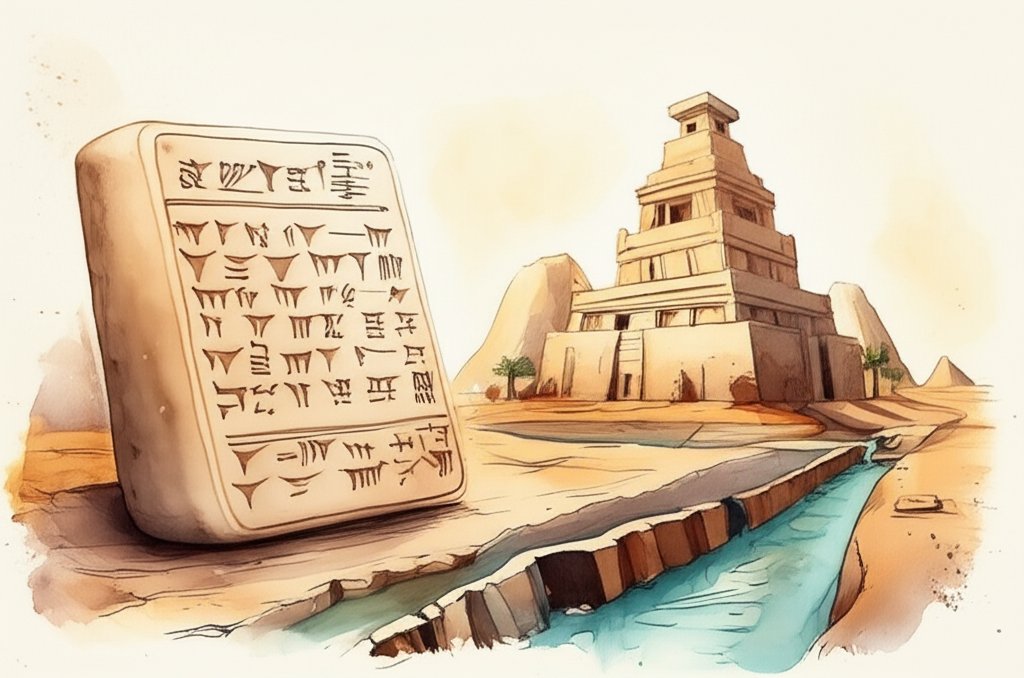
Often referred to as the “birthplace of civilization,” Mesopotamia witnessed the inception of numerous innovations – the invention of time, the wheel, mathematics, maps, writing, sailboats, cities, and early empires. The Sumerians, Akkadians (under Sargon), Babylonians (with Hammurabi and Nebuchadnear II), Assyrians, and Hittites all flourished in this region before it was conquered by the Persians.
Ancient Egypt: Land of the Pharaohs (3150-30 BC)
The civilization of Ancient Egypt thrived in the Nile Valley, renowned for its awe-inspiring pyramids, intricate mummification practices, powerful pharaohs, complex mythology, and distinctive hieroglyphic writing. Egyptian history is often divided into the Old Kingdom, Middle Kingdom, and New Kingdom periods. Egypt was conquered by Ta-Seti (3100 BC), Hyksos (1650 BC), Assyrians, Greeks, Romans and Arabs (640 AD).
Indus Valley Civilization: A Peaceful Society (2600-1900 BC)
Located in modern-day Pakistan, India, and Afghanistan, the Indus Valley Civilization was a large, peaceful society known for its extensive urban planning and robust trade networks. Its writing system, however, remains undeciphered to this day.
Ancient Greece: The Foundation of Western Thought (2700-479 BC)
Ancient Greece, with its independent city-states, laid the foundation for democracy, philosophy, and the Olympic Games. The Archaic period (2700-480 BC) paved the way for the Classical Age (480-323 BC), a period of remarkable artistic and intellectual achievement.
The Roman Empire: Engineering and Expansion (753 BC – 476 AD)
The Roman Empire left an enduring legacy of monumental architecture and an extensive road network that facilitated trade and communication across its vast territories. Internal strife and power struggles ultimately led to its decline and fall because the Roman upper crust fought over the crown until civil war broke out.
The Persian Empire: Connecting East and West (550 – 331 BC)
Known for its Royal Road connecting the Aegean Sea to Iran, the Persian Empire facilitated trade and cultural exchange between East and West. They were renown for practicing Zoroastrianism. It fell to Alexander the Great.
Chinese Civilization: Innovations in Silk and Paper (1600 – 1046 BC)
Early Chinese civilization made remarkable contributions, including the invention of silk and the development of paper.
Other Notable Civilizations
Beyond these prominent examples, numerous other civilizations flourished across the globe. The Norte Chico civilization (3000-1800 BC) in Peru boasted monumental architecture but lacked pottery or a known writing system. The Danubian Culture (5500-3500 BC) in Europe created “goddess” figurines and gold artifacts and developed Linearbandkeramik pottery. The Jiahu Culture (7000-5700 BC) in China is known for early wine, bone flutes, and possible evidence of the earliest Chinese writing. ‘Ain Ghazal (7200-5000 BC) in Jordan demonstrates early settled agricultural life. Çatalhöyük (7500-5700 BC) in Turkey provides insight into a densely populated Stone Age city. The Australian Aboriginals represent the longest continuous culture on Earth, dating back 50,000 years. Don’t forget the Inca (1438-1532 AD), Aztec (1325-1521 AD) and Mayan civilization (2600 BC-900 AD).
The Austronesian migrations in Southeast Asia resulted in extensive trade networks and colonization, reaching as far as Madagascar. In Africa, the Kingdom of Aksum (100-940 AD), the Nok culture (1000 BC-200 AD), Djenné-Djenno, Dhar Tichitt, Oualata, and the Bantu expansion all contributed to the rich tapestry of ancient societies. A study of the world’s great empires is a study of the world of civilization.
What We Can Learn From Ancient Civilizations
Studying ancient civilizations offers invaluable insights into the trajectory of human history. By examining their successes and failures, their innovations and adaptations, we can gain a deeper understanding of ourselves and the challenges we face today. The echoes of these societies resonate in our modern world, shaping our cultures, technologies, and institutions. The world is so full of culture due to the ancient civiliations, that its hard to fully grasp that world of civilization is a reality!










