Untuk gambaran yang lebih besar dan konteks penuh, pastikan Anda membaca panduan utama kami tentang Jupiters Moons and Rings: A Hidden Solar System Unveiled.
Unlike Saturn’s icy spectacles, Jupiter’s rings are faint, dusty whispers, hinting at violent collisions and a dynamic interplay with its inner moons. Understanding Jupiter’s rings composition and origin reveals a continuous cycle of creation and destruction, a cosmic dust bunny perpetually being kicked up and settling back down.
At a glance:
- Discover the surprising materials that make up Jupiter’s rings (hint: it’s not ice).
- Uncover the primary suspects in the ring-formation process: Jupiter’s inner moons.
- Learn how collisions and gravitational forces perpetually replenish the rings.
- Understand why Jupiter’s rings look so different from Saturn’s.
- Find out how future missions will provide even more data about this elusive system.
Decoding the Dust: Jupiter’s Rings Up Close
Jupiter’s rings aren’t the solid, icy structures you might expect. Instead, they’re primarily composed of dust grains, tiny particles eroded from Jupiter’s inner moons. This is a crucial difference compared to Saturn’s rings, which are made mostly of water ice. The reddish hue of the rings suggests a silicate or carbonaceous composition for the dust. This color provides clues about the source materials and processes at play.
Halo Ring: The Diffuse Inner Glow
The Halo ring is the innermost and thickest of Jupiter’s rings. Unlike distinctly defined rings, it’s a diffuse torus of particles extending approximately 20,000 km in thickness and 22,800 km in width. These tiny particles are thought to have originated from the main ring and are scattered inwards due to electromagnetic forces.
Main Ring: Bright But Fleeting
The Main Ring is the brightest part of the Jovian ring system, yet it’s still incredibly faint compared to Saturn’s rings. It’s a relatively thin structure, approximately 6,500 km wide, composed of dust ejected from the moons Metis and Adrastea. This ring is constantly replenished, like a sandcastle being rebuilt on a windy beach.
Gossamer Rings: Whispers in the Wind
Fainter still are the Gossamer Rings, named after the moons that act as their source: Amalthea and Thebe. These rings are much wider than the Main Ring, with a combined estimated width of 85,000 km. The thickness varies significantly, ranging from 2,500 to 8,500 km. They are formed from dust ejected from these moons through impacts. Think of them as delicate halos around their parent moons.
The Case of the Missing Ice: Why Jupiter’s Rings Are Different
Why are Jupiter’s rings predominantly dust and not ice like Saturn’s? The answer lies in the proximity to Jupiter itself. The intense radiation environment and Jupiter’s powerful magnetic field cause ice particles to quickly sublimate (turn directly into gas) and their constituent molecules are then swept away. This leaves behind the more resilient dust particles, primarily silicates and other materials.
Collision Course: How Jupiter’s Rings Are Forged
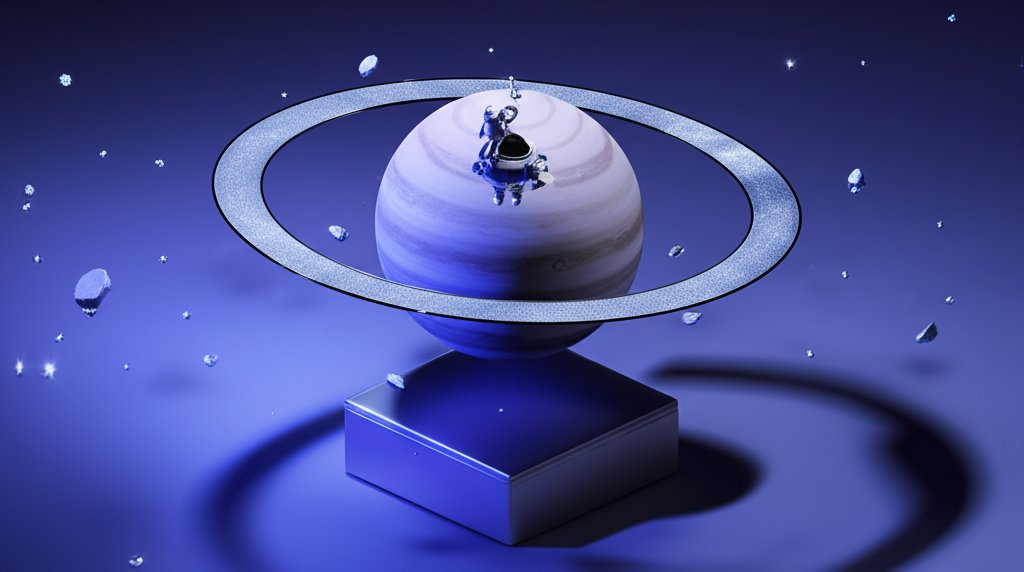
The origin of Jupiter’s rings is intrinsically linked to its inner moons. High-speed impacts from micrometeoroids and other space debris constantly bombard Metis, Adrastea, Amalthea, and Thebe. These impacts eject material into space, which then becomes trapped in orbit around Jupiter, forming the rings.
The Role of Inner Moons: Primary Suspects Identified
Metis and Adrastea are particularly important contributors to the Main Ring. Amalthea and Thebe are responsible for maintaining their respective Gossamer Rings. These moons aren’t just passively orbiting; they’re actively shaping the environment around them.
Example: Imagine throwing pebbles at a sandpile. Each pebble dislodges grains of sand, which then spread out around the pile. The inner moons are the sandpiles, and the micrometeoroids are the pebbles. Explore Jupiter’s unseen system to understand the larger context of these intricate relationships within the Jovian system.
A Fleeting Phenomenon: Ring Lifespan and Renewal
Jupiter’s rings are not permanent fixtures. Due to gravitational perturbations, electromagnetic forces, and solar radiation pressure, ring particles are continuously lost. Scientists estimate that the rings are relatively young, perhaps less than one million years old. This means that the rings we see today are the result of a continuous process of replenishment. Without the ongoing impacts on the inner moons, the rings would eventually dissipate.
Orbital Dynamics: A Gravitational Dance
The dynamics of Jupiter’s rings are complex and fascinating. The rings exist within Jupiter’s Roche limit, the distance within which a celestial body held together only by its own gravity will disintegrate due to Jupiter’s tidal forces. This prevents the ring particles from coalescing into larger bodies, keeping them as individual dust grains.
Electromagnetic Forces: The Unseen Hand
In addition to gravity, electromagnetic forces also play a significant role. Jupiter’s strong magnetic field interacts with the charged dust particles, influencing their trajectories and distribution within the rings. This is particularly important for the Halo ring, where electromagnetic forces help to scatter particles inwards.
Future Investigations: Missions to Unlock Ring Secrets
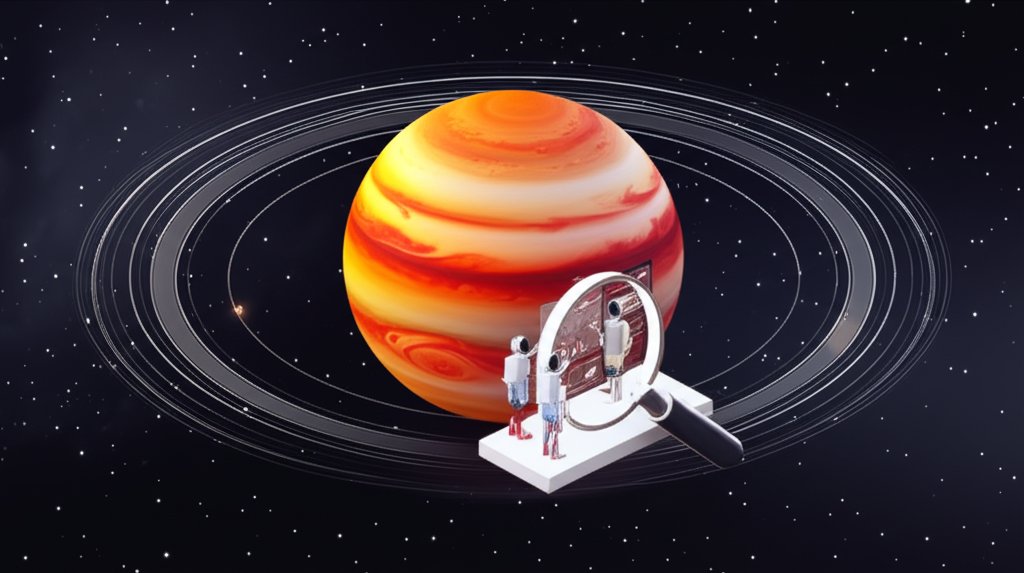
While we’ve learned a great deal about Jupiter’s rings from previous missions like Voyager and Galileo, future missions promise to reveal even more. NASA’s Europa Clipper and ESA’s JUICE missions will provide opportunities to study the rings indirectly, by observing the inner moons that source them.
Advanced Instruments: Peering Through the Dust
These missions will carry advanced instruments, including high-resolution cameras and spectrometers, allowing scientists to analyze the composition and dynamics of the ring particles in greater detail. This will help us to better understand the processes that create and maintain these faint, dusty rings.
Practical Playbook: Understanding Ring Dynamics
Let’s break down the key factors controlling the presence and appearance of Jupiters rings:
- Impact Events: Micrometeoroid impacts on inner moons are the primary dust source. More collisions, more dust.
- Moon Composition: The composition of the moons directly affects the ring particle composition/color.
- Roche Limit: Prevents ring particles from accreting into larger bodies.
- Electromagnetic Forces: Distribute particles, particularly in the Halo Ring.
- Radiation Environment: Destroys ice, leaving behind dust.
- Ring Age: Very young rings relative to the solar system.
Decision Tree:
- Is the ring particle icy? → Likely short lifespan due to sublimation.
- Is the ring particle close to a moon? → Likely sourced from that moon.
- Is the ring diffuse? → Electromagnetic forces are probably playing a significant role.
Quick Answers: Common Questions About Jupiter’s Rings
Q: Are Jupiter’s rings dangerous to spacecraft?
A: Yes, to some extent. While the rings are faint and composed of small particles, high-speed impacts can still damage spacecraft. Missions like Juno are carefully planned to minimize exposure to the densest regions of the rings.
Q: Could Jupiter ever have rings like Saturn’s?
A: It’s unlikely. Jupiter’s radiation environment and magnetic field prevent the long-term survival of icy particles, which are essential for forming prominent rings like Saturn’s.
Q: How do we know the composition of the ring particles?
A: Scientists use spectrometers to analyze the light reflected by the ring particles. The spectrum of light reveals the chemical composition of the material. Also, spacecraft can directly measure particle composition if they pass through the ring plane.
Q: Will the rings eventually disappear?
A: Yes, without continuous replenishment from impacts on the inner moons, the rings would eventually dissipate. However, as long as the inner moons exist and are subjected to impacts, the rings will likely persist in some form.
Actionable Close
Understanding Jupiter’s rings composition and origin offers a glimpse into the dynamic processes shaping our solar system. While they may not be as visually striking as Saturn’s rings, they represent a fascinating example of continuous creation and destruction, a testament to the relentless forces at play in the Jovian system. By understanding these dynamics, we gain a deeper appreciation for the intricate relationships between Jupiter, its moons, and its ethereal rings.










