
Remember begging your parents to shop at the store that gave out those little green stamps? The ‘S&H Green Stamps program history’ represents more than just collecting; it’s a fascinating look at the evolution of retail loyalty, predating even the earliest credit card rewards. Understanding this history provides context for today’s sophisticated loyalty programs.
At a glance:
- Discover the origins of S&H Green Stamps and their impact on American retail.
- Learn about the mechanics of the program: earning, collecting, and redeeming.
- Understand why S&H Green Stamps reached peak popularity and what led to their decline.
- Explore the modern-day reincarnation of Green Stamps, including digital transitions.
- Identify the key players and legal challenges that shaped the S&H Green Stamps story.
From Supermarket Aisles to Living Room Treasures: The Dawn of S&H Green Stamps
The story of S&H Green Stamps begins in 1896 with Thomas Sperry and Shelley Byron Hutchinson. Recognizing the potential of incentivizing customer loyalty, they created a system where retailers purchased stamps from S&H and distributed them to customers based on their purchases. Think of it as a very early version of cashback – but instead of cash, you got stamps.
By the mid-20th century, the S&H Green Stamps program had become a cultural phenomenon. It’s estimated that at its peak in the 1960s, around 80% of American households were avid collectors.
How the Green Stamp Machine Worked: A Step-by-Step Guide
The S&H Green Stamps program operated on a simple yet effective model:
- Retailer Purchase: Supermarkets, gas stations, and other retailers purchased stamps from Sperry & Hutchinson. The average supermarket in 1963 spent about $2.45 (equivalent to $25.36 in 2024) to buy enough stamps to fill one collector book.
- Customer Earning: Customers received stamps (denominations of 1, 10, or 50 points) based on their purchases at participating retailers. More spending meant more stamps.
- Stamp Collection: Customers diligently pasted their stamps into free S&H collector books. Each book had 24 pages, with each page holding 50 points, totaling 1,200 points per book.
- Catalog Dreaming: Filled books were then exchanged for merchandise at S&H Green Stamps stores or redemption centers. People eagerly flipped through the S&H catalog, dreaming of the items they could acquire like housewares, toys, and appliances.
- Redemption Reward: Finally, consumers got their desired items. It was a tangible representation of their loyalty.
This process made shopping an interactive game. Earning stamps, filling books, and choosing items from the catalog became a family activity.
The Rise and Fall (and Rise Again?) of Green Stamps
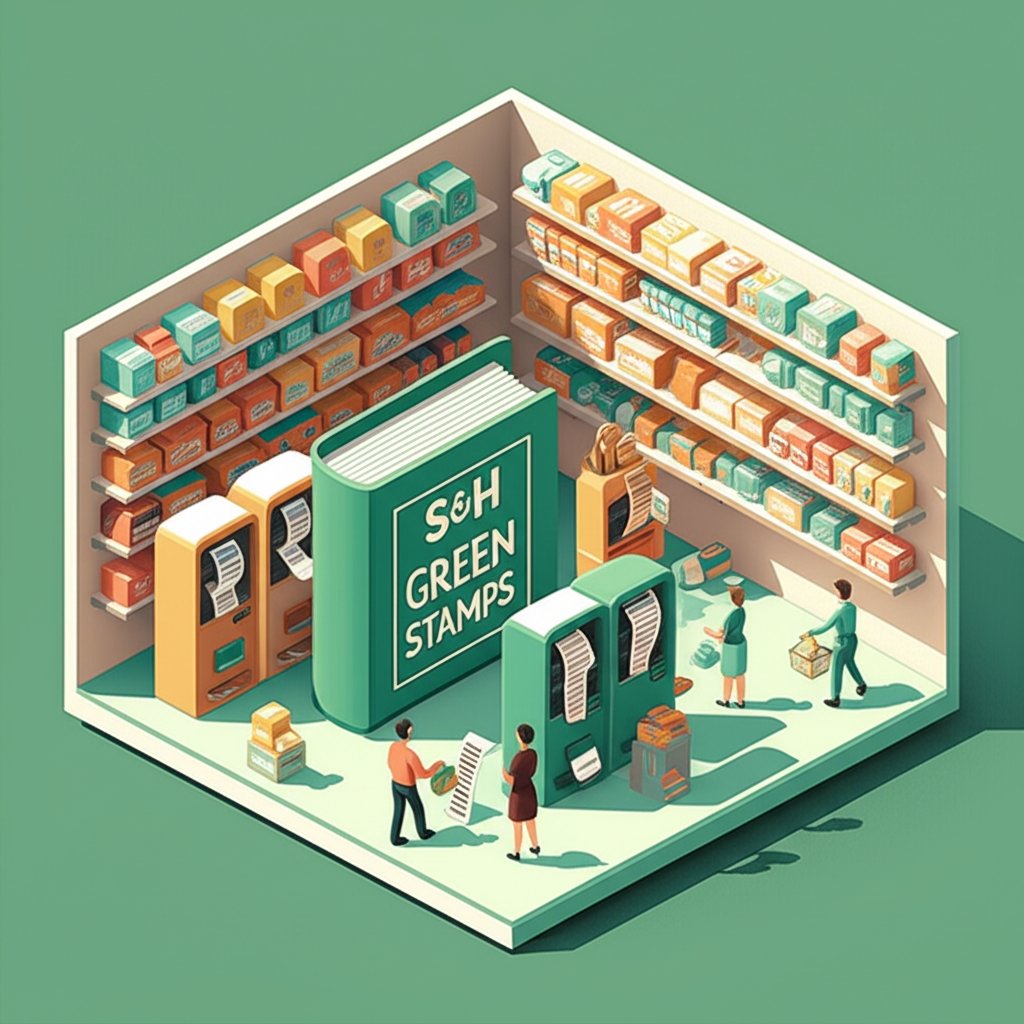
The immense popularity of S&H Green Stamps during the mid-20th century can be attributed to several factors:
- Post-War Consumerism: The booming post-World War II economy fueled consumer spending, and Green Stamps offered an added incentive to shop at participating stores.
- Family Entertainment: Collecting and pasting stamps became a family activity, providing a sense of shared accomplishment.
- Tangible Rewards: Unlike abstract points or discounts, Green Stamps offered tangible, desirable merchandise.
By the 1970s, however, the program began to decline due to several reasons: - Inflation: Rising inflation eroded the value of the stamps, making the rewards seem less attractive.
- Competition: The emergence of other loyalty programs, including those offered by credit card companies, provided alternative ways for consumers to earn rewards. Understanding the History of Credit Card Rewards gives important context to the shifting landscape.
- Legal Challenges: The 1972 Supreme Court case, FTC v. Sperry & Hutchinson Trading Stamp Co., restricted S&H’s ability to control the trade of stamps, further impacting their business model.
Despite the decline, S&H Green Stamps never entirely disappeared. The company adapted to the changing times, introducing “Greenpoints” for online purchases. In 2013, Anthony Zolezzi acquired the company with plans to revitalize the brand. While the “Greenpoints” program ended in 2020, transferring accounts to “Freshpoints,” the legacy of S&H Green Stamps remains.
S&H Green Stamps in the Digital Age: A Brief Reincarnation
As the internet rose, S&H Green Stamps attempted a transition to the digital world. The “Greenpoints” program allowed customers to earn points through online purchases and redeem them for a variety of rewards.
However, the online adaptation faced challenges:
- Competition: The online rewards landscape was already crowded with established players.
- Relevance: The nostalgia factor associated with the physical stamps didn’t translate as effectively to the digital realm.
- Program Termination: Ultimately, the Greenpoints program was discontinued, signaling the end of S&H’s direct involvement in the rewards space.
Despite the end of dedicated digital rewards, the acquisition and continued interest in the brand suggest a lasting power beyond simple retail incentives.
Key Players and Legal Battles: Shaping the Green Stamp Landscape
Several factors, including legal challenges, have influenced the ‘S&H Green Stamps program history’.
- Sperry & Hutchinson (S&H): The company behind S&H Green Stamps, founded in 1896, has been a constant in the evolution and changes of retail loyalty.
- Thomas Sperry and Shelley Byron Hutchinson: The founders of S&H, who set the stage for a new age of retail incentives.
- FTC v. Sperry & Hutchinson Trading Stamp Co.: This 1972 Supreme Court case had a significant impact on how S&H could operate, limiting its control over the trade of stamps. The court ruled restricting the trade of the stamps was illegal.
What Happened to All Those Green Stamps? Evaluating Their Collectible Value

Today, old S&H Green Stamps are mainly valued as collectible items and nostalgia pieces. A collector who finds old, unused stamps in good condition might be able to sell them for a modest sum, especially if they are part of a larger collection or have historical significance. S&H has indicated plans to update its website to explain how people might be able to redeem old stamps, though the specific details remain to be seen.
It’s essential to remember that the value of these stamps is primarily sentimental and historical rather than monetary.
Practical Playbook: Lessons from S&H Green Stamps for Modern Loyalty Programs
While the S&H Green Stamps program may seem like a relic of the past, it offers valuable lessons for modern loyalty programs:
- Tangible Rewards Matter: Offer rewards that customers can physically touch or experience. This creates a stronger emotional connection than abstract points or discounts.
- Make Earning Fun: Gamify the earning process to make it more engaging and enjoyable for customers.
- Build a Community: Foster a sense of community among your loyal customers through events, forums, or social media groups.
- Adapt to Changing Times: Be willing to adapt your loyalty program to meet the evolving needs and preferences of your customers.
Implementation Tips:
- Integrate Physical and Digital: Combine physical rewards with digital experiences to create a holistic loyalty program.
- Personalize Rewards: Offer personalized rewards based on customer preferences and purchase history.
- Focus on Customer Experience: Make the loyalty program seamless and easy to use, focusing on providing a positive customer experience.
Quick Answers: Common Questions About S&H Green Stamps
Q: Were S&H Green Stamps only for groceries?
A: No, S&H Green Stamps were offered at a variety of retailers, including gas stations, department stores, and even some restaurants.
Q: How did S&H make money?
A: S&H made money by selling the stamps to retailers. The retailers then used the stamps as an incentive to attract customers.
Q: Are S&H Green Stamps still redeemable today?
A: The original Green Stamps are generally not redeemable for merchandise through S&H anymore. The online “Greenpoints” program ended in 2020.
Q: What’s the story with Freshpoints?
A: When the Greenpoints program ended, S&H transferred accounts to something called “Freshpoints”. Essentially, this was a re-branding effort to signal a fresh start.
Actionable Close: Bringing the Lessons of Green Stamps to Today’s Loyalty Strategies
The ‘S&H Green Stamps program history’ offers valuable insights into the evolution of retail loyalty programs. By understanding the factors that contributed to its rise and eventual decline, businesses can create more effective and engaging loyalty programs that resonate with today’s consumers. While you can’t bring Green Stamps back, you certainly can learn from what made them so appealing to a huge segment of the U.S. population.










