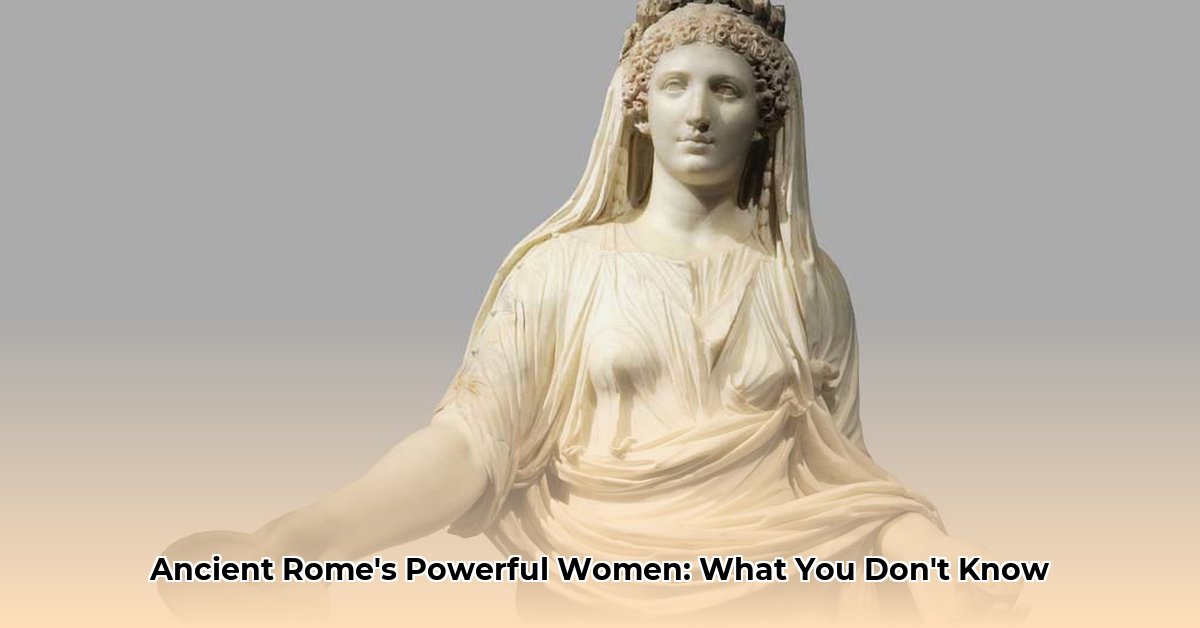
In the annals of ancient Roman history, narratives have predominantly been crafted by men, for men, often relegating the contributions of women to the periphery. Our collective imagination frequently conjures images of mighty emperors, formidable generals, and monumental triumphs, yet intertwined with these male-dominated spheres were extraordinary women who, against formidable odds, skillfully navigated, shaped, and left indelible marks on this powerful civilization. This comprehensive examination aims to transcend conventional accounts, shedding critical light on these often-overlooked figures and demonstrating the profound impact of their agency. It’s important to remember that Roman women’s clothing reflected their status.
Despite Rome’s foundational patriarchal structure, a cadre of exceptionally influential women adeptly discovered and exploited avenues to influence political discourse, cultural norms, and even the very trajectory of imperial power. How did they achieve this in a society where women were legally considered minors, largely excluded from public office, and perpetually under the patria potestas—the legal control of a male relative? By critically evaluating the nuanced lives of figures such as Livia Drusilla, an empress who mastered the intricate art of imperial politics; Fulvia, an assertive political force who audaciously defied societal norms and ignited significant civil upheaval; and Cornelia Scipionis, the philosophical paragon who embodied the pinnacle of Roman womanhood and intellectual integrity, we uncover the multifaceted power, intricate political maneuvers, and enduring contemporary relevance of these remarkable women. This exploration will peel back the layers of male-centric historical portrayals to reveal the authentic influence of Rome’s hidden matriarchy.
Navigating a Man’s World: The Strategies of Roman Women
The legal status of women in ancient Rome was akin to that of children, placing them under the perpetual guardianship of a male (father, husband, or appointed guardian). While elite women could accrue considerable personal wealth, especially through widowhood, their primary societal role, in the eyes of Roman society, was to produce legitimate heirs and manage the household. Yet, within these seemingly rigid constraints, certain women developed ingenious strategies to wield power. These strategies ranged from subtle influence behind the throne to overt political and military leadership, and from intellectual cultivation to religious authority.
Imperial Architects: Power Behind—and On—the Throne
The imperial court offered unique opportunities for women to exert influence, particularly through their relationships with the emperors themselves.
Livia Drusilla (58 BC – AD 29): The First Empress and Master Strategist
Imagine sharing your life with the world’s most powerful man for over five decades, ascending to unprecedented heights of influence. This was the reality of Livia Drusilla, the enduring and highly strategic wife of Emperor Augustus. On the surface, she personified the quintessential Roman matron: steadfastly loyal, supportive, and devoted to her familial duties. However, historical accounts, though often tinged with male suspicion, strongly suggest Livia was far more than a dutiful spouse; she was Augustus’s most trusted confidante, quietly wielding substantial, almost co-regent, influence.
Livia reportedly played a crucial role in ensuring the empire’s seamless operation, offering counsel on critical decisions and even shaping Augustus’s moral legislation, which promoted family values and conservative living—ideals she herself publicly embodied. Her image was elevated to an almost divine status, appearing on coins and statues, a testament to her unique public visibility. Some ancient historians, like Cassius Dio, even whispered that Livia subtly influenced the elimination of rivals threatening her son Tiberius’s ascension to the throne, allegedly by poisoning them with figs. While these rumors remain unsubstantiated, they underscore the pervasive belief in her shrewd political acumen. After Augustus’s death, Livia continued to exert significant influence during Tiberius’s reign, eventually being deified as the “Divine Augusta”—an unprecedented honor for a Roman woman. Her legacy established the mold for future imperial women, demonstrating how a determined woman could master the “long game” of dynastic politics.
Agrippina the Younger (AD 15–59): Unchecked Ambition on Display
Following the formidable path laid by her great-grandmother Livia, Agrippina the Younger was another woman resolutely determined to mold the Roman Empire, though with far less subtlety. Born with an impressive royal pedigree as the daughter of Germanicus and Agrippina the Elder, and sister to Emperor Caligula, Agrippina the Younger experienced a tumultuous early life, including exile for alleged conspiracy. Upon her return, she made a bold and controversial move: she married her uncle, Emperor Claudius, a union formalized only after Claudius manipulated incest laws.
Many scholars surmise her primary objective was to secure the imperial throne for her son, Nero, ahead of Claudius’s own son, Britannicus. After Claudius’s sudden demise—which ancient sources heavily imply was orchestrated by Agrippina through poisoning—she exercised considerable sway over Nero during the nascent years of his reign. She was granted the title “Augusta,” uniquely shared with her living husband, Claudius, further solidifying her political standing. Agrippina was deeply involved in the administration of the empire, attending Senate meetings (though behind a curtain) and wielding direct power, breaking every convention of appropriate female behavior. However, her strategic efforts spectacularly backfired. As Nero matured, he grew to resent his mother’s pervasive control, leading to a series of shocking assassination attempts, which Agrippina famously survived until finally succumbing to a Praetorian plot. Agrippina’s dramatic narrative underscores the perilous consequences of unchecked ambition and the inherent dangers of wielding immense power in a cutthroat political landscape. Her story also highlights how ancient male historians, like Tacitus and Suetonius, often amplified negative character traits to portray powerful women as dangerous and unnatural.
The Severan Matriarchy (Late 2nd – Early 3rd Century AD)
The Severan dynasty offers particularly compelling examples of pervasive female authority, operating effectively and overtly through their male relatives, marking a significant evolution in the public role of imperial women.
- Julia Domna (160 AD – 217 AD): Wife of Emperor Septimius Severus, Julia Domna was an exceptionally intelligent and cultured woman from Syria. She cultivated a thriving intellectual circle around herself, inviting prominent philosophers, rhetoricians, and poets to her court. More than a patron, she actively participated in the governance of the empire, accompanying her husband on military campaigns and earning the unprecedented title Mater Castrorum (“Mother of the Camp”). Her likeness graced coins, further solidifying her public image. After her husband’s passing, she skillfully mediated complex disputes between her warring sons, Caracalla and Geta, a task that ultimately ended in tragedy with Caracalla’s murder of Geta. She continued to serve as Caracalla’s chief advisor until her own death.
- Julia Maesa (Before 160 AD – c. 224 AD): Julia Domna’s astute sister, Julia Maesa, orchestrated the dramatic ascent and eventual downfall of two emperors. Following Caracalla’s assassination and Macrinus’s usurpation, Maesa retired to Syria with her daughters, Julia Soaemias and Julia Mamaea. Recognizing the Praetorian Guard’s discontent with Macrinus, Maesa brilliantly plotted to restore the Severan dynasty by promoting her grandson, Elagabalus (Soaemias’s son), as Caracalla’s illegitimate son. Her wealth and political maneuvering secured Elagabalus the throne. However, when Elagabalus proved an unpopular and controversial ruler, Maesa, with cold calculation, engineered his replacement with her other grandson, Alexander Severus (Mamaea’s son), ensuring her family’s continued grip on power.
- Julia Mamaea (After 180 AD – 235 AD): As the mother of the young Emperor Alexander Severus (who ascended at 14), Julia Mamaea served as his regent and chief advisor throughout his reign. She was renowned for her administrative competence and efforts to stabilize the empire after Elagabalus’s chaotic rule. Mamaea’s influence was such that Alexander was often perceived as weak, a “mama’s boy,” due to his reliance on her, which ultimately contributed to their joint assassination by mutinous soldiers.
These Severan women collectively illustrate a remarkable period where female agency was not merely subtle but overtly central to imperial politics, showcasing an evolution from Livia’s veiled influence to more direct, though still indirect, control through their male relatives.
The Political Mavericks: Women Who Dared to Fight
While many women exerted power indirectly, some, like Fulvia, charted a starkly different course, engaging directly in the cutthroat political arena, often with volatile consequences.
Fulvia (c. 83 BC – 40 BC): A Woman Who Raised Armies
Fulvia’s tumultuous life was intrinsically interwoven with the severe political upheaval and civil strife of the late Roman Republic. A pivotal figure in the period immediately following Julius Caesar’s assassination, Fulvia, born into a prominent plebeian family, strategically leveraged her three marriages to highly influential men for political gain. As the spouse of Publius Clodius Pulcher, a notorious populist tribune, she shrewdly acquired substantial political insight and considerable public clout by skillfully leveraging her husband’s potent influence. Following his tragic assassination, she publicly displayed his brutalized body and grievous injuries in the Roman Forum, adeptly igniting widespread public outrage and thereby assuming a pivotal role in securing his rival Milo’s subsequent conviction. This dramatic event truly signaled the irrevocable beginning of her active and unapologetic engagement in Roman politics, directly challenging the deeply ingrained conventions typically associated with aristocratic women.
Her subsequent strategic unions with Gaius Scribonius Curio and, most notably, Mark Antony, further consolidated her formidable standing within the volatile political sphere. After Caesar’s assassination, Fulvia acutely recognized Octavian’s burgeoning threat to Antony’s authority. When Antony departed Rome for his campaigns in the East, he remarkably entrusted Fulvia, alongside his brother Lucius, with overseeing his critical affairs in Italy. This unprecedented level of delegated authority for a woman inevitably stoked intense animosity with Octavian, particularly after he controversially divorced Fulvia’s daughter, Claudia Pulchra. The escalating conflict intensified dramatically, leading Fulvia to courageously rally and lead eight legions of soldiers in direct support of Antony’s brother Lucius during the Perusine War. Her military command—a truly rare feat for any woman in Roman history—demonstrated her unwavering resolve and her refusal to be a passive political bystander. While her actions unequivocally demonstrated immense courage and unwavering determination, they ultimately resulted in her defeat and subsequent exile.
Despite her undeniable political prowess and military leadership, Fulvia’s historical legacy has been irrevocably tainted by consistently adverse depictions and contentious accusations, largely stemming from the propaganda of her enemies. The most notorious account, found in Cassius Dio’s Roman History (penned centuries after the event), describes her alleged brutal defilement of Cicero’s severed head, piercing his tongue with her golden hairpin in revenge for his vitriolic speeches against Antony. Distinguished modern historians widely dispute the precise accuracy of this gruesome story, viewing it primarily as potent propaganda expressly aimed at discrediting and dehumanizing a powerful and politically active woman. Her story vividly illustrates the monumental risks women encountered when directly confronting male dominance in ancient Rome. Was her defiance brave or reckless? History, in its complexity and bias, provides no facile answers.
Pillars of Virtue and Intellect: Indirect Influence
While certain women pursued power through direct political engagement, others exerted profound influence over Roman society through their intellect, moral character, and strategic upbringing of the next generation.
Cornelia Scipionis Africana (c. 190s – c. 115 BC): The Matron Model
As the distinguished daughter of Scipio Africanus, the celebrated Roman general renowned for his decisive victory over Hannibal, Cornelia Scipionis Africana inherited a truly formidable legacy of Roman excellence and aristocratic prestige. She was celebrated for her eloquence, acute intellect, and unwavering virtue, widely regarded as the embodiment of an ideal Roman matron. Notably, she received a comprehensive Greek education, a distinct privilege not typically extended to women of her era, providing her with a solid foundation in both literature and philosophy.
Most famously, Cornelia was the revered mother of Tiberius and Gaius Gracchus, two intrepid tribunes who passionately championed radical land reforms explicitly aimed at assisting Rome’s impoverished and dispossessed citizens. She instilled in them a profound sense of civic duty and intellectual curiosity. While various historical sources consistently agree on her profound devotion to their comprehensive education, the precise extent of her direct involvement in their controversial political endeavors remains a significant point of intense contention among historians. Some scholars cautiously suggest she subtly yet powerfully encouraged their ambitious reforms, while others posit that she disapproved of their more extreme and destabilizing measures, as seen in the “Cornelia Fragments”—letters attributed to her, urging Gaius to delay his tribunate. These letters, if definitively authenticated, offer tantalizing glimpses into her presumed thoughts and emotional landscape, revealing a complex woman deeply proud of her sons’ intellectual prowess yet profoundly concerned about the potential dire consequences of their radical actions.
Cornelia’s remarkable life embodies a profound paradox: a woman formally excluded from direct political power, yet who nevertheless wielded significant influence through her formidable family connections, impeccable personal reputation, and cultivation of intellectual circles. Even after the tragic deaths of her sons, Cornelia steadfastly remained a highly respected figure in Roman society, embodying the highest ideals of Roman motherhood and profound personal virtue. Her life serves as a powerful and timeless reminder that influence can indeed manifest in myriad forms, and that even within a rigidly patriarchal society, women could and did find powerful ways to actively shape their world.
| Woman | Method of Influence | Outcome |
|---|---|---|
| Livia Drusilla | Advising her husband, strategic family maneuvering | Secured her family’s dynastic position on the throne, established the role of Empress. |
| Agrippina the Younger | Marrying the emperor, influencing her son’s early reign | Murdered by her own son after he resented her attempts at control. |
| Fulvia | Direct political action, raising private armies | Defeated and exiled for overtly challenging male political dominance, tarnished legacy. |
| Cornelia | Educating her sons, instilling civic duty and values | Her sons became influential political reformers, impacting Roman plebeian rights. |
Diverse Avenues of Influence: Beyond the Elite
The impact of Roman women extended beyond the imperial court and aristocratic circles, reaching into religious life, civic engagement, and even military leadership on the fringes of the empire.
Vestal Virgins: Sacred Power and Unique Freedoms
Roman women were not entirely excluded from significant public life. The Vestal Virgins, priestesses of Vesta, goddess of the hearth, were entrusted with the sacred and perpetual maintenance of Rome’s eternal flame—a duty considered vital for the city’s prosperity. Remarkably, their unique status exempted them from many of the traditional restrictions placed upon other Roman women. They possessed the rare legal ability to make a will, own property, and manage their own financial affairs. They even held the powerful capacity to pardon condemned criminals simply by encountering them on the street, and their presence ensured safe passage for travelers.
While their vow of chastity was absolute and their period of service (30 years) long and demanding, their considerable influence was deeply rooted in their sacred religious authority, serving as a powerful reminder that influence and power can indeed manifest in myriad, often unexpected, ways within a complex society. However, defying their vow carried the direst consequence: being buried alive, as was the fate of Cornelia the Chief Vestal under Emperor Domitian.
Boudicca (1st Century AD): A Rebel Queen Across the Empire
Beyond the heart of Rome, on the distant fringes of the empire, women sometimes attained direct military and political leadership. Boudicca, queen of the Iceni tribe in Roman Britain, stands as a fearsome testament to this. After her husband Prasutagus died, Roman officials violated his will, seized Iceni lands, and brutally assaulted Boudicca and her daughters. In AD 60/61, Boudicca united various British tribes, leading a massive rebellion against Roman rule.
Unlike women in Roman society, women in Celtic societies sometimes held positions of leadership and fought alongside men. Boudicca orchestrated devastating attacks on major Roman settlements, including Camulodunum (Colchester), Londinium (London), and Verulamium (St. Alb










