Ever wondered what truly powered the Roman war machine beyond just disciplined legions? It was their remarkable adaptability in military equipment, a testament to relentless innovation and pragmatic design. This comprehensive guide delves deep into the evolution, construction, and profound impact of ancient Roman soldier armor and weaponry, exploring how these protective layers and offensive tools were more than mere defense or attack – they were strategic assets. From the flexible lorica hamata to the iconic lorica segmentata, and from the versatile gladius to the piercing pilum, we will uncover how design, mass production, and continuous refinement were fundamental to Rome’s enduring military supremacy. Prepare for a fascinating journey into the sophisticated world of Roman military gear and discover enduring lessons for contemporary defense and logistics. Roman military ranks played a crucial role in command. Learn more about it here.
The Evolution of Roman Soldier Armor
Roman military success was intrinsically linked to its evolving equipment, a testament to their pragmatic approach to warfare. The willingness to adopt and refine technologies, such as integrating the gladius Hispaniensis (a short sword adapted from Spanish designs) or the lorica hamata (chainmail influenced by Celtic warriors), demonstrates their continuous pursuit of effectiveness. This constant adaptation highlights a key aspect of Roman military doctrine: a readiness to learn from both allies and adversaries, continuously modifying designs based on battlefield experiences.
Primary Forms of Roman Armor
Understanding the distinct types of ancient Roman soldier armor provides insight into their defensive capabilities and manufacturing complexities.
Lorica Hamata (Chainmail): This widely recognized form of chainmail, with origins in Celtic craftsmanship, was standard issue for Roman legionaries and auxiliaries from the Republic throughout much of the Empire. Constructed from thousands of interlocking iron or bronze rings—alternating closed washer-like rings with riveted rings—it created a highly flexible, reliable, and strong armor. Each ring typically had an inside diameter of 5-7 mm and an outside diameter of 7-9 mm. The shoulders featured distinctive flaps, similar to Greek linothorax, connected by brass or iron hooks. While labor-intensive to manufacture (a single shirt could take months, requiring upwards of 30,000 rings), its durability meant it could be used for decades with proper maintenance. It offered excellent protection against slashing attacks but was somewhat less robust against targeted piercing weapons compared to later designs. Its enduring presence, however, speaks to its reliability and ease of field repair.
- Advantages: High flexibility, excellent durability, relatively simple repair, reliable protection against slashing.
- Disadvantages: Heavy, time-consuming to produce initially, less robust against direct piercing thrusts compared to plate.
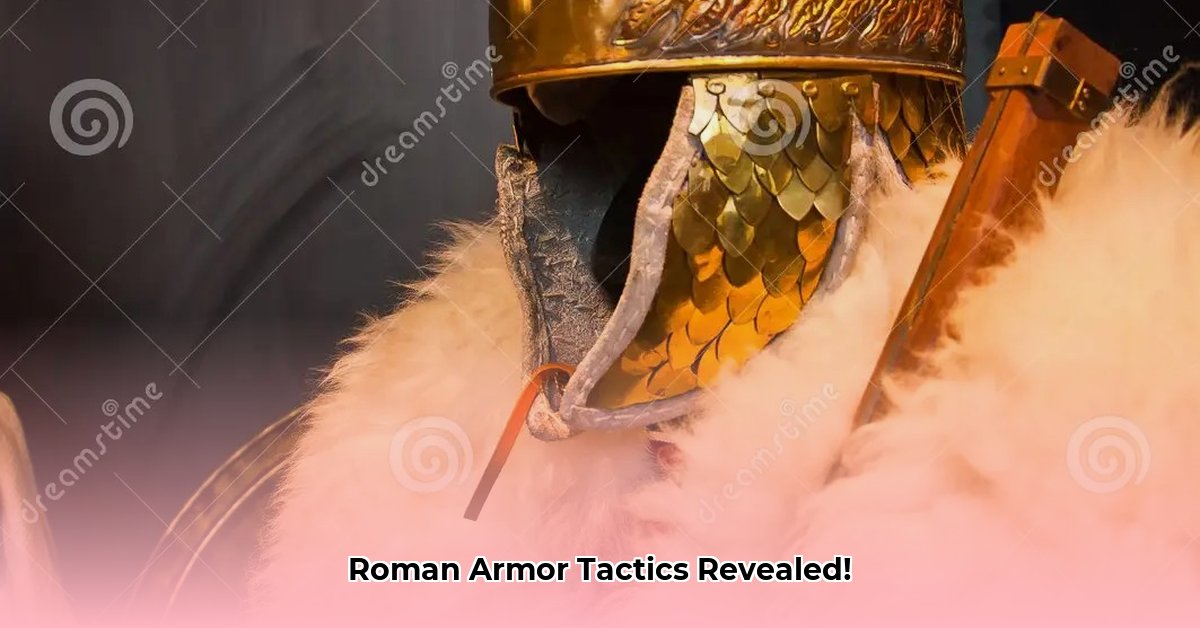
Lorica Squamata (Scale Armor): Composed of numerous small, overlapping scales (typically iron or bronze, sometimes alternating metals or tinned for decoration) sewn onto a fabric or leather backing, lorica squamata presented an improved protective barrier. The scales ranged in size from tiny (6 mm wide by 1.2 cm tall) to larger (5 cm wide by 8 cm tall), with common sizes around 1.25 by 2.5 cm. They overlapped in all directions, offering multiple layers of defense. Each scale had multiple holes (4-12) for wiring to adjacent scales and sewing to the backing, making it a labor-intensive process. This lamellar system offered better defense against slashing and piercing attacks than chainmail, and its flexibility made it a practical choice, particularly for standard bearers, musicians, centurions, cavalry, and auxiliary infantry. While some sources suggest vulnerability to an upward thrust, this is likely exaggerated given the overlapping design.
- Advantages: Enhanced protection against various attack types, good flexibility, visually striking.
- Disadvantages: Complex and time-consuming manufacturing, potential (though exaggerated) vulnerability in gaps between scales.
Lorica Segmentata (Segmented Plate Armor): Perhaps the most iconic Roman armor, lorica segmentata featured broad ferrous strips (girth hoops) secured to internal leather straps, arranged horizontally and overlapping downwards. This provided exceptional protection to the torso and shoulders, especially against powerful blows and missile strikes. Known types include Kalkriese (c. 20 BCE-50 CE), Corbridge (c. 40-120 CE), and Newstead (c. 120-early 4th century CE). Replicas have demonstrated its impermeability to most direct hits. While offering superior defense and being about half the weight of lorica hamata for similar protection, its widespread adoption across all units and its eventual decline remain subjects of scholarly debate. Historians frequently discuss its higher cost and the intensive maintenance required for its multiple hinged and strapped brass components, which made field repairs more challenging. It was notably compact for storage when disassembled.
- Advantages: Superior protection against impact and piercing, lighter than mail for comparable coverage, compact storage.
- Disadvantages: Higher production cost, complex maintenance, difficult to repair in the field, less flexible than other types.
Essential Defensive Aids and Garments
Roman soldiers’ effectiveness extended beyond just body armor. A suite of integrated equipment worked in synergy to enhance their combat prowess.
Helmets (Galea or Cassis): Roman helmets varied greatly in form, protecting the head—a critical vulnerability. Early types included the Montefortino (up to 1st century BCE, Celtic-influenced, conical with cheek and neck guards) and the Coolus (similar but cheaper for mass production, popular during Gallic Wars). Later, the Imperial Gallic (rounded cap, prominent cheek guards, flanged neck guard) and Imperial Italic designs emerged, both drawing influence from Gallic tribes. These typically featured a bowl, a neck guard, a ridge above the forehead for impact protection, and hinged cheek guards that left ears exposed for better hearing. Ridge helmets and Spangenhelms became prevalent in the late imperial period, some showing Eastern design elements like the Intercisa. The ornate Berkasovo helmet was likely reserved for high-ranking officers. Many were adorned with decorative features like horsehair plumes.
Shields (Scutum, Parma, Caetra): The distinctive large, rectangular, semi-cylindrical scutum served not merely as a defensive tool but also as an offensive instrument, used to push and disorient enemy formations. Adopted from Italic peoples, it replaced the round clipeus. Constructed from layers of wood reinforced with metal or leather, its curved shape effectively deflected blows and projectiles. Its size provided protection for both the individual soldier and neighboring comrades, fostering cohesion in formations like the testudo (tortoise), which was highly effective against missile fire during sieges. Other shields included the smaller, round parma (three Roman feet across, used by velites, strongly made with multiple wood layers glued, leather stretching, and an iron frame), and the light caetra (steel and leather, used by tribesmen from Hispania, Mauretania, and Britannia). Every scutum had a leather cover, removed before battle or triumph.
Manica (Arm Guard): Segmented armor for one or both arms, first used by gladiators and later depicted on Roman legionaries during the Dacian Wars. Made from padded cloth or overlapping metal sheets, it provided crucial limb protection while maintaining mobility.
Greaves: Sheet metal protecting the legs, particularly the shins and calves, were widely used in the early Republic and by some imperial troops. Early Roman legionaries often wore a single greave on the left leg, which was more exposed under the shield, a fashion common in Italic cultures.
Undergarments and Clothing:
- Tunic: A basic wool garment worn under armor by all soldiers, initially rectangular cloth pieces sewn together, later with sleeves. Often worn with braccae.
- Subarmalis: A padded jacket made of linen or leather, worn underneath armor (like lorica hamata or segmentata) to provide impact protection, better weight distribution, and comfort, reducing chafing and bruising.
- Focale: A scarf worn by legionaries to protect the neck from chafing caused by constant contact with armor and helmet.
- Balteus: A sword belt, typically for the gladius.
- Cingulum Militare: A type of decorated belt, broader than the balteus, often comprising multiple straps, serving as a symbol of the legionary’s status and indicating rank. It supported both the sword and dagger.
- Braccae: Woolen trousers, becoming fashionable later.
- Subligaria: Underpants, confirmed by Vindolanda tablets.
- Cloak: Two types, the sagum (similar to a poncho) and the paenula (hooded in colder climates). Both were made from wool for insulation and water repellency, fastened with a fibula. Essential for warmth, especially as soldiers slept in the open, they were designed to be double-folded to not fall beneath the knees when worn, ensuring portability.
- Caligae (Military Boots): Leather, laced up the center of the foot and onto the ankle, with iron hobnails hammered into the sole for added strength and grip, similar to modern cleats. Later, enclosed boots replaced them.
- Pteruges: Leather or fabric strips that formed a skirt or sleeves, typically part of the subarmalis, providing limb protection while maintaining mobility and ventilation. They could be fitted with small metal studs for additional defense.
Offensive Weaponry and Field Tools
In conjunction with their armor, the primary weapons completed the legionary’s formidable arsenal, making them a balanced and formidable fighting force.
Pugio (Dagger): A sidearm, typically 18-28 cm long and over 5 cm wide, with a leaf-shaped blade and a raised midrib. Early versions had a wide, flat tang with riveted hilts; later, around 50 CE, a rod tang was introduced, sometimes with narrower blades. Hilts, 10-12 cm long, were often decorated with inlaid silver and designed for a secure grip.
Gladius (Short Sword): The general Latin word for ‘sword’. The gladius Hispaniensis, a 60 cm (24 inches) short sword, became the primary weapon of Roman legionaries from the 3rd century BCE, replacing earlier thrusting weapons. Later designs included the Mainz and Pompeii gladii. Legionaries wore their gladii on their right hips. Blacksmiths crafted them with harder steels on outer layers and softer steels in the center for strength and flexibility.
Spatha (Long Sword): A longer sword characteristic of the middle and late Roman Empire. Roman cavalry started using spathae in the 1st century CE, and by the late 2nd or early 3rd century, Roman infantry also adopted them, often switching from javelins to spears. Shorter versions were called semispathae.
Hasta (Thrusting Spear): A Latin word for a thrusting spear, about 1.8 meters (six feet) long with an ash shaft and iron head (sometimes bronze in earlier Republican times). Carried by early Roman legionaries (camillan) and giving their name to the hastati. However, during Republican times, hastati were re-armed with pila and gladii, with only the triarii still using hastae.
Pilum (Heavy Throwing Javelin): The heavy Roman throwing javelin of the legions, typically less than two meters (6 ft 7 in) long, weighing 2-4 kg (later versions lighter). It consisted of a wooden shaft projecting an iron shank (about 7 mm in diameter and 60 cm long) with a pyramidal head. Designed to penetrate shields and armor, it could also get stuck, weighing down enemy shields. While some theories suggest the shank would bend, recent evidence indicates many types did not spontaneously bend, and historical accounts (Caesar, Plutarch, Arrian) describe its use in close-quarters melee combat as a spear or pike, suggesting a robust design.
Other Javelins: Lighter, shorter javelins like the verutum were used by velites. Later types like the lancea and spiculum were influenced by Italic warriors.
Bows and Arrows (Arcus & Sagitta): The sagittarius (archer) was armed with composite bows made of horn, wood, and sinew, shooting arrows. Vegetius recommended training recruits with wooden bows. Reinforcing laths for composite bows have been found across the empire, indicating widespread use.
Crossbows (Cheiroballistra or Manuballista): Mechanical hand-held weapons similar to medieval crossbows, occasionally used. Roman authors like Vegetius mentioned arcuballista and manuballista. Arrian recorded Roman cavalry training with such weapons from horseback, and sculptural reliefs depict their use in hunting.
Plumbatae (Lead-Weighted Throwing Darts): Late infantrymen often carried half a dozen of these darts (effective range c. 30 m), clipped to the back of their shield, offering a range well beyond typical javelins.
Entrenching Tools: Crucial for constructing nightly camps, fortifications, and latrines, these tools also served as impromptu weapons.
- Dolabra: A pickaxe used for entrenching.
- Ligo: A pick-mattock or draw hoe with a blade perpendicular to the handle.
- Falx: A curved blade, sharp on the inside edge (like a sickle or scythe), used for clearing.
- Shovel (Batillum) & Wicker Basket: Carried by legionaries for digging and hauling earth.
Standardization and Mass Production in the Roman Army
The Roman military’s shift towards greater standardization, significantly influenced by the Marian reforms around 107 BCE, marked a pivotal moment in ancient military logistics. This drive for uniformity aimed to streamline the logistical challenges of equipping vast armies, making training more consistent and efficient. Imagine the immense difficulty of supplying thousands of soldiers with a heterogeneous array of equipment; standardization offered a clear advantage.
However, despite these efforts, complete uniformity was rarely achieved in practice. Variations often existed based on a soldier’s unit type, the specific era, and even their individual wealth or rank. For instance, an officer’s armor would typically feature higher quality materials and craftsmanship compared to that of a common legionary, reflecting a blend of state-issued gear and personal acquisition. The Marian reforms, though often portrayed as a singular, immediate overhaul, were part of a more gradual process, continually adapting to the Republic’s evolving military needs and social dynamics. Indeed, at times, the massive demand for equipment, particularly during civil wars, led to a decline in quality, with sources describing helmets covered by wicker protections and reduced-size cuirasses indicative of cost-saving and rapid mobilization.
Constant Adaptation: A Roman Military Hallmark
The Roman military was not static; it was a living, breathing entity that constantly adapted to its operational environments and emerging threats. A critical aspect of their enduring success was their willingness to adopt effective equipment from conquered peoples, demonstrating a pragmatic and non-dogmatic approach to military innovation. From adopting Greek and Etruscan weapon models to basing new varieties on Celtic equipment and even constructing an entire fleet de novo based on Carthaginian designs, this process was continuous. Designs were frequently modified based on battlefield experiences and lessons learned from engagements with diverse enemies, such as the Parthians, which highlighted the usefulness of heavily armored cataphracts and mounted archers. The relentless pursuit of technological advancements in armor production and material science underpinned Rome’s sustained military superiority, ensuring their soldiers were consistently outfitted with the best available protective gear. For the Romans, innovation was not an occasional pursuit but an integral, ongoing component of their military strategy.
The Profound Impact of Armor on Roman Military Effectiveness
The design and deployment of ancient Roman soldier armor played a pivotal role in more than just individual soldier protection; it profoundly shaped Roman military effectiveness. Armor directly influenced Roman military tactics, enabling tightly packed formations like the tortoise formation (testudo) that could withstand volleys of projectiles, effectively transforming a unit into a mobile, almost impenetrable fortress. Furthermore, the psychological impact of Roman armor was immense. The imposing sight of heavily armored legionaries, marching in unison with their large scutum, could instill fear in their enemies before a single blow was struck, often influencing the outcome of engagements. The distinctive clanking of lorica segmentata and the glint of polished metal must have presented a formidable and terrifying spectacle. Simultaneously, this robust protection boosted the morale of Roman soldiers, fostering a sense of invincibility and confidence crucial for maintaining discipline under extreme pressure. Historical accounts suggest that in numerous pivotal battles, the superior protection offered by Roman armor was a decisive factor, tipping the scales in their favor against less well-equipped adversaries, allowing them to endure prolonged combat, advance through missile fire, and maintain cohesion.
The Decline of Segmented Armor and Enduring Legacy
The lorica segmentata, despite its superior protection, eventually saw a decline in its widespread use, particularly after the 3rd century CE. Contributing factors likely included its complex construction, higher production costs, and the considerable maintenance required for its multiple hinged and strapped components, making it less economical for a vast, increasingly decentralized empire. As the Roman Empire faced new threats and evolved its military strategies towards more mobile forces and a greater reliance on cavalry and auxilia, simpler, more versatile, and cost-effective armor types like chainmail (lorica hamata) and scale armor (lorica squamata) re-emerged as preferred options, with the army of the late empire largely reverting to mail. Actual examples of both scale armor and large sections of mail have been recovered from 4th-century contexts, despite earlier statements to the contrary. Despite these changes and the fall of the Western Empire, the Roman emphasis on military engineering, standardized production, and efficient logistics left an indelible mark on subsequent military organizations throughout history. Their innovations in resource management and supply chain resilience continue to be studied and admired, offering valuable insights into the principles of effective large-scale military operations.
Siege Engines and Field Artillery
Beyond personal equipment, the Romans developed advanced artillery to enhance their combat capabilities and siege warfare.
Ballista: A powerful catapult, consisting of a beam with a frame, mounting two rigid arms powered by torsion in bundles of sinew. It launched heavy bolts or spherical stone projectiles of various sizes. Ballistas were also fitted with grappling hooks to seize enemy vessels during naval engagements. The Romans developed improved versions, some with inward-facing arms, as evidenced by findings at Hatra in Iraq.
Scorpio: A torsion-powered catapult-type weapon, smaller than a ballista, firing bolts capable of piercing enemy shields and armor. The Roman army typically supplied 60 scorpioi to each legion, deploying them offensively during sieges and defensively as part of field camp defenses. They were also mounted on ships and carriages to provide mobile support to infantry.
Onager: A torsion-powered siege engine named after the “kicking” action of an Asiatic ass. It hurled projectiles (usually stones) in a high arc from a cup or sling attached to an arm that swung vertically against a stop.
Signaling and Communication
Effective communication and signaling were vital for coordinating large Roman armies.
- Buccina: A brass instrument, typically 11-12 feet long with a narrow cylindrical bore, played with a cup-shaped mouthpiece. Its tube was bent into a broad ‘C’ shape, held by a bar across the curve. The buccina was used for announcing night watches and various other announcements within the camp, serving as an ancestor to both the trumpet and trombone.
Defensive Obstacles
Romans also employed passive defensive measures to hinder enemy advances.
- Tribulus (Caltrop): A weapon made of four sharp nails or spines arranged so that one always pointed upward from a stable base. Caltrops were highly effective in slowing down the advance of horses, war elephants, and human troops, particularly against soft-footed animals like camels. The late-Roman writer Vegetius, in De Re Militari, describes how Romans used caltrops to neutralize scythed chariots by strewing the battlefield with them, causing the chariot horses to be destroyed.
The Soldier’s Pack (Sarcina)
A legionary’s personal gear extended beyond combat equipment. Each soldier carried a military pack (sarcina) suspended from a furca or carrying pole, making each soldier a “Marius’ mule.” This pack contained essential items for daily life and camp construction:
- Loculus: A leather satchel for personal belongings.
- Waterskin: For carrying daily water, even when camps were near water sources.
- Food Rations: Legionaries were required to carry about 15 days’ worth of basic food supplies (e.g., grain, salt, bacon) to ensure self-sufficiency on the march, supplementing the main baggage train.
- Cooking Equipment: Included a patera (pan/bowl), a cooking pot, and a skewer.
- Entrenching Tools: Each legionary typically carried either a shovel (batillum), a dolabra (mattock) for digging, a turf-cutting tool, or a wicker basket for hauling earth, essential for constructing the formidable Roman marching camps every night.
- Sudis (Palisade Stakes): Carried for constructing the defensive palisade around temporary camps, reinforcing the ramparts.
Actionable Intelligence for Stakeholders
Understanding the nuances of Roman military equipment provides invaluable insights across several modern domains.
For Historians and Researchers:
- Conduct detailed comparative assessments of Roman armor types, integrating both textual historical documents and archaeological discoveries to refine understanding of their widespread adoption and performance.
- Investigate the financial consequences of producing and maintaining standardized military equipment, analyzing the economic burden versus strategic advantage.
- Generate thorough digital recreations and material analyses of Roman military equipment using advanced computing and experimental archaeology to test historical theories.
- Explore the socioeconomic variables (e.g., soldier wealth, unit type, regional availability of materials) impacting equipment selection and their influence on broader Roman military capability and cohesion.
For Museums and Reenactors:
- Enhance the precision and historical genuineness of Roman military equipment exhibits and reenactments by incorporating the latest research on construction,











1 thought on “Decoding Ancient Warfare: Ancient Roman Soldier Armor Tactics Revealed”
Comments are closed.