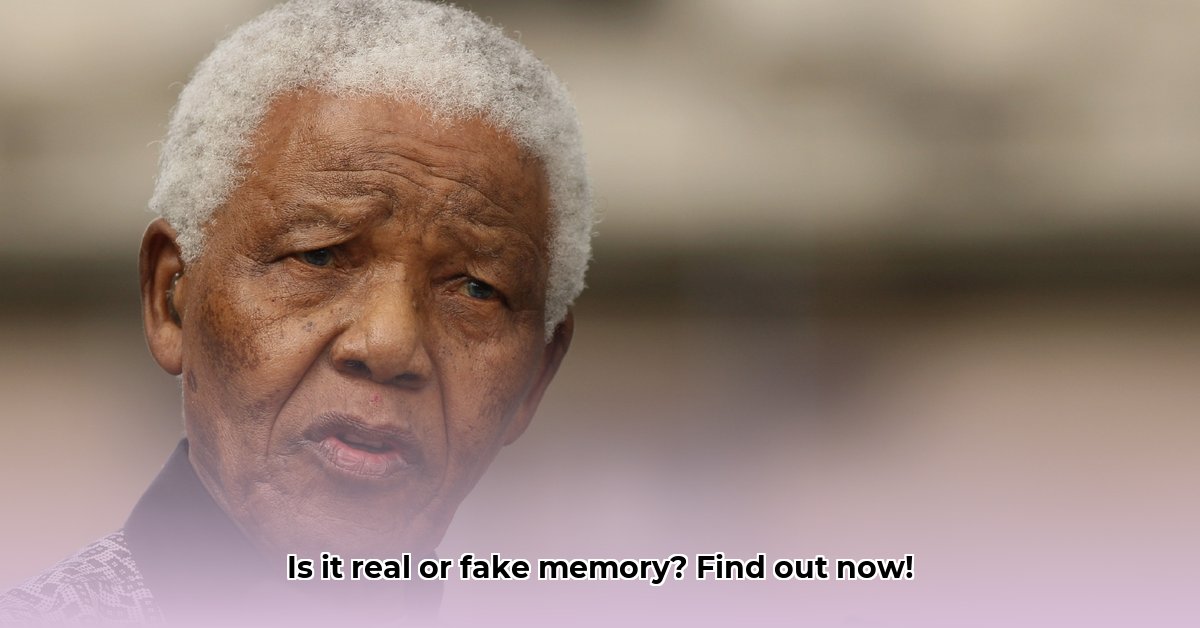
The Mandela Effect is a captivating phenomenon where substantial groups of people collectively harbor false memories of events that either never transpired or unfolded differently from their recollections. These shared inaccuracies, frequently centered on seemingly insignificant details, provide valuable insights into the intricate mechanisms of human memory, the pervasive influence of social dynamics, and the potent impact of the internet. For more on how collective memory shapes our perceptions of reality, see this article on mythical creature origins. Rather than attributing it to supernatural forces or mystical occurrences, understanding this phenomenon requires exploring cognitive biases and the ways in which we collaboratively construct our shared understanding of the past.
Delving into the Psychology of False Collective Memories
Have you ever experienced the disconcerting sensation of absolute certainty about something, only to confront the realization that your memory was inaccurate? This experience lies at the core of the Mandela Effect. It’s not merely about isolated instances of individual misremembering; rather, it constitutes a collective phenomenon that transcends individual boundaries. Cognitive distortions and social contagion are prominent factors contributing to the formation and propagation of false memories, thereby fueling the Mandela Effect. Consider the iconic line “Luke, I am your father” from the renowned film Star Wars. The widespread misremembering of this quote serves as a compelling illustration of how memories can undergo alteration and dissemination within a population. These pervasive “false memories” can extend to encompass a diverse range of elements, including corporate logos, significant historical events, and mundane everyday details, thereby underscoring the pervasive nature of this phenomenon.
Defining the Mandela Effect
The Mandela Effect manifests when a considerable number of individuals concurrently share an inaccurate recollection of an event, detail, or fact that deviates from its actual occurrence. What renders the Mandela Effect particularly intriguing is the collective nature of these false memories, thereby transforming it from an individual quirk into a widespread phenomenon. Rather than attributing it to speculative notions such as time travel or parallel universes, it is more appropriately regarded as a compelling puzzle rooted in the collective misremembering of information.
The Brain’s Memory System: Unraveling the Reasons Behind Memory Distortions
Our memories are not static, flawless recordings; rather, they resemble continuously evolving narratives that undergo revision each time we recall them. This iterative process entails the reconstruction of our past experiences, rendering them susceptible to errors and distortions. Various cognitive mechanisms, including confirmation bias, source monitoring errors, and reconstructive memory, play pivotal roles in shaping these memory distortions. This inherent propensity for memory distortion creates opportunities for inaccuracies to infiltrate our recollections.
- Confirmation Bias: Our inclination to selectively remember information that aligns with our pre-existing beliefs, while disregarding contradictory evidence, contributes to the distortion of memories.
- Source Monitoring Error: The brain’s occasional struggle to accurately identify the origin of a memory blurs the distinction between reality and suggestion, leading to source monitoring errors.
- Reconstructive Memory: Each instance of memory retrieval involves a process of reconstruction, during which we may unconsciously introduce or modify details. As time elapses, the clarity of details may diminish, leading us to unintentionally fill in gaps or alter aspects to enhance the coherence of the narrative.
The Internet’s Role: Amplifying and Disseminating Erroneous Recollections
Social media platforms can inadvertently foster the creation of “echo chambers,” wherein individuals primarily engage with others who espouse similar beliefs. Consequently, when a false memory is introduced into such an environment, it undergoes reinforcement and amplification. The collective confirmation of mistaken recollections among individuals within these echo chambers serves to solidify and authenticate such inaccuracies. This phenomenon underscores the potency of social contagion, whereby ideas, beliefs, and even false memories can propagate through social networks. This engenders a snowball effect, wherein the repetition of an incorrect version amplifies its perceived veracity.
Examining the Key Psychological Factors
The following table provides a detailed overview of the key psychological factors underpinning the Mandela Effect:
| Factor | Description | Example |
|---|---|---|
| Confirmation Bias | The tendency to favor information that confirms existing beliefs and disregard contradictory information. | Believing a misremembered quote because it aligns with your perception of the character. |
| Source Monitoring Errors | Difficulty in accurately identifying the origin of a memory, leading to misattribution of its source. | Mistaking information gleaned from a book for an actual memory from your childhood. |
| Reconstructive Memory | Memories are reconstructed each time we recall them, potentially incorporating inaccurate or imagined elements. | Incorporating details into a childhood memory that did not occur to create a more coherent narrative. |
| Social Contagion | The ease with which misinformation spreads within social groups through repetition and mutual reinforcement. | Repeating a false memory shared online and internalizing it as a veridical memory. |
| Online Echo Chambers | Online communities that reinforce existing beliefs by limiting exposure to alternative perspectives. | A Facebook group consistently sharing a demonstrably false historical account without affording opportunities for correction. |
Distinguishing Fact from Fiction: Cultivating Critical Thinking Skills
The Mandela Effect offers valuable insights into the often-unreliable nature of human memory. We must exercise critical thinking skills, including regularly examining our memories, verifying information from credible sources, and evaluating the information encountered online. This phenomenon serves as a potent reminder of the imperative to question our knowledge and assumptions. Implications extend to various domains, including eyewitness testimony in legal proceedings and the susceptibility of communities to the spread of misinformation. It emphasizes the significance of media literacy and the deliberate processing of information in the digital era.
Enhancing Accuracy Through Verification Techniques
Key Takeaways:
- False memories are not deliberate fabrications but rather result from errors in the brain’s processing and storage of information.
- Memory encoding, storage, and recall are all vulnerable to distortions.
- Misinformation exerts a substantial impact on memory accuracy and has the potential to overwrite genuine memories.
- Individual variations in factors such as age, attention span, and emotional state influence susceptibility to false memories.
- The internet and social media platforms amplify the dissemination of false memories, underscoring the need for source verification techniques to enhance accuracy in the digital age.
Exploring the Core of the Mandela Effect
That persistent sensation of something being “off” represents a common human experience. The Mandela Effect characterizes this phenomenon as a widespread, collectively shared false memory pertaining to a past event. It transcends the realm of individual memory slips, encapsulating instances wherein groups of individuals concurrently misremember specific details. Consider the quintessential example: many vividly recall Nelson Mandela’s demise in prison during the 1980s, a notion demonstrably refuted by historical records. This shared misremembering underscores the remarkable capacity of collective false memories.
Unveiling the Psychology Behind False Memories
These phenomena are not merely quirky anomalies but rather provide insights into the plasticity of human memory. Our memories are not immutable recordings; they are reconstructions susceptible to alteration. Several factors contribute to this phenomenon:
Cognitive Biases: Cognitive biases, including confirmation bias (favoring information that validates pre-existing beliefs), source monitoring errors (erroneously attributing the source of information), and reconstructive memory (integrating plausible but inaccurate details), play a role in shaping memory distortions.
Social Contagion: False memories can disseminate rapidly, particularly within online environments. Social contagion, defined as the spread of behaviors or beliefs within a group, amplifies this effect. Echo chambers and online communities characterized by the reinforcement of existing beliefs may exacerbate this phenomenon.
The Internet’s Influence on Misinformation Dissemination
The internet and social media platforms function as extensive echo chambers, accelerating the propagation of false memories. Information disseminates rapidly, irrespective of its veracity. Algorithms prioritize engagement, occasionally amplifying sensational or misleading content. This results in the swift and widespread dissemination of misinformation, thereby underscoring the imperative of adopting source verification techniques (fact-checking and media literacy) in the digital age.
Implications and Directions for Future Research
Understanding the Mandela Effect has far-reaching implications, including revealing limitations in eyewitness testimony and challenging conventional understandings of historical accuracy. It also illuminates the susceptibility of collective memory to distortion. Further research is warranted to explore:
- The underlying neural mechanisms involved in the formation and dissemination of false collective memories.
- The influence of various types of misinformation on memory distortion.
- The development of effective strategies for identifying and rectifying false memories, particularly in societal contexts.










