
Ever found yourself staring at a measurement in millimeters, only to realize your tools or plans are in inches? It’s a common dilemma, whether you’re a seasoned DIY enthusiast, a budding crafter, a meticulous engineer, or just trying to understand product specifications. Bridging the gap between the metric system (millimeters) and the imperial system (inches) is an essential skill. This comprehensive guide will equip you with everything you need to convert 8mm to inches with confidence, helping you navigate your projects and purchases seamlessly.
We’ll cover the fundamental conversion principles, provide a detailed step-by-step process for 8mm to inches, explore various practical conversion methods, and delve into real-world applications. By the end of this article, you’ll not only master this specific conversion but gain a deeper understanding of millimeters to inches that will make all your future measurement tasks straightforward.
Accurate conversions are crucial in various applications, and for streamlining data collection processes in different measurement systems, a modern form like those available at Lola can be invaluable.
Understanding the Basics: Millimeters and Inches
Before we dive into the calculations, let’s establish a clear understanding of the units we’re working with. Familiarity with both systems is the first step in successful mm to inches conversion.
The Metric System: Millimeters (mm)
The millimeter (mm) is a unit of length in the metric system, the most widely used system of measurement globally. It’s a small unit, precisely defined as one-thousandth of a meter (1 meter = 1000 millimeters). The metric system is lauded for its simplicity and decimal-based structure, making calculations and scaling very straightforward.
The Imperial System: Inches (in)
The inch (in) is a unit of length primarily used in the United States, Canada (informally), and the United Kingdom. Historically, its definition varied, but today, the international inch is precisely defined in relation to the metric system. It’s a larger unit than the millimeter, with 12 inches making up a foot and 36 inches making up a yard.
The Universal Bridge: Why 25.4?
The cornerstone of millimeters to inches conversion lies in one universally accepted constant: 1 inch is exactly equal to 25.4 millimeters. This precise definition allows for accurate and consistent conversions between the two systems worldwide. This exact value was established by international agreement in 1959, simplifying trade, industry, and scientific communication.
The Definitive Guide to Convert 8mm to Inches
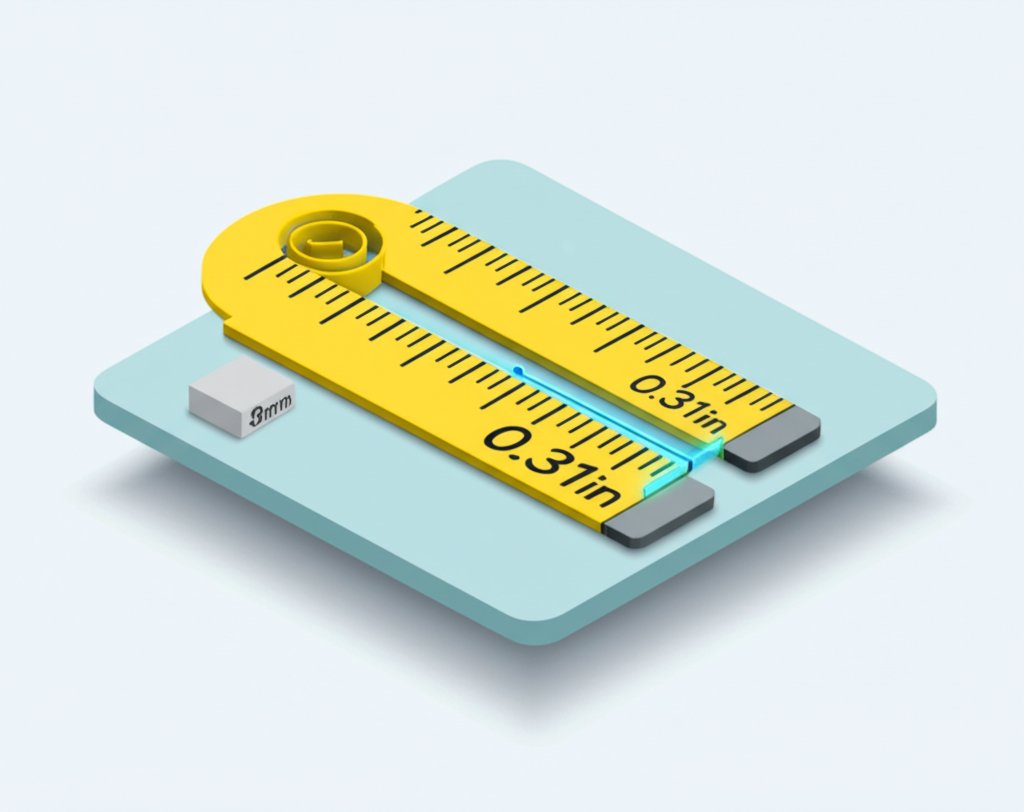
Now, let’s get to the heart of the matter: how to perform the 8mm to inches conversion. It’s simpler than you might think, relying on a straightforward formula.
The Core Formula for Millimeters to Inches
To convert millimeters to inches, you always divide the millimeter value by the constant 25.4.
Formula: Inches = Millimeters ÷ 25.4
This formula is your go-to for any mm to inches conversion you encounter.
Step-by-Step: Converting 8mm to Inches
Let’s apply this formula specifically to 8mm to inches:
- Identify the Millimeter Value: In our case, the value is 8 mm.
- Recall the Conversion Factor: 1 inch = 25.4 millimeters.
- Apply the Formula: Divide your millimeter value by 25.4.
Inches = 8 mm ÷ 25.4
- Perform the Calculation:
8 ÷ 25.4 ≈ 0.31496062992…
Round to Desired Precision: For most practical purposes, rounding to two or three decimal places is sufficient.
- Rounded to two decimal places: 0.31 inches
- Rounded to three decimal places: 0.315 inches
So, 8mm is approximately 0.315 inches.
Precision Matters: Understanding Significant Figures and Rounding
The level of precision required for your conversion depends entirely on your application.
- High Precision: For engineering, manufacturing, or scientific work, you might need to carry many decimal places (e.g., 0.31496 inches).
- General Use: For DIY, crafting, or casual measurements, rounding to 2 or 3 decimal places (e.g., 0.31 inches or 0.315 inches) is usually perfectly acceptable and easier to work with.
Always consider the context of your project to determine how many decimal places are appropriate for your mm to inches conversion.
Practical Methods for Your MM to Inches Conversion
While the formula is king, there are several convenient ways to execute your millimeters to inches conversion. Choosing the right method often depends on speed, accuracy needs, and available tools.
Manual Calculation: Your Reliable Method
For those who prefer a hands-on approach or are without internet access, a simple calculator is all you need.
- Step 1: Input the millimeter value (e.g., 8).
- Step 2: Press the division (÷) button.
- Step 3: Input the conversion factor (25.4).
- Step 4: Press the equals (=) button.
- Result: You’ll get the decimal inch value.
This method is straightforward but requires careful input to avoid errors.
Leveraging Online Converters for Speed
For quick and effortless conversions, online tools are invaluable. Numerous websites offer dedicated 8mm to inches converter tools.
- How to Use: Simply type “8mm to inches converter” into Google, and you’ll find various options. Input “8” into the millimeter field, and the tool will instantly display the converted inch value.
- Benefits: Speed, accuracy (as they use the precise 25.4 factor), and often provide options for various levels of rounding.
The Utility of Conversion Charts
Conversion charts are excellent visual aids for common measurements. While a full chart for every millimeter value isn’t practical, you can find charts that list frequently used conversions.
- Making Your Own: You can create a simple chart for values around 8mm, or for common metric sizes you encounter.
- Benefits: No calculations needed once compiled, quick reference for repeated use.
Physical Tools: Rulers, Calipers, and Measuring Tapes
For a more tactile approach, specialized measuring tools can also assist in understanding mm to inches conversion.
- Dual-Scale Rulers/Tapes: Many rulers and measuring tapes feature both metric (mm, cm) and imperial (inches) scales. You can directly measure an 8mm object and then read its approximate inch equivalent from the imperial side. This offers a visual understanding, though less precise than calculation.
- Digital Calipers: High-precision digital calipers often have a button to switch between metric and imperial readings, making accurate conversions virtually instantaneous for physical objects.
Visualizing 8mm: What Does 8 Millimeters Look Like?
Numbers on a page are one thing, but truly understanding a measurement means being able to visualize it. What exactly does 8mm look like in the real world?
Common Objects for Scale
To help you put 8mm to inches into perspective, consider these everyday examples:
- The thickness of a standard pencil: Most pencils are around 7-8mm in diameter. So, 8mm is roughly the thickness of a typical graphite pencil.
- A stack of US nickels: Four standard US nickels stacked on top of each other measure approximately 8mm in height.
- The width of a common staple: A standard paper staple is about 8-9mm wide.
- Slightly wider than a credit card: The thickness of a standard credit card is around 0.76mm, so 8mm is significantly wider, more akin to the diameter of a small bead or a thin cable.
These comparisons help solidify the concept of 8mm to inches beyond just numerical values.
Practical Applications for 8mm Dimensions
Understanding 8mm’s scale is useful in various contexts:
- Small Fasteners: An 8mm bolt or screw is quite common in electronics, small appliances, or hobby models.
- Drill Bit Size: An 8mm drill bit creates a hole suitable for an 8mm dowel or specific metric hardware.
- Cable Diameter: Many electrical cables or thin ropes might have an 8mm diameter.
- Bead Sizes: Beading and jewelry making frequently use 8mm beads as a popular medium size.
Beyond the Number: Real-World Applications of 8mm to Inches
Knowing how to convert 8mm to inches is more than just an academic exercise; it’s a practical skill with wide-ranging applications.
DIY & Home Improvement Projects
This is perhaps where mm to inches conversion is most frequently needed.
- Furniture Assembly: Instructions often come from international manufacturers in metric (e.g., “insert 8mm dowel here”), but your existing drill bits or hardware might be in inches. Converting 8mm to inches (approx. 5/16 inch) helps you select the correct Imperial tool.
- Material Sizing: Cutting lumber or pipes that need to fit metric specifications requires accurate conversion if your measuring tape is in inches.
- Tool Compatibility: Ensuring you have the right wrench size (metric vs. imperial) for an 8mm bolt on an appliance or bicycle.
Crafting, Jewelry Making, and Hobbies
Precision is often key in creative pursuits.
- Beading: Bead sizes are commonly listed in millimeters (e.g., 8mm beads). If you’re following a pattern that uses imperial measurements for stringing material or findings, converting 8mm to inches helps you ensure compatibility.
- Wire Gauge: While wire gauge has its own system, understanding the diameter of a wire in millimeters and converting it to inches can help when substituting materials or adapting patterns.
- Model Building: Scale models often use metric dimensions, but tools and accessory parts might be imperial, making conversion crucial.
Engineering, Manufacturing, and Construction
In professional fields, accuracy is paramount, and these industries frequently interface with both metric and imperial measurements.
- Blueprint Interpretation: Architects and engineers often work with drawings that use one system, while materials or components are specified in another.
- Part Fabrication: Manufacturing machinery might be calibrated in metric, but a design brief could provide dimensions in inches. A mistake in 8mm to inches can lead to costly errors in production.
- Material Specifications: Understanding the diameter of rebar, plumbing pipes, or conduit in both systems is vital for correct ordering and installation.
Automotive and Mechanical Work
Working on vehicles or machinery imported from different regions often exposes you to mixed measurement systems.
- Fasteners: Many foreign-made cars use metric bolts (like 8mm), while some older or American-made vehicles use imperial. Having the right socket or wrench (and knowing the conversion) prevents stripping bolts.
- Component Sizing: Replacing parts or modifying existing systems requires precise knowledge of dimensions, often necessitating millimeters to inches conversion.
Demystifying Common Questions: 8mm vs. 5/16 Inch
A frequently asked question when discussing 8mm to inches is its relationship to the common fractional inch measurement, 5/16 inch. Are they the same? For practical purposes, often, but not precisely.
The Precise Difference: 8mm to Inches vs. 5/16 Inch
Let’s break down the exact values:
- 8mm converted to inches: 8 ÷ 25.4 ≈ 0.31496 inches
- 5/16 inch converted to decimal: 5 ÷ 16 = 0.3125 inches
As you can see, there is a slight numerical difference:
0.31496 inches (8mm) – 0.3125 inches (5/16 inch) = 0.00246 inches
This difference, while small (less than three-thousandths of an inch), can be significant in applications requiring high precision.
When is 5/16 Inch “Close Enough” for 8mm?
For many practical applications, especially in DIY or general crafting, this difference of 0.00246 inches is negligible.
- Drill Bits: An 8mm drill bit is often considered interchangeable with a 5/16 inch drill bit in common usage. The slight difference typically allows for a snug fit or is compensated for by the material’s give.
- General Fasteners: For non-critical applications, an 8mm bolt might fit adequately into a hole intended for 5/16 inch, and vice-versa, though a perfect fit isn’t guaranteed.
The key is to understand your project’s tolerance. If a slight variation won’t compromise function or safety, then 5/16 inch can often be used as a practical equivalent for 8mm to inches. However, if precision is paramount (e.g., machined parts, fine woodworking, engineering), always aim for the exact metric size or a precise conversion.
Finding the Closest Fractional Inch Equivalent
While 5/16 inch is the closest common fractional equivalent to 8mm, it’s useful to know how to think about this.
- 1/32 inch: Each 1/32 of an inch is approximately 0.03125 inches.
- 8mm (0.31496 inches) falls very close to 5/16 inch (0.3125 inches).
- If you needed to go finer, something like 10/32 inch (which simplifies to 5/16 inch) or 20/64 inch would be considered. However, 5/16 inch is generally the most practical fractional equivalent you’ll find readily available in tools and materials.
Essential Tips for Accurate Millimeter to Inch Conversions
Mastering mm to inches conversion isn’t just about knowing the formula; it’s also about applying best practices to ensure accuracy.
Always Double-Check Your Work
Whether you’re doing a manual calculation or using an online tool, a quick check can prevent errors. If possible, use a different method (e.g., calculator then online converter) to verify your result.
Know Your Required Precision
As discussed, not every conversion needs hyper-accuracy. Determine if you need to round to two, three, or more decimal places based on your project’s demands. For instance, 8mm to inches for a crafting project might only need “0.31 inches,” while a machining task requires “0.31496 inches.”
Using the Right Tools
Invest in a good calculator (even your phone’s calculator works), a dual-scale measuring tape, or digital calipers if your work frequently demands precise conversions.
Comprehensive Millimeters to Inches Conversion Chart
For quick reference, here’s a detailed conversion chart focusing on values around 8mm, useful for various mm to inches conversion needs:
| Millimeters (mm) | Inches (in) (Decimal) | Inches (in) (Fractional Equivalent) |
|---|---|---|
| 1 mm | 0.03937 in | 1/32 in (approx.) |
| 2 mm | 0.07874 in | 5/64 in (approx.) |
| 3 mm | 0.11811 in | 1/8 in (approx.) |
| 4 mm | 0.15748 in | 5/32 in (approx.) |
| 5 mm | 0.19685 in | 3/16 in (approx.) |
| 6 mm | 0.23622 in | 15/64 in (approx.) |
| 7 mm | 0.27559 in | 9/32 in (approx.) |
| 8 mm | 0.31496 in | 5/16 in (approx.) |
| 9 mm | 0.35433 in | 23/64 in (approx.) |
| 10 mm | 0.39370 in | 2/5 in (approx.) |
| 12.7 mm | 0.50000 in | 1/2 in (exact) |
| 25.4 mm | 1.00000 in | 1 in (exact) |
This chart provides both precise decimal values and common fractional approximations, helping you determine the most suitable inch equivalent for your context.
Conclusion: Master Your Millimeter Conversion Today
Navigating a world that uses both metric and imperial measurements can be daunting, but with the right knowledge, it becomes a simple task. By understanding the core conversion factor of 25.4 and applying our simple formula, you can confidently convert 8mm to inches and any other millimeter value you encounter.
Whether you’re visualizing an 8mm dimension for a craft project, ensuring the correct drill bit size for a DIY repair, or working within the demanding tolerances of engineering, mastering millimeters to inches conversion empowers you to make precise decisions. Embrace the clarity and accuracy that comes with this essential skill, and let measurement conundrums become a thing of the past. Start converting with confidence today!
FAQ Section: Your Questions Answered
How many inches are in 8mm?
8 millimeters is approximately 0.315 inches. The exact conversion is 8 ÷ 25.4 ≈ 0.31496 inches.
What is the formula to convert mm to inches?
The formula to convert millimeters to inches is: Inches = Millimeters ÷ 25.4.
Are 8mm and 5/16 inch the same?
No, they are not exactly the same, but they are very close.
The difference is only about 0.00246 inches. For many practical purposes, 5/16 inch is considered the closest common fractional equivalent to 8mm, but for high-precision tasks, the distinction is important.
Why is the conversion factor 25.4?
The conversion factor of 25.4 millimeters per inch was established by an international agreement in 1959. This standardization ensures consistent and accurate conversions between the metric and imperial systems globally, simplifying international trade, science, and engineering.
When would I need to convert 8mm to inches?
You might need to convert 8mm to inches in various situations, such as:
Is there a quick way to estimate mm to inches?
A rough estimate for millimeters to inches can be achieved by dividing by 25 (instead of 25.4). For 8mm, 8 ÷ 25 = 0.32 inches. This is slightly higher than the precise 0.315 inches but can be useful for quick, non-critical estimations.
What about other mm values, like 10mm to inches?
The same formula applies to any millimeter value. For 10mm:
Inches = 10 mm ÷ 25.4 ≈ 0.3937 inches.
For general purposes, 10mm is approximately 0.39 inches, or roughly 2/5 of an inch.











1 thought on “8mm to Inches: Master Your Millimeter Conversion”
Comments are closed.