
Embark on an unparalleled journey through the annals of history, where the clash of empires and the fate of civilizations hung in the balance. This Legendary Military Campaigns: Commanders’ Strategy Masterclass delves deep into the minds of the most famous commanders who shaped the history of warfare, revealing the strategic brilliance that turned the tide of battle and forged indelible legacies. From ancient phalanxes to modern rapid deployments, we will unravel the timeless principles of military strategy that underpin every successful military campaign and enduring victory, offering a comprehensive understanding of how superior planning, audacious tactics, and unparalleled leadership define the very essence of warfare. Prepare to discover the secrets of strategic mastery that continue to echo through the corridors of power and the battlefields of today.
The Essence of Military Campaigns: Defining Victory Through Strategy
At its core, every military campaign is a meticulously planned sequence of operations designed to achieve a specific political or strategic objective through the use of armed force. It is far more than a series of battles; it is a grand narrative of logistical challenges, intelligence gathering, diplomatic maneuvering, and the psychological interplay between opposing forces. Understanding the full scope of military campaigns requires an appreciation for the intricate layers of decision-making that transform raw power into decisive outcomes.
Understanding Military Strategy Fundamentals
Military strategy is the art and science of planning and conducting military campaigns. It encompasses the deployment of forces, the allocation of resources, and the overall design for achieving war aims. Key fundamentals include:
- Objectives: Clear, achievable goals that drive all actions.
- Logistics: The often-overlooked backbone of any campaign, ensuring supplies, reinforcements, and communication.
- Intelligence: Gathering and analyzing information about the enemy, terrain, and political landscape.
- Maneuver: The art of positioning forces to gain advantage, often involving deception and speed.
- Concentration of Force: Applying overwhelming power at critical points.
- Economy of Force: Allocating minimal essential power to secondary efforts.
These principles form the bedrock upon which famous commanders built their empires and secured their legendary status.
To truly appreciate the impact of these strategic decisions, it’s vital to study figures who exemplified them, as detailed in our overview of iconic military leaders, and their landmark battles.
The Role of Command in Warfare
The commander sits at the apex of the military hierarchy, translating strategic vision into actionable plans and inspiring loyalty and courage. Effective command in warfare transcends mere tactical execution; it involves:
- Visionary Leadership: Articulating a clear direction and purpose.
- Decisive Action: Making critical decisions under extreme pressure.
- Adaptability: Adjusting plans in response to unforeseen circumstances.
- Morale Management: Maintaining the fighting spirit and discipline of troops.
- Understanding Human Nature: Exploiting enemy weaknesses while shoring up one’s own.
The history of military campaigns is replete with examples where a single commander’s genius or folly determined the fate of thousands, dramatically altering the course of history of warfare.
Anatomy of a Successful Military Campaign
A truly successful military campaign is a symphony of coordinated actions. It begins with meticulous planning that anticipates diverse scenarios, followed by rapid deployment and execution that exploits enemy vulnerabilities. This involves:
- Initial Assessment: Analyzing strength, weaknesses, opportunities, and threats.
- Operational Design: Crafting a coherent plan that integrates land, sea, and air (where applicable) elements.
- Execution: The tactical implementation of the plan, often involving feints, encirclements, and decisive engagements.
- Exploitation: Capitalizing on breakthroughs and pursuing defeated enemies.
- Consolidation: Securing captured territory and establishing new defensive lines.
These phases highlight that success in warfare is not simply about winning a battle, but about achieving the broader strategic objectives laid out for the military campaign.
Ancient Titans: Foundational Strategies of Famous Commanders
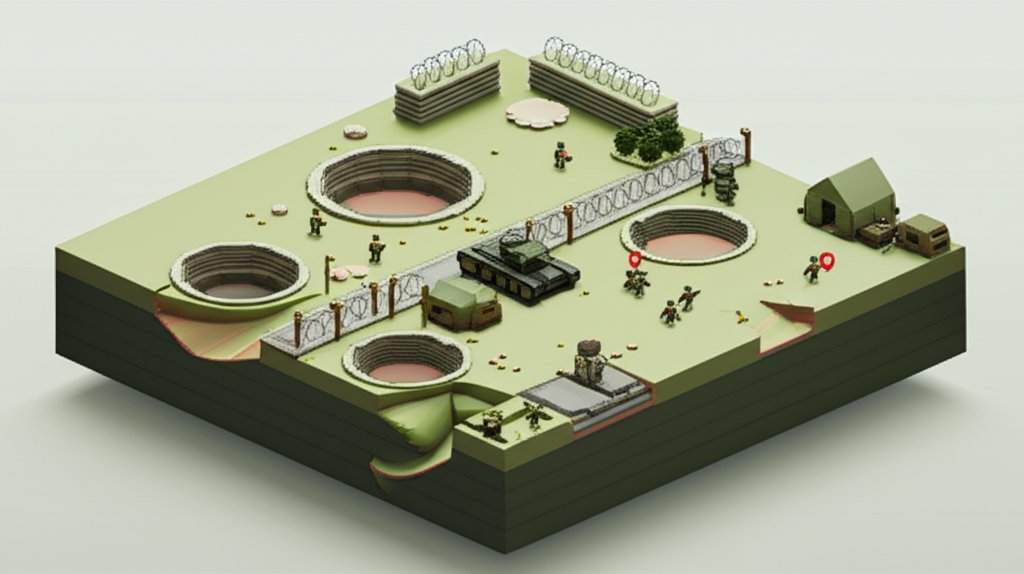
The ancient world provided the crucible for many of the most influential famous commanders and their military campaigns, laying the groundwork for much of subsequent military strategy.
Alexander the Great: Speed, Shock, and Discipline
Alexander III of Macedon, known as Alexander the Great (356-323 BC), orchestrated a series of military campaigns that remain unparalleled in their scope and ambition. His innovative military strategy centered on:
- Combined Arms: Perfect integration of the Macedonian phalanx (heavy infantry), Companion Cavalry (elite shock cavalry), and light skirmishers.
- Speed and Maneuver: Rapid movements that caught enemies off-guard, allowing him to dictate the terms of engagement.
- Psychological Warfare: Exploiting enemy fears and internal divisions, often offering merciful terms to those who surrendered swiftly.
- Decisive Battle: Aiming for a single, overwhelming engagement to shatter enemy resistance, exemplified at the Battle of Gaugamela (331 BC) where he decisively defeated Darius III’s vastly larger Persian army through brilliant outflanking maneuvers and pinpoint cavalry charges.
Alexander’s campaigns showcased a masterclass in aggressive, adaptable leadership, transforming a small kingdom into a vast Hellenistic empire and leaving an indelible mark on the history of warfare.
Hannibal Barca: Audacity, Deception, and Terrain Mastery
Hannibal Barca (247-183/181 BC), the Carthaginian general, is revered for his audacious invasion of Italy during the Second Punic War (218-201 BC). His military strategy was characterized by:
- Surprise and Audacity: The legendary crossing of the Alps with elephants in 218 BC, striking at the heart of Roman territory from an unexpected direction.
- Deception and Ambush: Masterfully employing feints and traps, such as at the Battle of Lake Trasimene (217 BC), where he ambushed a Roman army in a narrow pass.
- Terrain Exploitation: Using natural features to his advantage, nullifying Roman numerical superiority.
- Annihilation Warfare: His tactical masterpiece at the Battle of Cannae (216 BC) remains a paradigm of double envelopment, where Hannibal’s numerically inferior forces completely encircled and destroyed a much larger Roman army, inflicting one of Rome’s worst defeats.
Hannibal’s brilliance lay in his ability to maintain a protracted military campaign in enemy territory against overwhelming odds, demonstrating a profound understanding of psychology and tactical innovation in warfare. It remains one of the most studied military campaigns.
Julius Caesar: Engineering, Logistics, and Political Acumen
Gaius Julius Caesar (100-44 BC), the Roman statesman and general, was a master of both sword and pen, whose military campaigns profoundly shaped Rome’s destiny. His strategic hallmarks included:
- Engineering Prowess: Rapid construction of fortifications, siege works, bridges (e.g., the bridge over the Rhine), and even entire towns, demonstrating unparalleled logistical and engineering capabilities.
- Logistical Supremacy: Maintaining disciplined, well-supplied legions far from Rome, often living off the land with minimal disruption to local populations.
- Political-Military Integration: Understanding that every military campaign had political ramifications, using victories to enhance his popular support and undercut rivals, as seen in his conquest of Gaul (58-50 BC) and subsequent civil wars.
- Adaptable Tactics: His siege of Alesia (52 BC), a dual investment operation against Vercingetorix, is a testament to his tactical genius, building two massive circumvallations to trap the Gallic forces while fending off an external relief army.
Caesar’s detailed commentaries on his military campaigns offer unparalleled insight into Roman military strategy and the mind of a truly versatile commander in the history of warfare.
Sun Tzu’s Influence: The Art of Warfare
While not a general in the traditional sense, Sun Tzu’s “Art of War,” an ancient Chinese treatise on military strategy, has profoundly influenced famous commanders and thinkers for millennia. Its core tenets emphasize:
- Winning Without Fighting: The ultimate skill in warfare is to subdue the enemy without battle.
- Deception: All warfare is based on deception.
- Knowledge of Self and Enemy: “If you know the enemy and know yourself, you need not fear the result of a hundred battles.”
- Fluidity and Adaptability: Avoid fixed positions, adapt to changing circumstances.
Sun Tzu’s principles illustrate a timeless approach to military strategy that transcends specific technologies and cultures, providing foundational wisdom for countless military campaigns throughout the history of warfare.
Medieval & Early Modern Warfare: Evolution of Command
The period following antiquity saw remarkable shifts in weaponry, formations, and the overall approach to warfare, leading to new strategic innovations and the rise of other famous commanders.
Genghis Khan: Mobility, Coordination, and Psychological Impact
Genghis Khan (c. 1162-1227), the founder of the Mongol Empire, reshaped the history of warfare through his unprecedented military campaigns across Asia and into Europe. His strategy was defined by:
- Unrivaled Mobility: Utilizing highly mobile mounted archers and light cavalry to cover vast distances rapidly and strike unexpectedly.
- Centralized Command & Control: A highly disciplined, merit-based army with sophisticated communication (relay riders, flag signals) that allowed for complex, coordinated maneuvers over vast areas.
- Psychological
Warfare: Employing terror tactics, massacres, and exaggerated tales of Mongol ferocity to demoralize enemies before engagement. - Strategic Encirclement: The “feigned retreat” was a hallmark, drawing enemies into a trap before enveloping them with overwhelming force. His
military campaignsled to the largest contiguous empire inhistory of warfare.
Genghis Khan’s strategic prowess transformed nomadic mounted combat into a sophisticated, empire-building force, a truly legendary figure among famous commanders.
Gustavus Adolphus: Innovation in Combined Arms
Gustavus Adolphus (1594-1632), King of Sweden, transformed military strategy during the Thirty Years’ War, earning him the title “Father of Modern Warfare.” His innovations included:
- Lighter, More Mobile Artillery: Integrating field artillery directly with infantry, enabling rapid fire and maneuver.
- Abolition of the Pike-and-Shot Square: Developing linear formations that maximized firepower and flexibility, with infantry deployed in smaller, more maneuverable units.
- Combined Arms Doctrine: Effectively combining musketeers, pikemen, and cavalry to support each other on the battlefield.
- Discipline and Motivation: Emphasizing training, morale, and religious fervor among his troops.
His decisive victory at the Battle of Breitenfeld (1631) showcased the superiority of his innovative military strategy, highlighting a pivotal moment in the history of warfare where tactical formations and technologies evolved significantly.
Frederick the Great: Discipline, Maneuver, and Calculated Risk
Frederick II of Prussia (1712-1786), known as Frederick the Great, cemented Prussia’s status as a major European power through his brilliant military campaigns in the Silesian and Seven Years’ Wars. His military strategy was characterized by:
- Iron Discipline and Training: Developing the most highly trained and disciplined army of his era, crucial for executing complex maneuvers.
- Oblique Order: A tactical masterpiece where he concentrated his forces on one flank of the enemy, refusing the other, to achieve local superiority and roll up the enemy line. The Battle of Leuthen (1757) is a prime example of this audacious maneuver.
- Rapid Maneuver and Logistics: Covering vast distances quickly, surprising opponents, and maintaining supply lines.
- Personal Leadership: Leading from the front, inspiring his troops through courage and strategic foresight.
Frederick’s contributions profoundly influenced later famous commanders, including Napoleon, showcasing the power of precision and calculated risk in warfare.
The Napoleonic Era: Redefining Military Strategy
The late 18th and early 19th centuries witnessed a revolution in warfare, largely thanks to Napoleon Bonaparte, whose military campaigns redefined the art of command and military strategy.
Napoleon Bonaparte: Artillery, Maneuver Warfare, and the Grande Armée
Napoleon Bonaparte (1769-1821), Emperor of the French, is arguably the most influential of all famous commanders, whose military campaigns reshaped Europe. His strategic genius included:
- Mass Artillery Strikes: Concentrating artillery fire to soften enemy lines before infantry assaults, a revolutionary use of firepower.
Maneuver Warfare(Manœuvre sur les derrières): Rapidly moving army corps to outflank and envelop enemy armies, cutting off their retreat and supply lines. The Ulm Campaign (1805) and the Battle of Austerlitz (1805) are classic examples of this, where he masterfully exploited enemy errors and achieved decisive victories against numerically superior forces.- The Corps System: Dividing his army into self-contained corps, each capable of independent action but coordinated for unified objectives, allowing for unprecedented speed and flexibility.
- Psychological Motivation: Inspiring fierce loyalty and heroism among his “Grande Armée” through charismatic leadership, promises of glory, and meritocratic promotion.
Napoleon’s military campaigns represented a paradigm shift in the history of warfare, emphasizing speed, decisive engagement, and overwhelming psychological pressure. His strategies are still studied today by military academies worldwide, making him a central figure in any discussion of military strategy.
Wellington and the Peninsular Campaign: Defensive Mastery
Arthur Wellesley, the Duke of Wellington (1769-1852), a contemporary and eventual vanquisher of Napoleon, showcased a different but equally effective form of military strategy. During the Peninsular Campaign (1808-1814), he demonstrated:
- Defensive Patience: Utilizing strong defensive positions (often reverse slopes) to attrit French attacks, minimizing British casualties while inflicting heavy losses on the enemy.
- Logistical Discipline: Meticulous attention to supply lines and troop welfare, crucial for sustained operations in challenging terrain.
- Adaptability: Combining British, Portuguese, and Spanish forces effectively, respecting their strengths and weaknesses.
- Exploiting Terrain: Using geographical features to canalize French attacks and protect his flanks, a master of defensive warfare.
Wellington’s success against Napoleon’s marshals proved that a well-executed defensive military strategy, coupled with solid logistics and discipline, could overcome aggressive maneuver warfare.
Modern Military Campaigns: Adapting to Technological and Global Change
The 20th and 21st centuries ushered in an era of unprecedented technological advancement, transforming the scale and nature of military campaigns. Yet, the core tenets of military strategy laid down by famous commanders of the past often remain relevant.
World Wars & Total Warfare: Grand Strategy and Logistics
The World Wars (WWI and WWII) introduced “Total Warfare,” where entire nations were mobilized, and the scope of military campaigns became global. Commanders like Dwight D. Eisenhower, Erwin Rommel, and Georgy Zhukov adapted military strategy to this new reality:
- Grand Strategy: Integrating political, economic, and psychological elements alongside military objectives on a global scale.
- Industrial Mobilization: The ability to produce and deploy vast quantities of weapons, vehicles, and supplies became a decisive factor.
- Combined Arms at Scale: Integrating air power, naval forces, and mechanized ground units in complex, multi-front operations.
- Logistical Complexity: Supplying millions of troops across continents became an immense challenge, requiring innovative solutions like the Red Ball Express in WWII.
Commanders in this era, such as Eisenhower leading the D-Day military campaign, were less about personal tactical brilliance in a single battle and more about managing vast, complex enterprises of unprecedented scale, making strategic decisions with global repercussions. This period dramatically reshaped the history of warfare.
Clausewitz’s Enduring Principles: War as Politics
Carl von Clausewitz (1780-1831), a Prussian general and military theorist, published “On War,” a foundational text on military strategy. Although he died before its completion, his work remains profoundly influential, particularly his assertion that “war is merely the continuation of politics by other means.” His principles include:
- The Trinity of War: Integrating passion, chance, and reason into the understanding of warfare.
- Friction: The inherent difficulties and unpredictability that impede even the best-laid plans.
- Fog of War: The uncertainty in situational awareness on the battlefield.
- The Primacy of Policy: All military actions must serve political objectives.
Clausewitz’s analytical framework provides timeless insights into the nature of warfare and the strategic considerations for any military campaign, enduring as central to modern military strategy theory.
Asymmetric Warfare and the Future of Conflict
The post-Cold War era has seen a rise in asymmetric warfare, where state and non-state actors with vastly different military capabilities engage in conflict. This form of warfare challenges traditional military strategy and has spawned new types of military campaigns:
- Guerrilla Tactics: Small, mobile units using hit-and-run tactics against a larger, conventional force.
- Cyber Warfare: Battles fought in the digital realm, targeting infrastructure and information.
- Information Operations: Shaping public opinion and sowing discord through propaganda and misinformation.
- Terrorism: Using fear and violence against civilian populations to achieve political goals.
These evolving forms of warfare require famous commanders and strategists to adapt continuously, integrating intelligence, technology, and understanding socio-political landscapes into their military strategy to successfully navigate modern military campaigns.
The Enduring Legacy: Timeless Insights from Legendary Military Campaigns
The Legendary Military Campaigns orchestrated by the famous commanders throughout the history of warfare offer a timeless masterclass in military strategy. While technology and contexts change, certain fundamental principles of warfare remain constant:
- Leadership is Paramount: The ability of a commander to inspire, decide, and adapt is consistently a decisive factor.
- Intelligence and Deception are Critical: Knowing your enemy and misleading them are ancient arts that never fade.
- Logistics are the Unsung Hero: A well-supplied army, even a smaller one, often triumphs over a larger, poorly provisioned force.
- Adaptability is Key: Static plans rarely survive first contact; flexibility and improvisation are vital.
- Morale Determines Endurance: The will to fight can overcome immense material disadvantages.
- Warfare is a Human Endeavor: Despite technological advancements, the human element—courage, fear, resolve, and error—remains central to every
military campaign.
Understanding these lessons from history’s greatest military campaigns offers profound insights not just for military endeavors, but for strategic thinking in any field, from business to politics.
Conclusion
From the lightning-fast conquests of Alexander the Great and the audacious ingenuity of Hannibal, through the organized savagery of Genghis Khan and the revolutionary military strategy of Napoleon, to the grand logistical endeavors of the World Wars and the complexities of modern asymmetric conflict, the history of warfare is a testament to human ingenuity, ambition, and resilience. The famous commanders who orchestrated these legendary military campaigns were not merely warriors; they were master strategists, psychologists, engineers, and leaders who understood the intricate dance of power and purpose. Their legacies offer an enduring masterclass, proving that while the tools of warfare may evolve, the timeless principles of military strategy—adaptability, decisiveness, intelligence, and the indomitable spirit of command—remain the ultimate arbiters of victory.
FAQ
Q1: What are the most important elements of effective military strategy?
Effective military strategy hinges on several key elements: clear and achievable objectives, robust logistics, superior intelligence gathering, precise execution of maneuvers, decisive concentration of force at critical points, and the ability to adapt to unforeseen circumstances. A commander’s leadership, the morale of the troops, and understanding the political context of the military campaign are also crucial.
Q2: Who are considered the top three famous commanders in the history of warfare?
While subjective, many historians consistently rank Alexander the Great, Hannibal Barca, and Napoleon Bonaparte among the top three famous commanders due to their revolutionary military strategy, unparalleled success in military campaigns, and lasting influence on military thought. Other strong contenders include Julius Caesar, Genghis Khan, and Frederick the Great.
Q3: How have military campaigns evolved with technology?
Military campaigns have dramatically evolved with technology, from the bronze-age chariots to gunpowder artillery, then to tanks, aircraft, and cyber warfare. Technology has increased the speed, destructive power, and reach of forces, but it has also introduced new complexities like global logistics, information overload, and the need for advanced intelligence. Modern military strategy must constantly integrate these technological advancements, but the human element and core principles of warfare remain.
Q4: What role does leadership play in successful warfare?
Leadership is central to successful warfare. A famous commander must provide clear vision, make decisive choices under pressure, inspire loyalty and discipline among troops, maintain morale, and adapt plans as situations change. Effective leadership can turn the tide of a military campaign even when facing numerical or material disadvantages, as seen repeatedly throughout the history of warfare.
Q5: Can lessons from ancient military campaigns be applied today?
Absolutely. While the weaponry and scale are different, the fundamental human and strategic principles observed in ancient military campaigns remain highly relevant. Lessons in logistics, deception, morale, leadership, the importance of intelligence, and the psychology of conflict are timeless. Modern military strategy draws heavily from the history of warfare to understand enduring patterns and decision-making processes, even in the context of contemporary warfare.










