
Embark on a captivating voyage through time to uncover the profound history of Hindustani music, a vibrant and evolving Indian classical music tradition that has enchanted generations. From the sacred chants of ancient India to the intricate improvisations of contemporary maestros, Hindustani music stands as a testament to cultural fusion and artistic innovation. This article delves deep into its ancient roots, tracing its journey through transformative eras, diverse influences, and the legendary figures who shaped it into the modern masterpiece it is today. Prepare to explore the rich tapestry of North Indian music and understand why it remains one of the world’s most cherished classical music traditions.
Understanding the historical timeline of Hindustani music provides valuable context when exploring the broader landscape of musical evolution, as detailed in our article on the history of music genres.
The Ancient Genesis: Tracing the Early Roots of Hindustani Music
The foundational elements of Hindustani music resonate from an antiquity that stretches back millennia, firmly establishing its place among the oldest classical music traditions globally. Its origins are deeply intertwined with the spiritual and cultural fabric of ancient India.
Vedic Echoes: Music in Ancient India
The earliest discernible signs of Indian musical science are found in the Vedic Age (c. 2000 BCE – 500 BCE). The Samaveda, one of the four principal Vedas, is dedicated almost entirely to music, containing nearly 1,875 hymns designed for chanting during religious rituals. These hymns, primarily drawn from the Rigveda, were set to specific meters and melodies, marking a nascent attempt to systematize musical expression. The concept of “Nadabrahma,” or sound as the primal manifestation of the divine, underscores the spiritual significance of music during this era, suggesting that music was not merely entertainment but a path to the divine. Early Vedic chants utilized three to seven musical notes, laying a rudimentary groundwork for the complex melodic structures that would later define Indian classical music.
Early Forms and Philosophical Underpinnings
Beyond the Vedic rituals, two prominent musical genres prevailed in ancient times: Gandharva and Gana. Gandharva represented a formal, composed music often performed during ceremonies, regarded as celestial and divine. Gana, on the other hand, was more informal and improvisational, serving entertainment purposes. As centuries progressed, forms like Prabandh Sangeet, primarily in Sanskrit, became highly popular between the 2nd and 7th centuries CE. This structured musical form is widely believed to be the precursor to Dhrupad, one of the oldest and most revered vocal styles in Hindustani music. The philosophical emphasis on spirituality and devotion, deeply rooted in Hindu traditions and Vedic philosophy, remained a guiding principle, influencing the development of rhythmic patterns and melodies focused on evoking specific moods, or rasas.
A Transformative Bifurcation: The Birth of North Indian Classical Music
A pivotal moment in the history of Hindustani music occurred during the medieval period, leading to its distinct identity separate from the southern classical music traditions of India.
The Great Divide: Divergence from Carnatic Traditions
By the 12th and 13th centuries CE, a significant divergence began to shape the Indian classical music landscape. Repeated invasions and cultural exchanges in North India, notably with Persian and Arab cultures, led to a bifurcation. The music of the South, largely insulated from these external influences, retained its original character, evolving into what is known today as Carnatic music. Meanwhile, the music of North India actively absorbed and integrated these new elements, giving rise to Hindustani music as a distinct art form. This geographical and cultural separation marked the formal birth of North Indian music as a unique classical tradition.
Eastern Influences: Persian, Arab, and Afghan Contributions
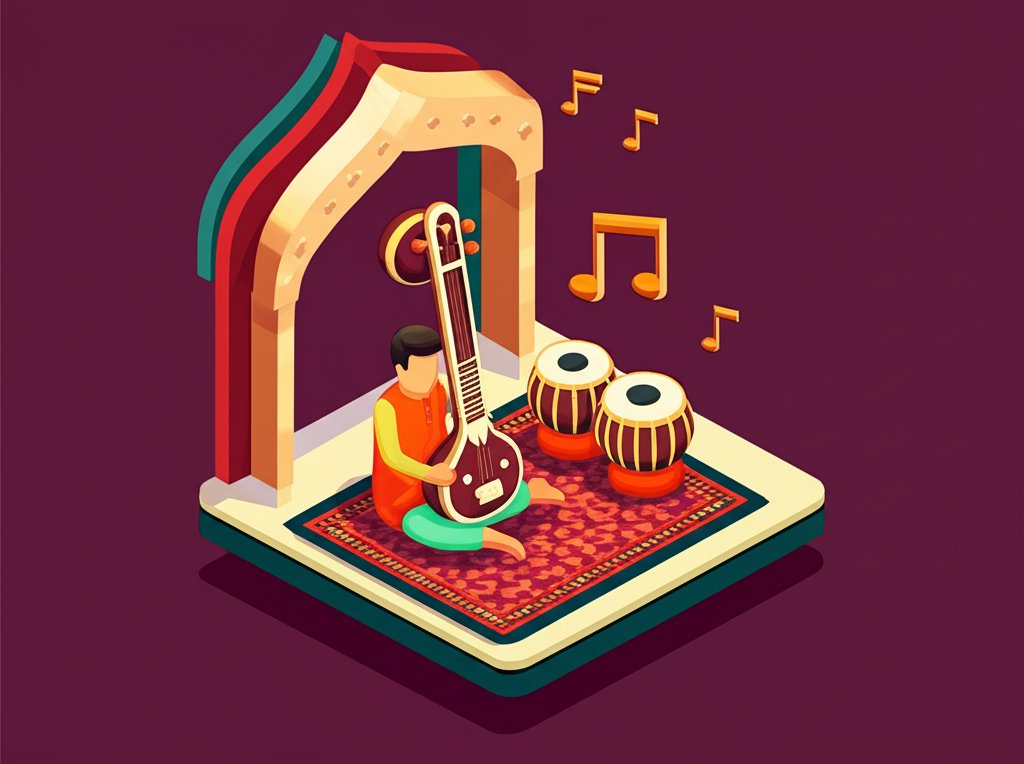
The arrival of Islamic cultures, particularly Persian, Arab, and Afghan traditions, had a profound and lasting impact on Hindustani music. This cross-cultural exchange introduced new melodic ideas, rhythmic patterns, and most significantly, new instruments. The sitar, a stringed instrument, and the tabla, a pair of hand drums, became integral to the Hindustani music ensemble. Persian concepts of ornamentation and improvisation, along with new lyrical forms, enriched the existing musical framework. This fusion resulted in a sophisticated synthesis, creating a sound that was uniquely Indian yet imbued with a distinct Middle Eastern flavor, setting the stage for its grand evolution.
The Mughal Golden Age: Patronage and Flourishing of Hindustani Music
The Mughal Empire (16th to 19th centuries) is often considered the golden age for Hindustani music, marking a period of unparalleled patronage, innovation, and refinement.
Imperial Courts as Hubs of Innovation
The Mughal emperors were renowned connoisseurs and patrons of the arts, and music flourished under their generous support. Their courts transformed into vibrant centers of musical innovation and performance. Musicians from across the empire, and even from Persia, gathered to showcase their talents, leading to an extraordinary exchange of ideas and styles. Legendary figures like Miyan Tansen, one of the ‘Navratnas’ (nine jewels) in Emperor Akbar’s court, exemplify this era. Tansen’s contributions are deeply etched in the history of Hindustani music, credited with composing several ragas and evolving various forms. This royal patronage provided stability and resources, allowing musicians to dedicate themselves to perfecting their art and pushing its boundaries.
Evolution of Forms: Dhrupad to Khayal
During the Mughal period, older forms like Dhrupad, which had roots in Prabandh Sangeet, saw significant refinement and expansion. Dhrupad, characterized by its majestic and austere style, with an emphasis on the purity of raga and rhythmic complexity, continued to be performed. However, it was also during this time that Khayal, meaning “imagination” or “free thought,” began to emerge and gain prominence. Khayal offered greater flexibility and scope for improvisation compared to Dhrupad, quickly becoming the dominant vocal form in Hindustani music. Its lyrical expressiveness and emphasis on melodic elaboration allowed for deeper personal interpretation within the rigid framework of ragas and talas. Other forms like Tarana, with its rhythmic syllables, also developed and gained popularity.
Instruments and Melodic Development
The Mughal era solidified the role of instruments like the sitar and tabla within Hindustani music, integrating them seamlessly into the tradition. Other instruments like the sarod, harmonium, and various percussion instruments also became essential. The development of specific melodic scales (ragas) and rhythmic cycles (talas) became more formalized. Musicians meticulously explored the nuances of each raga, understanding its specific emotional essence (rasa) and the appropriate time of day or season for its performance. This period laid much of the theoretical and practical framework that defines Hindustani music as we know it today, making it a cornerstone of classical music traditions.
Enduring Legacy: From Decline of Patronage to Modern Revival
Following the decline of the Mughal Empire, Hindustani music faced significant challenges, yet its inherent resilience and the dedication of its practitioners ensured its survival and eventual global resurgence.
Shifting Tides: Post-Mughal Era and British Influence
With the waning of imperial patronage, musicians had to adapt. Many found support in regional princely states or moved to wealthy private households and temples, continuing the tradition in smaller, more intimate settings. The advent of British colonial rule brought new influences and, in some ways, a period of obscurity for Indian classical music. However, it also sparked a renewed interest among Indian intellectuals in preserving and systematizing their rich cultural heritage. This period saw the first attempts at documenting ragas and talas, moving away from purely oral traditions.
The 20th Century Renaissance: Guru-Shishya Parampara and Public Outreach
The 20th century witnessed a remarkable revival of interest in Hindustani music. Crucially, the traditional “Guru-Shishya Parampara” (teacher-disciple tradition) continued to be the primary mode of knowledge transmission. This intimate, face-to-face instruction ensured the preservation of intricate musical knowledge, techniques, and philosophies. However, to broadbase its appeal, innovators organized public music conferences and established music schools, making North Indian music accessible to a wider audience beyond hereditary musical families.
Legendary musicians played a pivotal role in this renaissance. Maestros like Ustad Amir Khan, Ustad Bade Ghulam Ali Khan, Pandit Ravi Shankar, and Ustad Ali Akbar Khan not only preserved the traditional forms but also pushed artistic boundaries, created new compositions, and captivated audiences worldwide. Their international tours, especially by Pandit Ravi Shankar, exposed Hindustani music to Western audiences, leading to its global popularization and cross-cultural collaborations with Western musicians, solidifying its place among revered classical music traditions.
Gharanas: The Pillars of Hindustani Musical Traditions
A unique and defining feature of Hindustani music is the concept of “Gharanas,” or musical lineages. A Gharana represents a school of thought and a distinctive stylistic approach to musical performance, passed down through generations of a specific family or guru-disciple tradition. Each Gharana possesses unique characteristics in its rendition of ragas, voice culture, improvisational techniques, and repertoire.
Prominent Gharanas include:
These Gharanas ensure the preservation of diverse styles and interpretations, contributing to the rich and varied tapestry of Hindustani music and its broader classical music traditions.
The Soul of Hindustani Music: Key Elements and Diverse Forms
The enduring appeal of Hindustani music lies in its sophisticated structural elements and the vast array of forms it encompasses, each offering unique expressive possibilities.
Raga and Tala: The Melodic and Rhythmic Frameworks
At the heart of all Indian classical music, including Hindustani music, are the concepts of Raga and Tala.
The emphasis on improvisation within these frameworks allows performers to showcase profound creativity and emotional expressiveness, making each performance a unique artistic journey. Techniques like sargams (singing note names) and taans (rapid melodic runs) are integral to this improvisatory aspect.
Vocal and Instrumental Traditions: A Rich Tapestry
Hindustani music boasts a rich array of vocal and instrumental forms, each with its unique character:
Instrumental forms mirror these vocal traditions, with ragas being performed on sitar, sarod, flute, santoor, violin, and other instruments, often accompanied by tabla.
Linguistic Diversity in Compositions
A distinctive feature of Hindustani music is its embrace of diverse languages for compositions. Unlike Carnatic music, which predominantly uses South Indian languages, Hindustani music features compositions in a wide range of Northern Indian languages. These include:
This linguistic pluralism reflects the vast cultural landscape of North India and adds another layer of richness to the classical music traditions of the region.
Conclusion: A Living, Evolving Legacy
The history of Hindustani music is a magnificent narrative of continuity and change, from its ethereal Vedic origins to its intricate modern forms. As a cornerstone of Indian classical music, it has traversed centuries, absorbing diverse influences, surviving periods of challenge, and blossoming into a globally recognized North Indian music phenomenon. Its journey is a testament to the enduring power of art to adapt, connect, and inspire across cultures and generations.
Today, Hindustani music continues to be a living, breathing art form, sustained by the dedication of gurus and disciples, the brilliance of contemporary performers, and the unwavering passion of its global audience. Its emphasis on improvisation, emotional depth, and the intricate interplay of raga and tala offers an unparalleled listening experience, inviting you to delve into the profound beauty of one of the world’s most cherished classical music traditions. Experience the timeless magic of Hindustani music; it’s a masterpiece that continues to evolve.
FAQ
Q1: What is Hindustani Music?
A1: Hindustani music is one of the two main genres of Indian classical music, primarily prevalent in North India, Pakistan, and Bangladesh. It is characterized by its melodic framework (raga) and rhythmic cycles (tala), and its emphasis on improvisation, emotional expression, and the unique contributions from Persian, Arab, and Afghan traditions over centuries.
Q2: When did Hindustani music originate?
A2: While its roots trace back to the ancient Vedic period (c. 2000 BCE), Hindustani music emerged as a distinct form of North Indian music around the 12th-13th century CE, diverging from the southern Carnatic tradition due to significant cultural influences from various invasions and migrations in the North.
Q3: What are the main differences between Hindustani and Carnatic music?
A3: The primary differences lie in their geographical prevalence (Hindustani in North India, Carnatic in South India), the extent and style of improvisation, the specific ragas and talas used, the instruments typically favored (sitar, tabla in Hindustani; veena, mridangam in Carnatic), and the linguistic diversity of compositions (Hindustani uses Hindi, Urdu, Braj Bhasha, Punjabi; Carnatic primarily uses South Indian languages like Tamil, Telugu, Kannada, Malayalam).
Q4: Who are some legendary Hindustani musicians?
A4: Many maestros have shaped the history of Hindustani music. Key figures include Miyan Tansen from the Mughal era, and 20th-century legends such as Ustad Amir Khan, Ustad Bade Ghulam Ali Khan, Pandit Ravi Shankar (sitar), Ustad Ali Akbar Khan (sarod), Pandit Bhimsen Joshi, and Kishori Amonkar, among many others.
Q5: What are ‘Gharanas’ in Hindustani music?
A5: ‘Gharanas’ are distinctive schools or lineages of musical thought and performance styles within Hindustani music. Each Gharana (e.g., Gwalior, Agra, Kirana, Jaipur-Atrauli, Patiala) has its unique approach to raga rendition, voice training, improvisation techniques, and repertoire, passed down through the guru-shishya parampara (teacher-disciple tradition).
Q6: What role does improvisation play in Hindustani music?
A6: Improvisation is a cornerstone of Hindustani music. Within the strict framework of a raga and tala, performers are given immense freedom to explore and interpret the melodic and rhythmic possibilities spontaneously. This allows for personal expression, creativity, and makes each performance unique, making it a hallmark of classical music traditions.
Q7: What languages are typically used in Hindustani music compositions?
A7: Hindustani music embraces a rich linguistic diversity. Compositions are often found in Sanskrit (especially older forms), Hindi, Braj Bhasha, Urdu, Punjabi, and Rajasthani, reflecting the cultural mosaic of North Indian music.










