
Imagine a world where melodies weren’t just entertainment, but the very fabric of society – a language of gods and mortals, a tool for war and wisdom. Much of this ancient sonic tapestry seems lost to time, yet tantalizing echoes remain. Through groundbreaking archaeological discoveries and meticulous scholarly research, we can begin to unearth ancient music history, piecing together the vibrant soundscapes that defined life in antiquity. This article embarks on an extraordinary journey, revealing the profound and multifaceted role of music in ancient times across the globe, from the earliest human expressions to the sophisticated theories that still resonate today.
The Dawn of Sound: Prehistoric Roots of Ancient Music History
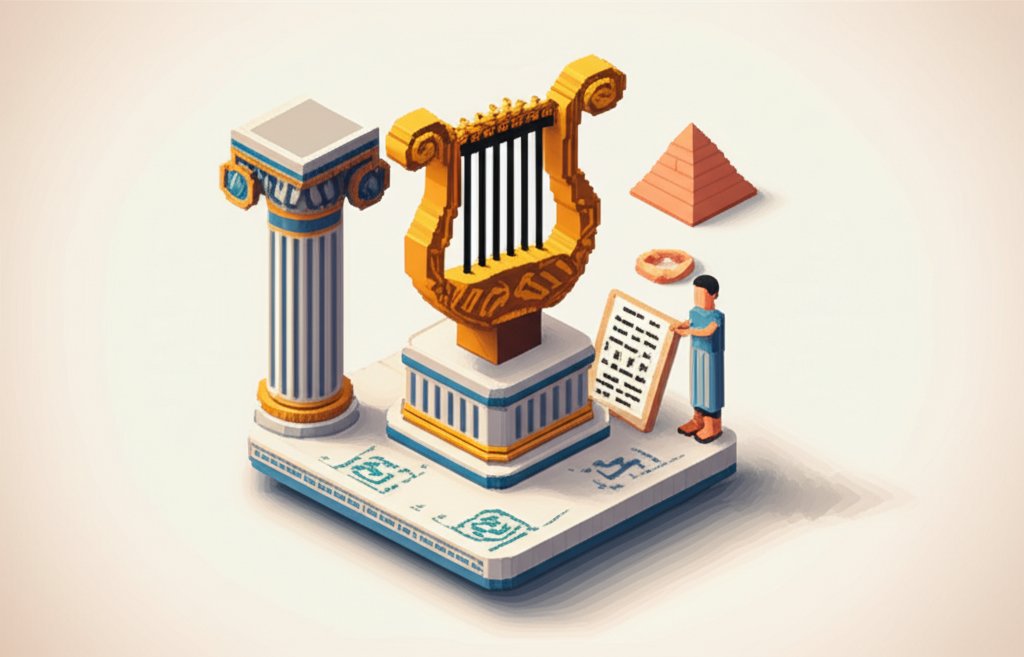
Long before written records, humans found their voice through sound. The very first notes played by our ancestors laid the foundational stones of ancient music history, demonstrating an innate human connection to rhythm and melody.
The Earliest Instruments and Evidence
Our earliest glimpses into music in ancient times come from the Upper Paleolithic era. Imagine a hunter-gatherer, perhaps sitting by a fire, crafting a simple instrument from bone. This isn’t just speculation; archaeological finds confirm it.
- Bone Flutes (c. 40,000 – 35,000 BCE): The caves of Hohle Fels and Geissenklösterle in Germany have yielded incredible discoveries: flutes made from bird bone and mammoth ivory. These sophisticated instruments demonstrate a remarkable understanding of acoustics and craftsmanship, capable of producing a range of pitches. They challenge earlier assumptions that complex music emerged much later.
- Percussion and Early Rhythms: While flutes are the most well-preserved instruments, it’s highly probable that early humans also utilized natural elements for percussion – clapping, stomping, striking stones, or using hollow logs. The rhythmic beat is a fundamental aspect of human expression, likely accompanying rituals and communal activities.
- Iconographic Clues: Wall paintings and rock art from sites like Çatalhöyük (6000 BCE, Turkey) depict figures playing instruments or engaged in what appear to be musical performances, offering visual context to these nascent sound traditions.
Music’s Role in Proto-Societies
For early humans, music was more than just sound; it was a potent force for survival and community building.
Understanding the nuances of prehistoric rhythm provides a foundation for appreciating the complex tapestry of the history of music genres that would later unfold across civilizations.
- Ritual and Spirituality: Music likely played a central role in shamanistic rituals, healing ceremonies, and rites of passage. Repetitive rhythms and hypnotic melodies could induce trance states, facilitating perceived communication with the spirit world.
- Communication and Storytelling: Before sophisticated language, music could convey emotions, warnings, or signal group cohesion. Storytelling, a cornerstone of early human culture, was often enhanced and preserved through chant and song.
- Social Bonding: Communal singing and dancing fostered solidarity within groups, strengthening social ties and coordinating collective activities like hunting or gathering. It created a shared emotional experience, reinforcing identity and belonging.
Cradle of Civilizations: Music in Ancient Times Across Mesopotamia and Egypt
As societies grew from nomadic tribes to complex civilizations, ancient music history evolved rapidly. The fertile crescent, a birthplace of writing and cities, also fostered sophisticated musical traditions.
Mesopotamian Melodies: From Sumer to Babylon
Mesopotamia, the land between the rivers, was a crucible of innovation, and its musical practices profoundly shaped music in ancient times.
- The Ur Lyres (c. 2500 BCE): Perhaps the most iconic musical finds come from the Royal Cemetery of Ur, where elaborate lyres, one adorned with a bull’s head, were discovered in the tomb of Queen Puabi. These exquisite instruments, often inlaid with precious materials, reveal a highly developed courtly music culture. Their construction suggests a rich tonal palette and complex performance practices.
- The Hurrian Songs (c. 1450-1250 BCE): Discovered on cuneiform tablets in Ugarit (modern-day Syria), these are the oldest known complete notated musical compositions. The “Hurrian Hymn No. 6” is particularly famous, providing not only melodic lines but also instructions for playing a lyre. Deciphering these fragments gives us an incredible, albeit challenging, window into how music in ancient times might have actually sounded.
- Purpose and Instruments: Mesopotamian music served diverse functions:
- Religious Rituals: Chants, hymns, and instrumental pieces were integral to temple worship and appeasing deities.
- Royal Courts: Musicians entertained kings and queens, performing at banquets and ceremonies.
- Lamentations and Epics: Vocalists, often accompanied by lyres or harps, would narrate myths, historical events, and express communal grief.
- Common Instruments: Lyres, harps, lutes (long-necked string instruments), drums, and various wind instruments like flutes and double pipes were prevalent.
The Divine Harmonies of Ancient Egypt
Across the desert, the Nile Valley fostered an equally rich and unique ancient music history, deeply intertwined with religion and the afterlife.
- Role of Music in Egyptian Society:
- Religious Ceremonies: Music was absolutely central to temple rituals, cults of the gods, and funerary rites. It was believed to possess spiritual power, capable of invoking deities, protecting the deceased, and aiding their journey to the afterlife. Processions were accompanied by musicians, and hymns were sung to various gods.
- Royal and Elite Entertainment: Harps, lutes, and flutes were played for pharaohs and the nobility at banquets and private gatherings. Professional musicians held a respected status.
- Harvest Festivals and Daily Life: Music punctuated the rhythms of daily life, from celebrations of the Nile’s bounty to simple entertainment.
- Characteristic Instruments:
- Harps: Ranging from small, portable instruments to large, elaborate arched or angular harps, these were prominent.
- Flutes (Memet): Various types of end-blown flutes were common.
- Sistra: These distinctive rattle-like percussion instruments, often associated with the goddess Hathor, were used in temple rituals to ward off evil and ensure fertility.
- Trumpets: While less common than strings and winds, trumpets were found in tombs (like Tutankhamun’s) and likely used for ceremonial or military purposes.
- Visual Evidence: Tomb paintings and reliefs provide a wealth of information, showing detailed depictions of musicians, their instruments, and performance contexts, allowing us to visualize the performance of music in ancient times.
The Philosophers’ Soundtrack: Music in Ancient Greece and Rome
The Classical world, especially Greece, elevated the study of music to an intellectual pursuit, deeply influencing the trajectory of ancient music history and Western thought.
Greek Music: Ethos, Theory, and Education
Ancient Greece not only gave us democracy and philosophy but also laid the foundations of Western music theory, believing music held profound ethical and educational power.
- Pythagoras and Musical Ratios (c. 500 BCE): The legendary mathematician Pythagoras is credited with discovering the mathematical ratios behind musical intervals (octave, fifth, fourth). This groundbreaking realization linked music to cosmology and philosophy, asserting that music reflected the harmony of the universe. This mathematical approach to sound was a cornerstone of Greek musical thought.
- The Doctrine of Ethos: Greek philosophers like Plato and Aristotle believed that music had a direct impact on the human character or “ethos.” Certain modes (scales) were thought to evoke specific emotions or moral states – a Dorian mode for bravery, a Lydian for softness. Music was therefore a critical component of education (mousike, which encompassed music, poetry, and dance) to cultivate virtuous citizens.
- Instruments of the Greeks:
- Lyre: A string instrument, iconic of Apollo and poetry, often used to accompany recitations.
- Kithara: A larger, more complex version of the lyre, used by professional musicians.
- Aulos: A double-reed wind instrument, often associated with Dionysus and more ecstatic, passionate music. Its sound might be compared to a modern oboe or clarinet.
- Role in Society:
- Drama: Music was integral to Greek tragedy and comedy, with choruses singing and dancing. The “Stasimon Chorus from Euripides’ Orestes” (408 BCE) is a notable surviving fragment of Greek musical notation.
- Athletic Events: Music accompanied the training and performance of athletes.
- Symposia and Festivals: Music was central to banquets and religious festivals, fostering communal spirit.
- Notation: While only a handful of fragments survive, the Greeks developed a sophisticated system of notation, using letters for pitches, giving us precious clues about their melodies.
Roman Resonances: Adaptation and Grandeur
While less focused on theoretical innovation, Rome adopted and adapted much from Greek and Etruscan musical traditions, using music in ancient times for spectacle and power.
- Purpose and Grandeur: Roman music was often about grandeur, spectacle, and public display.
- Military: The Roman army famously used robust brass instruments like the tuba (a straight trumpet) and cornu (a G-shaped horn) to signal commands, instill courage, and intimidate enemies. The rhythmic marching pace was often set by music.
- Public Games and Entertainment: Music was omnipresent at gladiatorial contests, chariot races, and theatrical performances.
- Imperial Cult and Civic Ceremonies: Grand processions and state rituals were accompanied by large musical ensembles.
- Private Entertainment: Wealthy Romans employed musicians for banquets and parties.
- Roman Instruments:
- Tuba and Cornu: As mentioned, vital for military and civic events.
- Hydraulis (Water Organ): A complex, innovative instrument played with keys, using water pressure to produce sound, a technological marvel of its time used in arenas and for public entertainment.
- Lyre and Cithara: Inherited from the Greeks, remaining popular.
- Tibia: The Roman equivalent of the Greek aulos.
Eastern Echoes: Rich Traditions in Ancient India and China
Moving eastward, the ancient civilizations of India and China developed exceptionally profound and enduring musical traditions, showcasing different philosophies and practices of music in ancient times.
The Cosmic Sounds of Ancient India
India’s ancient music history is deeply spiritual, with roots stretching back millennia, forming the bedrock of its classical traditions.
- Vedic Chants (c. 1500-500 BCE): The earliest documented music in India is found in the Vedas, particularly the Samaveda, which contains hymns specifically designed for chanting. These elaborate, systematized chants laid the groundwork for the highly theoretical and spiritual classical music forms that would follow, including the concept of ragas (melodic frameworks).
- Natyashastra (c. 200 BCE – 200 CE): This ancient Sanskrit treatise on performing arts is a monumental work, detailing everything from drama and dance to an extensive section on music. It discusses scales (gramas), modes (murchhanas), rhythm (tala), and the concept of rasa (aesthetic emotion), which music was intended to evoke.
- Purpose and Philosophy:
- Religious Devotion: Music was a direct path to the divine, used in temple worship, meditation, and spiritual practice.
- Storytelling and Epic Recitation: The great epics like the Ramayana and Mahabharata were often sung or chanted.
- Court Entertainment: While spiritual, music also graced royal courts.
- Early Instruments: Early forms of the veena (a plucked string instrument), bamboo flutes, and various drums (precursors to the tabla) were central to Indian music.
Imperial Harmonies: Music in Ancient China
China’s ancient music history is characterized by its close ties to philosophy, cosmology, and imperial governance, with music seen as a reflection of universal order.
- Philosophical Underpinnings: Confucianism emphasized music’s role in cultivating morality and social harmony (yayue, ritual music). Daoism saw music as a means to achieve balance with nature and the cosmos. Music was not just art; it was a tool for governance and a mirror of the universe’s order.
- Historical Records: Ancient texts like the Book of Rites (Liji) meticulously document musical practices, instruments, and theories, providing invaluable insights into music in ancient times in China.
- Scale Systems and Pitch Standards: Chinese theorists developed sophisticated systems for defining pitches and scales, often based on the cycle of fifths. Precision in pitch was crucial, believed to align with cosmic forces.
- Key Instruments:
- Bianzhong (Bronze Bells): Elaborate sets of tuned bronze bells, like the Marquis Yi of Zeng bells (c. 433 BCE), are among the most spectacular archaeological finds. These were used for grand imperial rituals and court music, capable of producing complex melodic and harmonic structures.
- Guqin: A seven-stringed zither, revered for its subtle tones and associated with scholars and contemplation.
- Sheng: A mouth organ with multiple pipes, creating a layered, harmonious sound.
- Drums: Various types of drums were used for rhythm and ceremony.
- Ritual vs. Entertainment: A distinct division existed between yayue (refined, ritual court music) and suyue (entertainment music for common folk), though both held cultural significance.
Unearthing the Past: How We Reconstruct Ancient Music
Given the passage of millennia, how do we, as modern listeners and scholars, begin to comprehend the “lost sounds” of ancient music history? It’s a challenging, multidisciplinary endeavor, combining archaeology, art history, linguistics, and musicology.
Archaeological Discoveries: Instruments and Iconography
The physical remnants of music in ancient times are our most tangible links to this lost world.
- Preserved Instruments: The discovery of actual instruments, from bone flutes and Ur lyres to Chinese bronze bells, provides direct evidence of their construction, materials, and potential sonic capabilities. Modern instrument makers and scholars can reconstruct replicas to understand their sound production.
- Artistic Depictions: Tomb paintings, pottery, sculptures, and mosaics offer visual narratives of ancient musical life. They show musicians holding instruments, performing in ensembles, and engaging in dance, providing context for how and where music was performed, and even hinting at playing techniques or attire.
- Acoustic Archaeology: Studying the acoustics of ancient performance spaces (theaters, temples, caves) can provide clues about how music might have sounded in its original environment.
Deciphering Ancient Notations and Texts
While rare, surviving musical notations and theoretical texts are goldmines for understanding ancient music history.
- Challenges and Breakthroughs: Deciphering notations like the Hurrian Songs or the Greek fragments is akin to solving an ancient puzzle. Scholars must interpret symbols, understand ancient linguistic contexts, and cross-reference with other historical sources. Breakthroughs come from cross-cultural comparisons and developing new interpretive methodologies.
- Ethnomusicology and Comparative Studies: By studying existing traditional music cultures around the world, ethnomusicologists gain insights into how music might have functioned in ancient societies. Comparing ancient finds with continuing oral traditions (e.g., in India or parts of Africa) can suggest possible links or performance practices.
- Scholarly Interpretations and Modern Reconstructions: Once evidence is gathered and interpreted, scholars can attempt to reconstruct ancient melodies and performance styles. These are always educated interpretations, but they offer fascinating glimpses into the lost soundscapes, revealing the ingenuity and artistry of music in ancient times.
The Lingering Legacy: Ancient Music’s Influence on Today
The echoes of ancient music history are far from silent; they resonate in the very foundations of contemporary music, demonstrating the enduring power of these “lost sounds.”
Foundations of Western and Eastern Music Theory
Many core concepts in music theory, both East and West, can be traced back to ancient civilizations.
- Greek Modes and Pythagorean Tuning: The Greek understanding of modes (scales) and their associated emotional qualities, along with Pythagoras’s mathematical ratios of intervals, directly influenced the development of medieval church modes and, subsequently, Western classical music theory. The idea of tuning systems based on mathematical principles is a direct legacy.
- Indian Ragas and Chinese Pentatonic Scales: The highly developed melodic structures (ragas) of Indian classical music have ancient roots, as do the characteristic pentatonic (five-note) scales and systematic pitch standards of ancient Chinese music. These foundational concepts continue to shape their respective classical traditions and global contemporary music.
- Universal Musical Elements: The emphasis on rhythm, melody, harmony (even if rudimentary), and the emotional power of sound in ancient cultures are universal aspects that continue to define music across all genres today.
The Enduring Power of Sound
The influence extends beyond theory into contemporary practice and appreciation.
- Resurgence of Historical Performance Practices: There’s a growing movement among musicians and scholars to perform ancient music on reconstructed instruments, attempting to recreate the authentic sounds of the past. This provides a tangible link to ancient music history.
- Inspiration for Contemporary Composers and Film Scores: Modern classical composers, world music artists, and especially film score composers often draw inspiration from ancient world music, using ancient instruments, scales, or rhythmic patterns to evoke historical periods or mystical atmospheres.
- Universal Human Connection: Ultimately, the study of music in ancient times reminds us that music is a fundamental, timeless human expression. Its roles in ritual, emotional expression, storytelling, and community building are as relevant today as they were thousands of years ago. The lost sounds, when revealed, speak to our shared humanity across epochs.
Conclusion
Our journey through ancient music history reveals a profound and intricate world where sound was interwoven with every aspect of life – from the cosmic mysteries of Mesopotamia and Egypt to the philosophical depths of Greece and the spiritual richness of India and China. Far from being merely a historical curiosity, music in ancient times was a dynamic, evolving force, shaping cultures, expressing beliefs, and connecting humanity to the divine and to each other.
Though many of these ancient melodies are forever lost to the sands of time, the fragments we unearth—the bone flutes, the cuneiform hymnals, the elaborate lyres, and the philosophical treatises—offer tantalizing glimpses into a sonic heritage that continues to resonate. By carefully reconstructing these “lost sounds,” we not only enrich our understanding of the past but also gain a deeper appreciation for the enduring, universal power of music itself.
FAQ
Q1: What is the earliest evidence of music in ancient times?
A1: The earliest concrete evidence of music dates back around 40,000 to 35,000 BCE, with the discovery of sophisticated bone and ivory flutes from prehistoric sites like Hohle Fels and Geissenklösterle in Germany.
Q2: How was music used in ancient civilizations?
A2: Music in ancient times served numerous vital roles, including religious and spiritual ceremonies, entertainment for royalty and common folk, storytelling and epic recitation, military signaling and morale-boosting, social bonding and communication, and education (particularly in ancient Greece, where it was believed to shape character).
Q3: Which ancient civilization had the most developed music theory?
A3: Ancient Greece is widely credited with developing the most sophisticated and influential music theory in antiquity. Philosophers like Pythagoras established mathematical relationships for musical intervals, and the concept of “ethos” explored music’s ethical and emotional effects, profoundly impacting later Western music.
Q4: What are the Hurrian Songs, and why are they significant in ancient music history?
A4: The Hurrian Songs, discovered on cuneiform tablets from Ugarit (c. 1450-1250 BCE), are significant because they represent the oldest surviving nearly complete musical notation known to humankind. They offer a rare, direct insight into the melodies and musical structures of ancient Mesopotamia.
Q5: How do modern scholars and archaeologists uncover and understand ancient music?
A5: Scholars reconstruct ancient music history through a multidisciplinary approach: analyzing archaeological finds of instruments, interpreting iconography (depictions of musicians in art), deciphering rare fragments of musical notation, studying ancient theoretical texts, and using ethnomusicological comparisons with living traditional music cultures to inform their interpretations and modern reconstructions.
Q6: Did ancient civilizations have ‘orchestras’ or large musical ensembles?
A6: While not “orchestras” in the modern classical sense, many ancient civilizations did employ large musical ensembles. For example, Mesopotamian and Egyptian courts featured multiple harps, lyres, flutes, and percussion. Ancient China famously used elaborate sets of bronze bells (bianzhong) and other instruments in grand ceremonial ensembles, demonstrating complex orchestration for their time.










