
In the sprawling multiverses of Dungeons & Dragons 5th Edition, few weapons hold the versatile charm and lethal potential of the humble dagger. Often underestimated, the 5e dagger transcends its simple origins to become an indispensable tool, a stealthy assassin’s blade, or even a legendary artifact capable of turning the tide of an apocalypse. This comprehensive guide will plunge deep into the world of daggers D&D 5e, from their basic properties to the most coveted magic daggers 5e and the stories they weave. Prepare to discover how these nimble blades can elevate your gameplay, solve complex challenges, and carve your legend into the annals of D&D.
The Humble 5e Dagger: Core Mechanics & Properties
Before delving into the extraordinary, it’s essential to understand the foundation: the basic dagger D&D 5e. Often dismissed in favor of larger, flashier weapons, the default dagger possesses a unique set of properties that make it a cornerstone for many character builds and tactical situations.
Beyond the game, daggers have held a place of intrigue and importance throughout history, with many being considered as significant as the ones described in this article, so it’s worth exploring some famous daggers to see their real-world counterparts.
What Defines a Basic Dagger D&D 5e?
At its core, a basic dagger D&D 5e is a simple melee weapon with the following characteristics:
- Cost: 2 gold pieces (gp)
- Damage: 1d4 Piercing damage
- Weight: 1 lb.
- Properties: Finesse, Light, Thrown (range 20/60)
These properties are what give the daggers D&D 5e their incredible flexibility:
- Finesse: This property allows you to use your Dexterity modifier, instead of Strength, for attack and damage rolls. This is a game-changer for Dexterity-based characters like rogues, monks, and rangers, making daggers a viable primary weapon.
- Light: Essential for two-weapon fighting, the Light property means you can wield a dagger in each hand. When you take the Attack action and attack with a light melee weapon held in one hand, you can use a bonus action to attack with a different light melee weapon held in the other hand. You don’t add your ability modifier to the damage of the bonus attack, unless that modifier is negative.
- Thrown (range 20/60): A dagger can be thrown, extending its utility beyond melee reach. With a normal range of 20 feet and a long range of 60 feet, it can be a quick ranged option for engaging distant foes or hitting targets that are just out of reach.
Why Every Adventurer Should Carry a D&D 5e Dagger
Beyond combat, the 5e dagger offers unparalleled utility:
- Concealment and Stealth: Its small size makes it easy to hide, a favorite for rogues attempting to smuggle weaponry into restricted areas or for any character needing a discreet self-defense option.
- Backup Weapon: Even plate-clad warriors can benefit from a dagger. If disarmed of their primary weapon, a dagger is easily drawn and can keep them in the fight.
- Tools for the Trade: Beyond stabbing, a dagger can serve as a pry tool, a small digging implement, a means to cut rope, or even a make-shift crafting tool in a pinch.
- Off-Hand Option: For characters who don’t always want to dual-wield, a single dagger can be an excellent off-hand weapon when their main hand is occupied (e.g., with a shield, spellcasting focus, or grappling an enemy).
Mastering Daggers D&D 5e: Combat Tactics & Two-Weapon Fighting
The strategic application of daggers D&D 5e can turn an ordinary encounter into a masterclass of combat prowess. From swift strikes to deadly throws, understanding how to leverage their unique properties is key.
Daggers D&D 5e for Rogues, Bards, and Agile Fighters
For many Dexterity-focused classes, daggers D&D 5e are more than just a last resort; they are a calling card.
- Rogue’s Best Friend: The Finesse property allows rogues to apply their potent Sneak Attack damage with a dagger, making it a reliable choice for burst damage. Its Light property also synergizes perfectly with the Rogue’s bonus action economy, allowing for a main hand attack, and if conditions are met, a bonus action attack to potentially land another Sneak Attack or simply increase damage output.
- Bardic Flourishes: College of Valor Bards or those with certain feats can effectively use daggers for both melee and ranged attacks, maintaining their mobility and spellcasting.
- Monk’s Versatility: While monks have their unarmed strikes, a dagger can be a useful alternative, especially if they need to overcome resistance to non-magical bludgeoning damage before they gain magical unarmed strikes.
- Fighters and Rangers (Dex-based): A Dexterity Battle Master or Monster Slayer can use daggers to deliver maneuvers or Hunter’s Mark, making every hit count.
Dual-Wielding 5e Daggers: Rules & Feats
The Light property of the 5e dagger makes it an ideal weapon for dual-wielding, allowing for an additional attack as a bonus action.
- Two-Weapon Fighting: When you take the Attack action with a light melee weapon in one hand, you can use a bonus action to attack with a different light melee weapon in the other hand. You don’t add your ability modifier to the damage of the bonus attack.
- The Fighting Style (Two-Weapon Fighting): This fighting style, available to Fighters, Rangers, and some Paladins, allows you to add your ability modifier to the damage of the bonus action attack, significantly increasing your overall damage with two daggers.
- Dual Wielder Feat: This feat further enhances dual-wielding:
- You gain a +1 bonus to AC while you are wielding a separate melee weapon in each hand.
- You can use two-weapon fighting even if the one-handed melee weapons you are wielding aren’t light. (But daggers are light, so this mainly benefits other weapon combinations).
- You can draw or stow two one-handed weapons when you would normally be able to draw or stow only one. This negates the common issue of needing to spend an action to draw both daggers at the start of combat.
The Art of the Thrown D&D 5e Dagger
The Thrown property offers crucial tactical flexibility.
- Switching Damage Types: Need to hit flying enemies or those behind cover? A quick thrown dagger can do the trick.
- Range and Ammunition: While not technically ammunition, treating a pouch of daggers like a quiver means you can efficiently unleash a volley. Remember, drawing a weapon typically uses your free object interaction, meaning you can draw one dagger per round without using an action. To throw multiple daggers, you’d likely need the Dual Wielder feat or specific class features to draw more than one.
- Sharpshooter Synergy: While primarily for ranged weapons, the Sharpshooter feat’s ability to ignore half and three-quarters cover can be applied to thrown daggers, potentially giving them an edge against enemies seeking protection. The ability to take a -5 penalty to the attack roll for a +10 bonus to damage also applies, turning a small d4 into a potentially much more impactful hit.
Official Magic Daggers 5e: A Treasure Hunter’s Guide
Beyond the mundane, the realms of D&D are rife with magic daggers 5e, each bearing unique enchantments, histories, and sometimes, wills of their own. These items transform the simple blade into a weapon of cunning, defense, or devastating power.
Enchanted Basics: Magic Dagger 5es of +1, +2, +3
The most common magic daggers 5e are simple enhancements:
- Dagger +1, +2, or +3 (Uncommon, Rare, Very Rare): These daggers grant a bonus to attack and damage rolls, making them inherently more reliable and potent. A +1 dagger is often a first magical upgrade for many adventurers, while a +3 is a powerful relic. They overcome resistance to non-magical damage, a critical advantage against many monsters.
Daggers of Utility & Subtle Power
Many D&D 5e magic daggers offer more than just numerical improvements, providing strategic advantages or unique abilities:
- Dagger of Blindsight (Homebrew Inspired): Imagine a dagger that, when attuned, grants the wielder blindsight out to a certain range (e.g., 10-30 feet). This would be invaluable in darkness, against invisible foes, or in areas of heavy fog or magical obscurity.
- Dagger of Venom (Rare): This sinister magic dagger 5e lets you use an action to make one of its blades drip with poison. The next creature hit by an attack with this dagger takes an additional 2d10 poison damage and must succeed on a DC 15 Constitution saving throw or be poisoned for 1 minute. The dagger can’t be used this way again until the next dawn. Perfect for rogues and assassins.
- Dagger of Warning (Uncommon): While attuned to this dagger, you have advantage on initiative rolls. Additionally, you and any of your companions within 30 feet of you can’t be surprised, provided you aren’t incapacitated. A fantastic item for any scout or party leader.
- Bracers of Flying Daggers (Rare): Mentioned in competitor intelligence, these bracers allow you to draw a magic dagger from them as a bonus action. This dagger appears in your hand, then vanishes if it leaves your hand or if you draw another one. It’s a +1 magic dagger, and you can also spend an action to make two attacks with these summoned daggers, throwing one with each arm (even if you only have one arm free), applying your proficiency bonus and Dexterity modifier to the attack and damage rolls. This is a powerful item for characters focused on thrown weapons.
- Rakdos Riteknife (Rare): From Guildmasters’ Guide to Ravnica, this dagger is attuned to a cultist. As an action, you can wound yourself with the dagger, taking 1d4 piercing damage, and regain one expended spell slot (max 5th level). This adds a dark, sacrificial element to resource management.
- Needle of Mending (Rare, from Acquisitions Incorporated): A fine needle that functions as a +1 magic dagger. When you hit a creature with it, you can expend one of its 3 charges (recharges 1d3 at dawn) to heal yourself for 2d4 + 2 hit points. A useful tool for a melee combatant who needs a bit of self-sustain.
Sentient DND 5e Daggers and Their Perils
Some magic daggers 5e possess their own personalities, desires, and even alignments. These sentient items can be powerful allies or dangerous masters.
- Whisperwind (Example): A +2 dagger, Whisperwind, might be sentient, filled with the spirit of an ancient scout. It constantly whispers tactical advice, sometimes helpful, sometimes paranoid. It might demand stealth from its wielder, refusing to grant its magical bonus if loud combat is engaged.
- Stonefang (Example): This +1 adamantine dagger might house a grumpy dwarven spirit. It grants advantage on checks to detect false walls and hidden passages, but dislikes being used against constructs, constantly grumbling about “wasting good steel on soulless junk.”
Legendary Magic Dagger 5es & Unique Artifacts
At the pinnacle of power stand the legendary magic dagger 5es – weapons of immense power, often tied to epic quests, ancient evils, or the very fabric of the multiverse. While true artifacts are typically massive swords or staves, the essence of legendary power can certainly be imbued into a dagger. These are the blades that define heroes and villains alike.
The Stuff of Legends: Apex Daggers D&D 5e
Official legendary daggers are rare, often found within specific module lore. However, when a common 5e dagger ascends to legendary status, its abilities become world-shaping.
- Blade of the Shadow Thief (Legendary Artifact): A +3 Magic Dagger that can cast Pass Without Trace at will. Upon killing a creature with it, the wielder may immediately become invisible as if by the Invisibility spell, remaining invisible until they attack, cast a spell, or take damage. It can also, once per long rest, teleport the wielder up to 60 feet. This dagger hums with dark energy and might whisper suggestions of assassination to its wielder.
- Mavaro, the Flying Fang (Legendary Artifact – Inspired): A long-bladed +2 dagger appearing as silver-hued dragon scales. This dagger is actually a transformed blue dragon hatchling, Mavaro. It grants its attuned wielder blindsight 30ft, resistance to lightning damage, and the ability to cast Gust of Wind once per day. Mavaro is sentient, bitter, and compelling, often pushing its wielder towards selfish acts or schemes to regain its true form. It can project its thoughts into the wielder’s mind and speak telepathically.
- Ghost Fang, the Bane of Vampires (Legendary Artifact – Inspired): A +3 silvered magic dagger 5e that glows with faint blue light in the presence of undead, especially vampires. When attuned, the wielder gains advantage on saving throws against being charmed or frightened. When Ghost Fang deals a critical hit to a vampire, the vampire must succeed on a DC 17 Constitution saving throw or be instantly transformed into a mindless zombie under the wielder’s control for 24 hours. Vampires within 1 mile are acutely aware of the dagger’s presence and will actively seek its destruction or its wielder’s subjugation. If touched by a lich or struck by a sufficiently powerful necromantic spell, the dagger might teleport to a new, random location on the plane.
- Mind Fang, the Psionic Blade (Legendary Artifact – Inspired): A +2 silver-plated steel magic dagger 5e housing a fragment of an Elder Brain’s neural node. It grants the wielder telepathy with creatures within 60 feet and the ability to cast Detect Thoughts at will. However, the Elder Brain fragment constantly tries to exert control, forcing Wisdom saving throws (DC 15) daily. Failed saves result in the wielder becoming increasingly susceptible to its influence, potentially leading to mind control or madness. Only those with immense willpower or psychic protection can wield it safely.
Crafting Epic Narratives with Magic Daggers 5e
Legendary daggers are not just stat blocks; they are story hooks. A quest for such a blade could span entire campaigns, involving ancient lore, forgotten crypts, and powerful guardians. They can be the MacGuffin that drives a villain, the final tool needed to defeat a looming threat, or the source of a hero’s internal struggle. DMs looking to add depth to their campaigns should consider how these powerful blades impact the narrative.
Beyond the Core: Homebrewing DND 5e Daggers
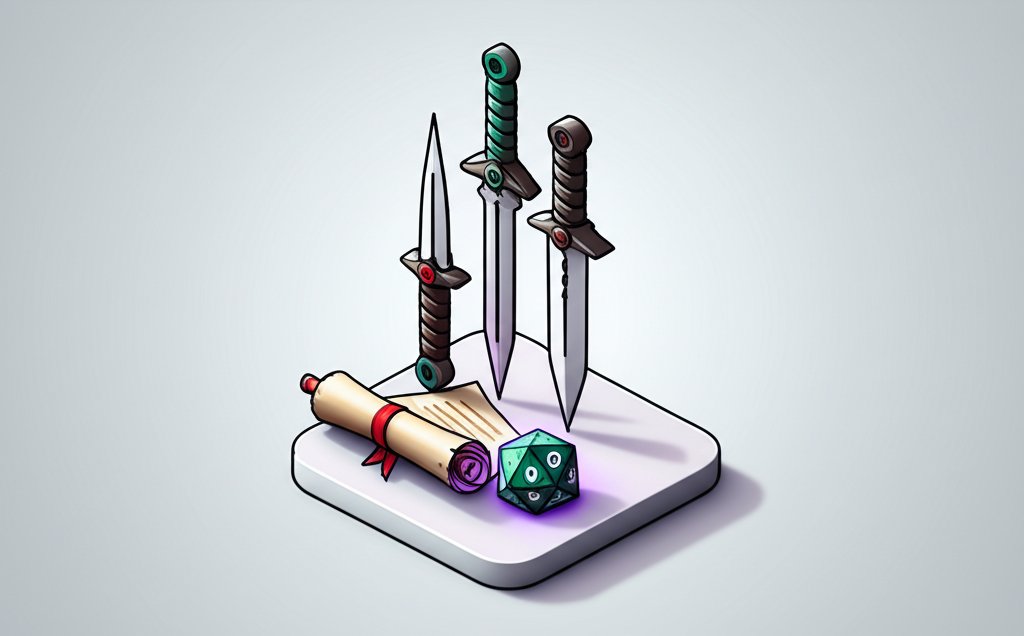
The official list of magic daggers 5e is a great starting point, but the true magic of D&D often lies in customization. Homebrewing allows Dungeon Masters to create unique items perfectly tailored to their campaigns and players.
Principles of Balanced D&D 5e Magic Daggers
When crafting your own dnd 5e daggers, consider these principles to maintain balance:
- Rarity and Power: Align the dagger’s power with its intended rarity (Common, Uncommon, Rare, Very Rare, Legendary, Artifact). A Common magic dagger might have a minor, flavorful effect, while a Legendary one could grant multiple powerful abilities.
- Attunement: Does the dagger require attunement? Attunement limits the number of powerful magic items a character can use, helping to balance the game. Complex or powerful abilities often warrant attunement.
- Limitations and Costs: Powerful abilities should have limitations. This could be a limited number of uses per day, a recharge mechanic (e.g., 1d4 charges at dawn), a saving throw for the target, or even a cost to the wielder (e.g., temporary hit point loss, disadvantage on certain checks).
- Flavor and Lore: Every homebrewed 5e dagger should have a story. Who made it? What is its purpose? What secrets does it hold? This makes items more engaging than just a list of stats.
Inspiring Homebrew Ideas for Your 5e Dagger
Here are some concepts to spark your creativity for new D&D 5e daggers:
- Dagger of the Shifting Sands (Uncommon): A +1 dagger. Once per short rest, when you hit a creature, you can reduce its movement speed by 10 feet until the start of your next turn.
- Gloom’s Kiss (Rare, Attunement): A +1 dagger. When you hit a creature with this dagger, you can choose to make the creature bleed, taking 1d4 necrotic damage at the start of each of its turns until it uses its action to make a DC 13 Wisdom (Medicine) check to stop the bleeding, or until it receives magical healing.
- Echoing Blade (Very Rare, Attunement): A +2 dagger. When you throw this dagger, it immediately reappears in your hand after hitting or missing its target. It also grants advantage on Perception checks to hear faint sounds.
- Sunstone Shard (Rare, Attunement): A +1 dagger that sheds bright light in a 10-foot radius and dim light for an additional 10 feet. As a bonus action, you can cause it to flare, forcing all creatures within 10 feet to make a DC 13 Constitution saving throw or be blinded until the end of their next turn. This ability can be used once per long rest.
- Dagger of the Feywild Bloom (Uncommon, Attunement): A standard dagger that, when plunged into bare earth, can cause beautiful, sweet-scented flowers to bloom in a 5-foot radius over 10 minutes. The flowers last for 24 hours. Purely cosmetic, but useful for roleplay or charming NPCs.
Enhancing Your Game with Magic Daggers 5e: DM & Player Tips
Whether you’re holding the blade or placing it in an adventurer’s path, magic daggers 5e can significantly enrich your D&D experience.
Choosing the Optimal Magic Dagger 5e for Your Character
As a player, selecting the right magic dagger 5e involves considering your character’s class, fighting style, and role in the party:
- Rogue/Assassin: Prioritize daggers that enhance stealth (Dagger of Warning), provide debilitating effects (Dagger of Venom), or increase damage output.
- Dexterity Fighter/Ranger: Look for daggers that boost attack and damage rolls (+x daggers), offer defensive bonuses (like the Dual Wielder feat AC bonus), or complement ranged combat (Bracers of Flying Daggers).
- Wizard/Sorcerer/Bard: While not primary weapons, a utility 5e dagger (like one that provides a small spell slot recharge or a minor defensive spell) can be a valuable last resort or tool.
- Monk: A +x dagger can compensate for lower damage dice of early unarmed strikes, or provide a magical damage type when needed.
- Any Character: A dagger with a “light” effect or a minor healing ability can be beneficial for anyone.
DM Guide: Integrating D&D 5e Daggers into Your Campaign
For Dungeon Masters, D&D 5e daggers are incredibly versatile plot devices:
- Quest Hooks: A legendary magic dagger 5e could be the key to unlocking an ancient vault, defeating a specific monster, or completing a prophecy. The quest to find it can drive an entire arc.
- Villainous Tools: A cunning antagonist might wield a poisoned or sentient dagger, reflecting their personality and providing a unique challenge for the players.
- Loot and Rewards: Daggers are perfect for early-level magic item drops. A +1 dagger, while simple, is a significant upgrade for a low-level character. Unique homebrewed daggers can make for memorable mid-campaign rewards.
- Environmental Interaction: A dagger could be necessary to cut through magical vines, stabilize a collapsing structure, or be used in a ritual.
- Sentient Companion: A sentient daggers D&D 5e can serve as an NPC, offering advice, humor, or even conflicting motivations, adding depth to the party’s dynamic.
- Customization: Don’t be afraid to reskin existing magic items as daggers or take inspiration from other weapons and adapt their properties to a dagger.
Conclusion
From the essential utility of a basic 5e dagger to the awe-inspiring power of legendary magic daggers 5e, these compact blades are a cornerstone of adventure in Dungeons & Dragons 5th Edition. They offer unmatched versatility for any character, whether through stealthy strikes, dual-wielded fury, tactical throws, or specialized magical effects. By understanding their properties, exploring official magic items, and embracing the boundless potential of homebrewing, players and Dungeon Masters alike can truly unleash the legendary power hidden within daggers D&D 5e. Embrace these sharp, agile tools, and watch as they carve your path to glory, intrigue, and unforgettable tales.
FAQ Section
Q1: What are the base stats for a basic 5e dagger?
A1: A basic 5e dagger costs 2 gold pieces, deals 1d4 piercing damage, weighs 1 lb, and has the Finesse, Light, and Thrown (range 20/60) properties.
Q2: Can you dual-wield daggers D&D 5e?
A2: Yes, daggers D&D 5e are Light weapons, making them ideal for two-weapon fighting. When you take the Attack action with a light melee weapon in one hand, you can use a bonus action to make an attack with a dagger in your other hand.
Q3: What are some good magic daggers 5e for a rogue?
A3: Excellent magic daggers 5e for a rogue include a Dagger +1, +2, or +3 for reliable damage, a Dagger of Venom for added poison, or a Dagger of Warning for initiative advantage and avoiding surprise. The Bracers of Flying Daggers are also highly effective for ranged rogue builds.
Q4: How does the Bracers of Flying Daggers work in D&D 5e?
A4: The Bracers of Flying Daggers (Rare) allow you to draw a magic dagger as a bonus action, which vanishes if it leaves your hand or you draw another. As an action, you can make two attacks, throwing these summoned +1 daggers, using your Dexterity modifier for attack and damage.
Q5: Are there any legendary magic dagger 5es in official lore?
A5: While standard D&D 5e lore features many legendary swords (like Blackrazor or Luck Blade), specific named legendary daggers of artifact status are less common in core rulebooks. However, adventures and supplemental materials (like Rakdos Riteknife) introduce unique and powerful daggers. DMs often homebrew legendary daggers D&D 5e to fit their campaign narratives.
Q6: What’s the best way to get a magic dagger 5e?
A6: Magic daggers 5e can be found as treasure in dungeons, purchased from specialized merchants in large cities, received as quest rewards, or even crafted by characters with the appropriate feats and resources, or through homebrew rules.










