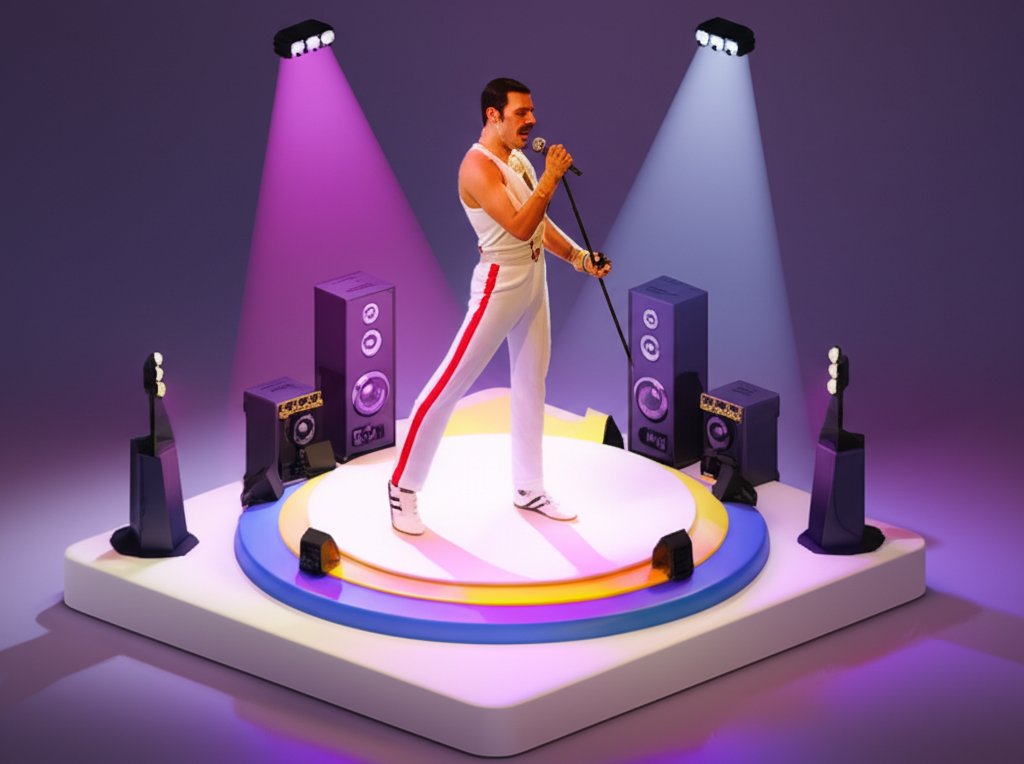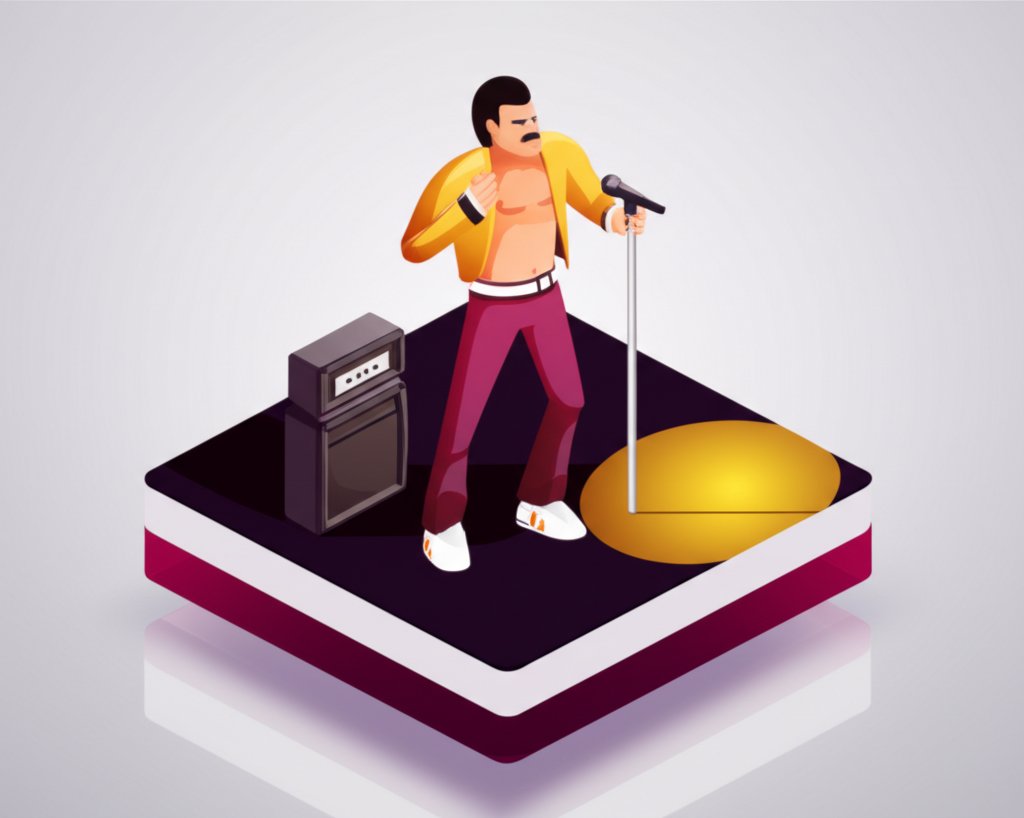
Before the moustache, the yellow jacket, and the global stadium dominance of Live Aid, there was the 70s Freddie Mercury. This was the decade of transformation—a ten-year crucible where a shy art school student named Farrokh Bulsara morphed into one of the most electrifying and unpredictable frontmen in music history. It was the era of black nail polish, satin wings, and harlequin leotards; a time when Queen forged their sound, and Freddie unleashed the full, untamed power of his voice and vision upon an unsuspecting world.
This wasn’t just a prelude to the 80s. The 70s were Freddie’s grand experiment, the period where he built the very foundation of his legend, note by operatic note and strut by theatrical strut.
At a Glance: The Freddie Mercury of the 1970s
To understand Freddie’s journey, it helps to see the 70s as his defining decade. Here’s what made this period so foundational:
- The Birth of a Band: Freddie co-founded Queen in 1970, not just as its singer but as a core creative force, even designing their iconic crest.
- A Chameleonic Evolution: His look transformed dramatically, from a long-haired, glam-rock visionary in flowing silks to a leather-clad, short-haired rock god by the decade’s end.
- Vocal Mastery on Display: He honed his legendary four-octave range, layering his voice to create the symphonic, choir-like sound that became Queen’s signature.
- The Songwriting Genius Emerges: He penned some of music’s most ambitious and beloved tracks, including “Killer Queen,” “Somebody to Love,” and the game-changing “Bohemian Rhapsody.”
- Crafting the Ultimate Stage Persona: The 70s saw Freddie develop his unparalleled command of the stage, blending rock aggression with balletic grace and theatrical camp.
The Man Before the Legend: Forging an Identity
You can’t fully appreciate the artist without understanding the person. Born Farrokh Bulsara in Zanzibar to Parsi-Indian parents, Freddie’s background was anything but typical for a British rock star. His family fled to Middlesex, England, in 1964 to escape a revolution, an upheaval that undoubtedly shaped his outsider perspective.
This period was a culmination of Freddie Mercurys early life, a time when the shy but determined Bulsara was already dreaming big. He’d spent his formative years at a British-style boarding school in India, where he first took up piano and started his first band, The Hectics.
Back in England, he enrolled in Ealing Art College, a creative hotbed whose alumni included Pete Townshend of The Who. It was here that he honed his visual aesthetic and met the musicians who would change his life. He was a quiet observer who could suddenly erupt with star power, a contradiction that would define him. He played in a few fledgling bands like Ibex and Wreckage, testing his vocal chops and stage moves, but he was waiting for the right vehicle for his boundless ambition.
From Art School to Arena Rock: The Birth of Queen
In 1970, that vehicle arrived. Freddie joined forces with guitarist Brian May and drummer Roger Taylor, who were playing in a band called Smile. With Freddie’s dynamic presence, they knew they had something special. He christened the new band “Queen,” a name he admitted was “very regal, obviously, and it sounds splendid.” It was bold, a bit controversial, and utterly unforgettable—just like him.
The band’s genesis is a story of ambition and happy accidents, a defining chapter in Freddie Mercurys early Queen years. After bassist John Deacon joined in 1971, the classic lineup was complete. Freddie didn’t just provide the name; he also used his art school skills to design their iconic crest, weaving in the members’ zodiac signs: two lions for Leo (Deacon and Taylor), a crab for Cancer (May), and two fairies for his own Virgo sign. It was a statement of intent: this wasn’t just a band, it was a universe of its own making.
Their early albums, Queen (1973) and Queen II (1974), were steeped in a heavy, progressive rock sound, with fantasy-laden lyrics and May’s layered guitar harmonies. They were finding their footing, but Freddie’s star quality was already undeniable.
The Chameleon of Rock: Freddie’s Evolving 70s Style
One of the most thrilling things about 70s Freddie Mercury was watching his visual transformation. He was a true style icon who used fashion as another instrument. His look wasn’t static; it evolved with the music.
The Zandra Rhodes Era (Early 70s)
In the beginning, Freddie embraced the androgyny of the glam rock movement. He sported long, flowing hair, dark eyeliner, and often wore extravagant, custom-made outfits by designer Zandra Rhodes. These were the days of pleated white satin outfits with batwing sleeves, creating a dramatic, almost ethereal silhouette on stage. It was pure rock theater, perfectly suited to the mythic tales on their first two albums.
The Black-and-White Harlequin (Mid-70s)
By the time A Night at the Opera (1975) and A Day at the Races (1976) catapulted them to global fame, Freddie had adopted one of his most iconic looks: the skintight leotards and ballet shoes. Often in striking black-and-white patterns, these outfits highlighted his athleticism and grace. He moved like a dancer, combining preening showmanship with raw power. This was Freddie at his most flamboyant, a master of ceremonies presiding over his own rock and roll circus.
The Leather-Clad Rock God (Late 70s)
As punk rock started stripping away the artifice of rock music, Queen responded with a leaner, more direct sound on albums like News of the World (1977) and Jazz (1978). Freddie’s look changed with it. He cut his hair short and swapped the satins and silks for leather jackets, tight trousers, and studded belts. It was a tougher, more overtly masculine image that hinted at the iconic look he would perfect in the 1980s.
The Voice That Defined a Decade: A Vocal Deep Dive
Beyond the costumes and the stagecraft, the core of 70s Freddie Mercury was his voice. It was an instrument of staggering power, range, and emotional depth. While his speaking voice was a warm baritone, his singing could soar into the tenor range and even touch soprano notes.
Scientific analysis after his death confirmed what fans always knew: his vocal control was extraordinary. He possessed a faster-than-average vibrato and the rare ability to produce subharmonics, a technique more common in Tuvan throat singing. In layman’s terms, he had a natural “distortion” in his voice that gave it a signature roar.
You can hear the full spectrum of his 70s vocal genius across their catalog:
- “Killer Queen” (1974): Precise, witty, and Vaudevillian. He delivers each line with a theatrical wink, demonstrating impeccable diction and control.
- “Bohemian Rhapsody” (1975): The ultimate vocal showcase. He moves seamlessly from a tender ballad to soaring operatic falsetto, then to hard-rock aggression, all within six minutes. The complex vocal harmonies, largely overdubbed by Freddie, Brian, and Roger, created a “choir of queens” that had never been heard before.
- “Somebody to Love” (1976): Freddie’s tribute to Aretha Franklin is a masterclass in gospel-infused rock. Backed by a multitracked choir of his own voice, his performance is raw, desperate, and immensely powerful.
- “We Are the Champions” (1977): The definitive stadium anthem, built on Freddie’s commanding and triumphant vocal delivery. It’s a performance of pure power and conviction.
The Architect of Anthems: Freddie’s 70s Songwriting
Freddie was never just the singer; he was one of the band’s primary songwriters, and his 70s compositions are a testament to his eclectic genius. He rarely wrote simple three-chord rock songs. Instead, he drew from opera, classical piano, Vaudeville, gospel, and rockabilly, fusing them into something entirely new.
He composed primarily on the piano, and his complex chord progressions and melodic structures set Queen apart from their peers.
| 70s Hit Song | Written By Freddie | What Made It a Masterpiece |
|---|---|---|
| “Seven Seas of Rhye” (1974) | Freddie Mercury | An early taste of his fantasy-world lyricism and powerful, piano-driven rock. |
| “Killer Queen” (1974) | Freddie Mercury | A perfect pop-rock confection with sophisticated lyrics and a chic, detached charm. |
| “Bohemian Rhapsody” (1975) | Freddie Mercury | A six-minute, multi-part suite that broke every rule of commercial radio and became an eternal classic. |
| “Somebody to Love” (1976) | Freddie Mercury | A complex, gospel-inspired anthem exploring themes of love and loneliness with breathtaking vocal arrangements. |
| “We Are the Champions” (1977) | Freddie Mercury | An exercise in audience connection, designed from the ground up to be sung by thousands in a stadium. |
| “Don’t Stop Me Now” (1978) | Freddie Mercury | A pure explosion of joy and self-confidence, driven by his rollicking piano and euphoric vocals. |
| “Crazy Little Thing Called Love” (1979) | Freddie Mercury | Written in the bathtub in minutes, this rockabilly tribute proved he could craft a simple, infectious hit with just as much flair. |
Answering Your Questions About 70s Freddie
Even decades later, this era of Freddie’s career fascinates fans. Here are crisp answers to some of the most common questions.
What was Freddie Mercury’s most iconic 70s look?
While he had many, the full-body, black-and-white harlequin-patterned leotard from the mid-70s is arguably the most famous. It captured his blend of athletic energy, balletic grace, and theatrical camp perfectly.
Did Freddie Mercury have his famous moustache in the 70s?
No. The iconic moustache, along with the very short hair, was a look he adopted around 1980. Throughout the entire 1970s, he was clean-shaven.
What was Freddie’s vocal range in the 1970s?
His famed four-octave range was already fully apparent in the 1970s. From the low growls on tracks like “’39” (sung live) to the soaring soprano notes in the “opera” section of “Bohemian Rhapsody,” he used every inch of his vocal canvas during this decade.
How did his stage presence develop during this decade?
He went from a slightly shy, yet compelling, frontman in the early 70s to an absolute master of the stage by the end of the decade. He learned how to command massive audiences, using his famous half-mic stand as a prop—sometimes a sceptre, sometimes a guitar, always an extension of his own flamboyant personality.
The Legacy of a Decade: How the 70s Built a King
The Freddie Mercury of the 1970s was a force of creative nature. He was an artist refusing to be categorized, a frontman who redefined what a rock performance could be, and a songwriter who built worlds in his music.
This was the decade where he and his bandmates paid their dues, honed their craft, and took monumental risks that paid off spectacularly. Every anthem that would later echo through Wembley Stadium in the 80s had its roots in the bold experiments of the 70s. The confidence, the vocal power, the uncanny connection with the audience—it was all forged here.
When you look back at the 70s Freddie Mercury, you see more than just a rock star. You see an artist in the process of becoming. It’s a reminder that legends aren’t born overnight. They are built, song by song, show by show, in a glorious, decade-long explosion of creativity, courage, and sheer, unadulterated talent.