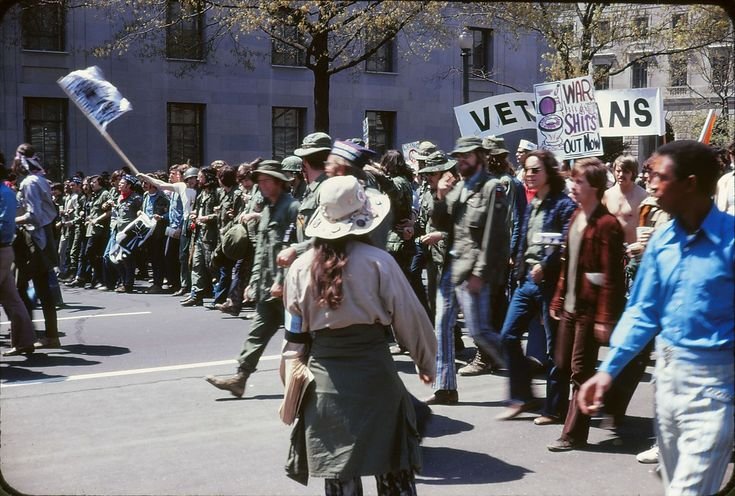
The year 1971 felt like a national fever dream. On one hand, the country was tearing itself apart over the Vietnam War, with massive protests and shocking government revelations. On the other, President Richard Nixon was engineering one of the most audacious diplomatic pivots in modern history. The sheer number of conflicting 1971 events in america created a landscape of deep anxiety and profound change, where the seeds of our modern political and cultural world were sown in the soil of discord.
At a Glance: Key Takeaways from 1971’s Tumultuous Year
- The Vietnam War’s Boiling Point: The conflict expanded into Laos, anti-war protests reached an unprecedented scale, and the explosive Pentagon Papers revealed decades of government deceit.
- Nixon’s Paradoxical Presidency: While prosecuting the war, Nixon also secretly installed the taping system that would cause his downfall, initiated a “War on Drugs,” and completely upended the global economic system.
- Landmark Legal and Social Shifts: The 26th Amendment granted 18-year-olds the right to vote, the Supreme Court mandated busing for school desegregation, and the Attica prison uprising exposed deep cracks in the justice system.
- The Seeds of Modern America: The year saw the founding of NASDAQ, Greenpeace, and the first Starbucks, alongside the release of Intel’s first microprocessor—quietly building the framework of the future.
While the political and social dramas defined the year’s headlines, they were part of a much larger tapestry of change. You can explore the full timeline of the year’s pivotal moments in our broader guide on How 1971 shaped America.
The War at Home and Abroad: Vietnam’s Unrelenting Grip
By 1971, the Vietnam War was no longer a distant conflict; it was a wound in the American psyche. Nixon’s policy of “Vietnamization”—shifting the combat burden to South Vietnamese forces—was put to a brutal test, and the public’s patience had worn thin.
Operation Lam Son 719: A Widening War
In theory, Vietnamization was meant to de-escalate American involvement. In practice, it led to an expansion of the conflict. On February 13, South Vietnamese troops, backed by ferocious U.S. airpower, invaded Laos in Operation Lam Son 719. The goal was to sever the Ho Chi Minh Trail, a key North Vietnamese supply line.
The operation was a bloody and ambiguous affair. It highlighted the South Vietnamese army’s persistent weaknesses and proved that even without U.S. ground troops, America was still deeply entrenched in the war. For protestors back home, this wasn’t a withdrawal; it was a horrifying expansion of the fighting by proxy.
The Pentagon Papers: A Secret History Revealed
If the invasion of Laos fueled anger, the Pentagon Papers ignited an inferno of distrust. On June 13, The New York Times began publishing excerpts from a top-secret Department of Defense study. This 7,000-page document, officially titled History of U.S. Decision-Making Process on Vietnam Policy, laid bare a stunning truth: four successive presidential administrations had systematically lied to the American public and Congress about the scope and failures of the Vietnam War.
The Nixon administration immediately sought an injunction to halt publication, citing national security. The case rocketed to the Supreme Court. In a landmark decision on June 30, New York Times Co. v. United States, the Court sided with the press, affirming that the government had not met the heavy burden of proof required for prior restraint. The truth, however damaging, could be published. The papers shattered what little remained of public trust in the government’s handling of the war.
The People Protest: A Nation Divided
The combination of the war’s expansion and the Pentagon Papers’ revelations pushed the anti-war movement to its zenith.
- April 24: An estimated 500,000 people marched in Washington, D.C., while another 125,000 demonstrated in San Francisco. It was the largest anti-war protest in U.S. history to that point.
- May 3-5: The “May Day” protests aimed to shut down the government in Washington, D.C. The Nixon administration responded with force, conducting mass arrests that swept up over 12,000 people—protestors and bystanders alike—in the largest mass arrest in the nation’s history.
- February 28: Earlier in the year, the radical Weather Underground had detonated a bomb in a bathroom in the U.S. Capitol, causing significant damage but no injuries. This act, while condemned by mainstream protestors, illustrated the desperate rage felt by some.
Nixon’s White House: Power, Paranoia, and Pivots
No figure looms larger over 1971 than Richard Nixon. His presidency was a study in contradiction, mixing cynical political maneuvers with bold, history-altering decisions.
The Secret Tapes and the Seeds of Watergate
On February 10, Nixon gave a fateful order: install a secret, voice-activated taping system in the Oval Office and other key locations. Driven by a desire to have an unvarnished record of his presidency for his memoirs, this decision was an act of hubris.
He had no idea he was creating the very evidence that would, just a few years later, expose the Watergate cover-up and force his resignation. The 1971 decision to “tape everything” was the beginning of his end.
“The Nixon Shock”: Upending the Global Economy
By mid-1971, the U.S. economy was struggling with high inflation and a weakening dollar, partly due to the costs of the Vietnam War. On August 15, Nixon delivered a televised address announcing a radical new economic policy. In what became known as the “Nixon Shock,” he unilaterally:
- Ended the Gold Standard: He suspended the direct convertibility of the U.S. dollar to gold, effectively dismantling the Bretton Woods system that had governed international finance since World War II.
- Imposed a 90-Day Freeze: He ordered a freeze on all wages and prices to combat inflation.
This was a seismic event. It devalued the dollar, fundamentally reshaped global trade, and ushered in an era of floating exchange rates. While it was a bold move to address domestic economic woes, it sent shockwaves through the international financial community.
The Great Thaw: Ping-Pong Diplomacy and China
Simultaneously, Nixon the Cold Warrior was making an unbelievable diplomatic gambit. After decades of non-recognition and hostility toward Communist China, the administration began sending quiet signals. The breakthrough came from an unexpected source: table tennis.
In April, the American ping-pong team, competing in Japan, received a surprise invitation to visit China. Their visit, dubbed “Ping-Pong Diplomacy,” captured the world’s imagination and cracked open the door. Three months later, on July 9, National Security Advisor Henry Kissinger made a secret trip to Beijing. On July 15, Nixon stunned the world by announcing he would visit the People’s Republic of China in 1972. It was a masterstroke of foreign policy that would realign the global balance of power.
A Nation in Flux: Social and Legal Transformations
Beneath the high-stakes drama of war and geopolitics, fundamental changes were reshaping American society and law.
The 26th Amendment: “Old Enough to Fight, Old Enough to Vote”
The Vietnam War amplified a glaring hypocrisy in American law: 18-year-olds could be drafted to fight and die, but they couldn’t vote in most states. The movement to lower the voting age gained unstoppable momentum.
Congress passed the 26th Amendment in March, and the states ratified it with record speed. On June 30, it became law, just over three months after its passage. It was a direct, tangible consequence of the war and a major victory for youth activists.
The Supreme Court and School Desegregation
Seventeen years after Brown v. Board of Education, many school districts remained deeply segregated in practice. On April 20, the Supreme Court issued a unanimous and controversial decision in Swann v. Charlotte-Mecklenburg Board of Education. The ruling held that federal courts could order the use of busing—transporting students to schools outside their neighborhoods—as a tool to achieve racial integration. The decision was met with fierce resistance in many communities and made busing one of the most divisive political issues of the 1970s.
The Attica Prison Uprising: A Cry for Human Rights
From September 9 to 13, the Attica Correctional Facility in upstate New York became a flashpoint for the nation’s debates on race, justice, and human rights. Inmates seized control of the prison, taking guards hostage and issuing a list of demands for better living conditions and political rights.
After days of tense negotiations, Governor Nelson Rockefeller ordered state police to retake the prison by force. The resulting raid was a massacre, leaving 29 inmates and 10 hostages dead, nearly all killed by law enforcement gunfire. Attica became a symbol of state brutality and the urgent need for prison reform.
Quick Answers: Unpacking the Events of 1971
Q: Why are the Pentagon Papers so important?
A: They were concrete proof of a massive “credibility gap.” They revealed that multiple administrations, both Democratic and Republican, had misled the public about the justifications for and the progress of the Vietnam War. This institutional betrayal fundamentally eroded Americans’ trust in their government.
Q: What was the “Nixon Shock”?
A: It was President Nixon’s executive order on August 15, 1971, that ended the international convertibility of the U.S. dollar to gold. This dismantled the Bretton Woods system of fixed exchange rates. He also imposed a 90-day freeze on wages and prices to fight inflation, marking a dramatic government intervention in the economy.
Q: Did the anti-war protests in 1971 actually accomplish anything?
A: Absolutely. While they didn’t end the war overnight, the sheer scale of the 1971 protests demonstrated that opposition to the war was a mainstream position, not a fringe movement. This immense political pressure constrained Nixon’s military options and accelerated the timeline for U.S. withdrawal in the following years.
Q: Why was lowering the voting age to 18 such a big deal?
A: It was a powerful moral and political victory that directly addressed the central injustice felt by young people: being old enough to be drafted and die for your country but too young to have a say in its leadership. The rapid passage and ratification of the 26th Amendment showed how the war was directly reshaping American democracy.
Understanding 1971’s Turbulent Legacy
To make sense of 1971, you have to embrace its contradictions. It was a year of endings and beginnings, of violence and diplomacy, of cynicism and idealism. The events of that single year did more than just fill newspapers; they set the trajectory for the rest of the 20th century and beyond.
When you look back, connect the dots. The war in Vietnam wasn’t just a military conflict; it was the engine driving protests, the 26th Amendment, and the crisis of trust revealed by the Pentagon Papers. Nixon’s paranoia, which led him to install the secret tapes, coexisted with his geopolitical brilliance in opening relations with China.
The upheaval of 1971 was not just chaos. It was the painful, necessary process of a nation being forced to confront its own ideals, its government’s secrets, and the deep-seated injustices within its society. The echoes of that confrontation still resonate today.










