The year 1948 was not a quiet period of post-war recovery; it was a year of seismic shifts and foundational cracks. The critical 1948 historical events didn’t just happen—they collided, creating the tense, divided, and interconnected world we still navigate today. From the concrete barriers of a divided Berlin to the new flags of independent nations, the geopolitical landscape was being redrawn in real-time, with consequences that echo into the present.
At a Glance: Key Geopolitical Shifts of 1948
This article unpacks the strategic importance of 1948’s pivotal moments. You’ll gain a clear understanding of:
- The Cold War’s Hardening: How ideological tension turned into direct, high-stakes confrontation in Europe and Asia.
- Decolonization’s Turbulent Dawn: The complex and often violent birth of new nations and the simultaneous entrenchment of new forms of segregation.
- The Architecture of a New World: The creation of international institutions designed to manage conflict, health, and human rights.
- The Seeds of Modern Conflicts: Why events in Israel, Korea, and Germany became enduring global flashpoints.
- Civil Rights as a Geopolitical Force: How domestic policy in the U.S. began to reflect the broader ideological struggle for hearts and minds.
These individual events were deeply intertwined, forming a complex global narrative. For a complete overview of this pivotal year, you can explore the broader context of How 1948 shaped the world. Here, we will dissect the specific geopolitical machinery behind these monumental shifts.
The Cold War Solidifies into Concrete and Barbed Wire
By 1948, the ideological divide between the United States and the Soviet Union was no longer a matter of rhetoric. It became a tangible reality, with events forcing nations to choose sides and transforming Europe into a continent of two armed camps.
The Czechoslovak Coup: The Iron Curtain Clangs Shut
In February 1948, the fragile democracy of Czechoslovakia was extinguished. In a well-orchestrated coup, the Communist Party of Czechoslovakia, with clear backing from the Soviet Union, seized undisputed control of the government. This wasn’t a military invasion but a political one, demonstrating a chilling new Soviet tactic for expanding its sphere of influence.
For the West, this was a terrifying wake-up call. The coup proved that Stalin’s ambitions were not limited to areas his army already occupied. This single event directly spurred Western European nations to action, accelerating talks that led to the Treaty of Brussels in March—a mutual defense pact that was the direct forerunner to NATO.
The Marshall Plan vs. The Berlin Blockade
The American response to Soviet expansion was primarily economic. The Marshall Plan, officially signed into law on April 3, was a massive economic aid package—over $5 billion in its first year—designed to rebuild war-torn European economies. The goal was twofold: humanitarian aid and preventing the poverty-driven rise of communism.
The Soviets saw the plan as “dollar imperialism.” Their response was a direct, physical challenge. On June 24, Soviet forces initiated the Berlin Blockade, cutting off all road, rail, and canal access to the Western-controlled sectors of Berlin. The city, located deep within Soviet-occupied East Germany, became a pawn. Stalin’s gamble was that the Western allies would abandon the city, delivering a massive propaganda victory.
Instead, the West responded with the Berlin Airlift. In a monumental logistical feat, American and British planes supplied West Berlin entirely from the air for nearly a year. This confrontation defined the new rules of the Cold War: direct military conflict was too risky, but brinkmanship, proxy struggles, and symbolic showdowns would become the norm.
The End of Empire and the Birth of New Conflicts
While superpowers tussled, the old colonial empires were fracturing. But the dawn of independence was rarely simple or peaceful. The year 1948 produced a messy and often violent map of new nations and new conflicts.
A State is Born: The Creation of Israel and the First Arab-Israeli War
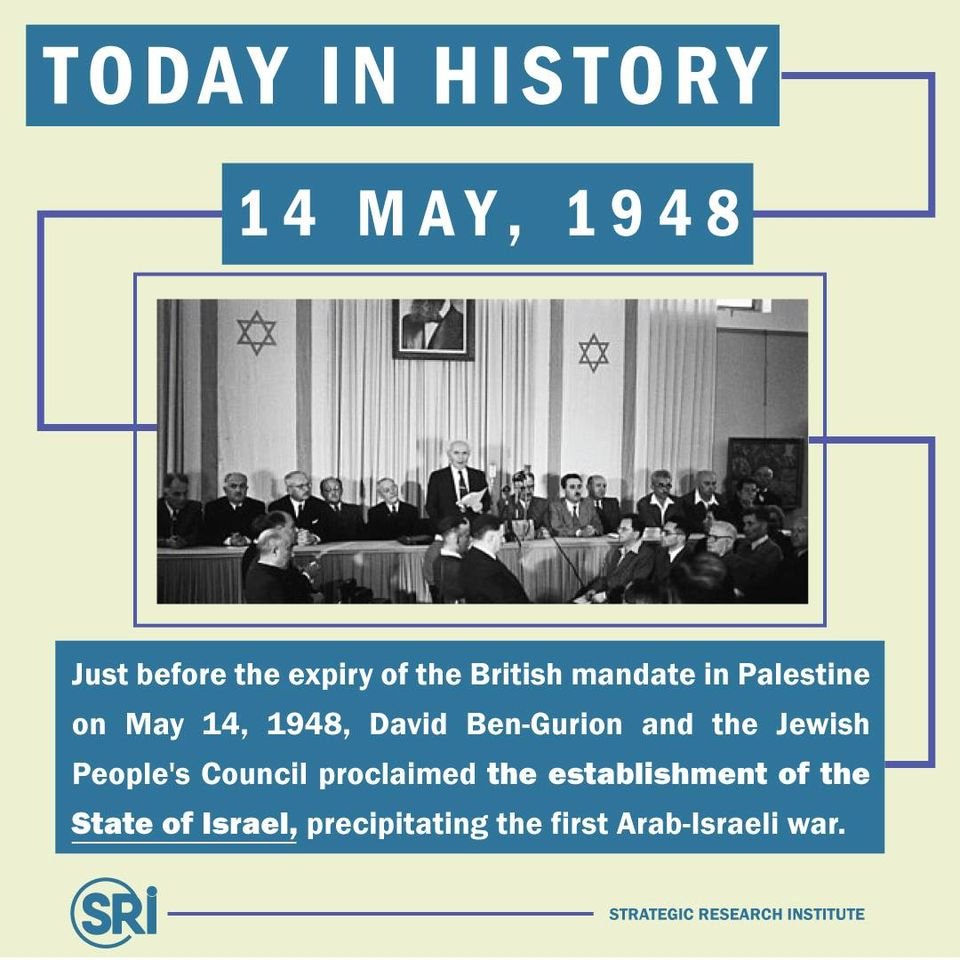
On May 14, 1948, David Ben-Gurion declared the establishment of the State of Israel. The United States and the Soviet Union—in a rare moment of agreement—swiftly recognized the new nation. For them, it was a strategic foothold in the Middle East.
For the region, it was a cataclysm. The very next day, a coalition of neighboring Arab states—Egypt, Syria, Jordan, and Iraq—invaded. The 1948 Arab-Israeli War had begun. This event established a conflict that has remained a central feature of global politics, demonstrating how decolonization, when mixed with competing historical claims and superpower interests, could create a self-perpetuating cycle of violence.
The Divided Peninsula: North and South Korea Formalized
The Korean Peninsula, occupied by the Soviets in the north and the Americans in the south after World War II, saw its division formalized in 1948.
- August 15: The Republic of Korea (South Korea) was established in Seoul.
- September 9: The Democratic People’s Republic of Korea (North Korea) was declared in Pyongyang.
This wasn’t a mutual separation; it was the creation of two rival states, each backed by a different superpower and each claiming to be the sole legitimate government of all of Korea. This solidified the peninsula as a permanent Cold War flashpoint, setting the stage for the devastating Korean War just two years later.
A Counter-Narrative: South Africa Embraces Apartheid
While many parts of the world moved toward self-determination, South Africa moved decisively in the opposite direction. The general election on May 26 brought the pro-apartheid National Party to power.
This wasn’t just a change in government; it was the beginning of a systematic, state-enforced policy of racial segregation and white-minority rule. As other nations shed colonial structures, South Africa codified racial hierarchy into law, creating an internal system of oppression that would make it a global pariah for decades.
Building a New World Order on the Ashes of the Old
Amid the conflict and division, 1948 was also a year of ambitious construction. Global leaders established a series of international institutions designed to prevent a third world war and create a more stable, rule-based order.
An Alphabet Soup of Global Governance
Several key organizations founded or activated in 1948 formed the bedrock of the post-war international system.
| Institution | Date Activated/Founded | Core Purpose | Geopolitical Significance |
|---|---|---|---|
| GATT (General Agreement on Tariffs and Trade) | Jan 1 | To reduce trade barriers (tariffs, quotas) and promote free trade. | The economic foundation of the Western-led global order; a precursor to the WTO. |
| WHO (World Health Organization) | Apr 7 | To direct and coordinate international health within the UN system. | A recognition that public health is a global security issue, transcending national borders. |
| OEEC (Organisation for European Economic Co-operation) | Apr 16 | To administer the Marshall Plan and foster economic cooperation in Europe. | The vehicle for America’s economic influence and the first step toward European integration (later became the OECD). |
| OAS (Organization of American States) | Apr 30 | A regional bloc for the Americas to promote peace, security, and development. | Solidified U.S. leadership in the Western Hemisphere under a banner of multilateralism. |
The Moral Compass: Codifying Human Rights
Perhaps the most aspirational work of 1948 took place at the United Nations. In December, the General Assembly adopted two landmark documents:
- The Convention on the Prevention and Punishment of the Crime of Genocide (Dec 9): This was a direct response to the Holocaust. For the first time, international law defined genocide and made it a crime, whether committed in peace or war.
- The Universal Declaration of Human Rights (Dec 10): This document, championed by Eleanor Roosevelt, established a common standard of fundamental rights and freedoms for all people and all nations. Though not legally binding, it became the moral and political foundation for all subsequent human rights law.
These acts were an attempt to build a global conscience—a set of universal principles to which all nations could be held accountable.
Quick Answers to Key Questions
A few common questions help clarify the complex dynamics of 1948.
Q: Why was the US suddenly desegregating its military in 1948?
A: President Truman’s Executive Order 9981 on July 26 was driven by both domestic pressure from civil rights activists and Cold War pragmatism. The U.S. was promoting democracy and freedom abroad while practicing segregation at home. This hypocrisy was a powerful propaganda tool for the Soviet Union. Desegregating the military was a crucial, if incomplete, step to align America’s actions with its stated ideals on the world stage.
Q: What was the most significant technological advance of 1948?
A: While the Manchester Baby computer (June 21) and the Polaroid camera (Nov 28) were impressive, the patent filing for the transistor on June 26 by Bell Labs scientists was the most revolutionary. This tiny semiconductor device replaced bulky vacuum tubes, paving the way for virtually all modern electronics, from radios to smartphones and supercomputers. It was the quiet invention that would power the information age.
Q: Did the creation of new institutions like the UN actually prevent conflict?
A: Not entirely, as the immediate Arab-Israeli War and the looming Korean War showed. However, they created new channels for diplomacy, humanitarian aid (like through the WHO), and established international norms (like the UDHR). They shifted the landscape from a pure power-of-the-strongest model to one where international law and opinion had a role to play, even if often ignored.
The Enduring Fault Lines of 1948
The year 1948 did not resolve the world’s problems; it redefined them for the next half-century and beyond. The divisions etched onto the map—a divided Berlin, a divided Korea, the contested borders of Israel—became the front lines of the Cold War and the sources of conflicts we still grapple with today.
The institutions built in 1948, from the UN to GATT, formed the operating system for the post-war world, promoting a model of global cooperation that, while imperfect, has largely held. Understanding the 1948 historical events is not just about looking back; it’s about recognizing the origins of our modern geopolitical realities. The decisions made in that single, frantic year laid the foundation for the world you woke up in this morning.










