The year 1860 in the United States wasn’t just a collection of months; it was the final, frantic countdown to a national cataclysm. The political arguments, constitutional debates, and moral crises that had simmered for decades boiled over, leaving no room for compromise. Every speech, every convention, and every ballot cast that year was a shove, pushing the nation closer to the edge of a cliff it would tumble over just a few months later. This was the year the talking stopped and the fuse was irrevocably lit.
Understanding 1860 is to understand not just that the Civil War happened, but why it became unavoidable. The mechanisms of American democracy, strained to their breaking point, finally snapped under the weight of the slavery question.
At a Glance: The Point of No Return
This deep dive into 1860 will give you a clear-eyed view of the final moments of the old Union. Here’s what you’ll grasp:
- The Fractured Political Landscape: See why the old two-party system shattered, leading to a chaotic four-way presidential race.
- The Election That Broke the Nation: Understand the distinct platforms on slavery and why Abraham Lincoln’s victory, despite winning less than 40% of the popular vote, was the ultimate trigger for secession.
- The Immediate Path to Disunion: Follow the step-by-step reaction in the South, particularly South Carolina’s swift move to leave the Union before the year was even out.
- Federal Paralysis: Learn why the sitting government under President James Buchanan was unable—or unwilling—to stop the country from tearing itself apart.
A Nation Politically Shattered
By 1860, the political parties that had once papered over the nation’s deep sectional divides were themselves casualties of the conflict. The Whig Party was long dead, and the Democratic Party, the last remaining national institution, was about to tear itself in two. This collapse is central to understanding the year’s events.
The lingering impact of John Brown’s 1859 raid on Harpers Ferry had Southerners seeing abolitionist conspiracies everywhere, while Northerners increasingly viewed the “Slave Power” as an aggressive force intent on dominating the federal government. The Supreme Court’s 1857 Dred Scott decision, which declared that Black people were not citizens and that Congress could not ban slavery in the territories, had obliterated previous compromises.
It was in this hyper-polarized environment that the country faced a presidential election. This single year was the tipping point for a decade of conflict. To see how these events fit into the broader narrative of the war and its aftermath, you can Explore 1860s Civil War History.
The Most Consequential Election in American History
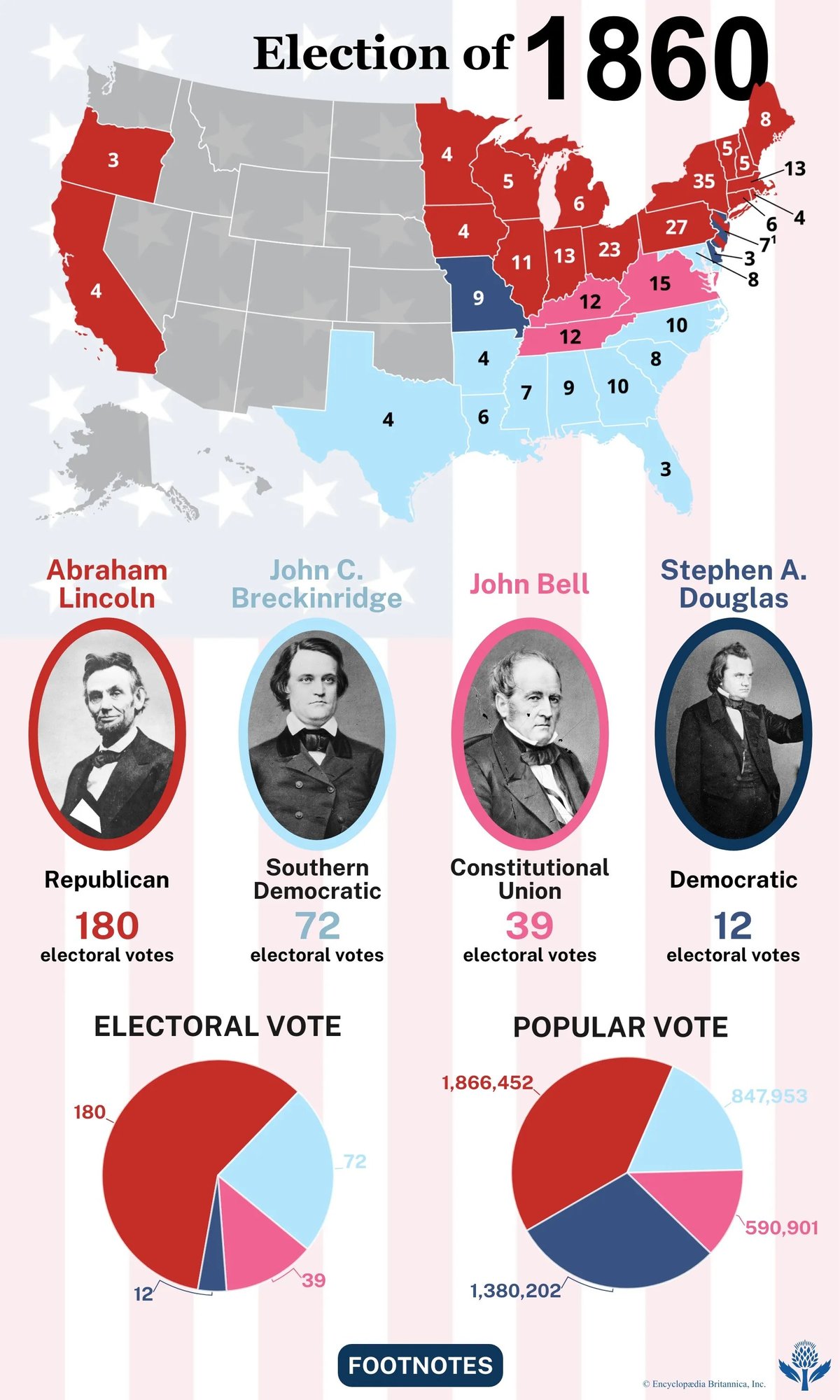
The 1860 presidential election was not a single contest but four regional ones. The Democratic Party, unable to agree on a single platform regarding slavery in the territories, split apart. This fragmentation resulted in four major candidates, each representing a distinct faction of the fractured nation.
Understanding these four platforms is key to seeing why no compromise was possible.
| Candidate & Party | Core Stance on Slavery in Territories | Primary Base of Support |
|---|---|---|
| Abraham Lincoln (Republican) | No expansion. Prohibit slavery in all federal territories, but leave it untouched where it already existed. | The North and West. He was not on the ballot in 10 Southern states. |
| Stephen A. Douglas (Northern Democrat) | Popular Sovereignty. Let the settlers of each territory vote for themselves whether to allow slavery. | Northern Democrats and some moderates in border states. |
| John C. Breckinridge (Southern Democrat) | Federal Protection. Demand that the federal government actively protect slavery in all territories. | The Deep South. |
| John Bell (Constitutional Union) | Avoid the issue. Uphold the Constitution, the Union, and the enforcement of laws, with no specific stance on slavery’s expansion. | Border states and former Whigs hoping to stave off disunion. |
The Campaign and Its Inevitable Outcome
The campaign was fiercely sectional. Lincoln and the Republicans campaigned almost exclusively in the North, arguing that stopping the spread of slavery was essential to preserving free labor for white men. Douglas was the only candidate to campaign nationwide, warning that Lincoln’s election would mean disunion.
Breckinridge’s supporters in the South presented the election as an existential choice, with many openly stating that a “Black Republican” victory would be grounds for secession. Bell’s campaign was a desperate plea for moderation and unity that was largely drowned out by the radicalism of both sides.
The Results:
- Abraham Lincoln: Won with 180 electoral votes (1,866,452 popular votes, 39.8%).
- John C. Breckinridge: Carried the Deep South with 72 electoral votes (847,953 popular votes, 18.1%).
- John Bell: Won three border states with 39 electoral votes (590,631 popular votes, 12.6%).
- Stephen A. Douglas: Despite coming in second in the popular vote, he only won Missouri and part of New Jersey, for 12 electoral votes (1,380,202 popular votes, 29.5%).
Lincoln secured a clear majority in the Electoral College by winning nearly every free state. But to the South, his victory was illegitimate. He had won without a single electoral vote from their region and with a minority of the national popular vote, confirming their fears that they had lost all political power in the Union.
The Fuse is Lit: “Secession Winter” Begins
The reaction to Lincoln’s victory was swift and decisive. While radical “fire-eaters” in the South had been threatening secession for years, the 1860 election gave them the mandate they needed.
Step 1: South Carolina Acts (November-December 1860)
South Carolina, the long-time heart of secessionist sentiment, didn’t wait for Lincoln’s inauguration.
- November 7, 1860: The day after the election, a federal judge and district attorney in Charleston resigned their posts. The state legislature, already in session, immediately called for a convention to consider secession.
- December 20, 1860: The secession convention, meeting in Charleston, voted unanimously (169-0) to dissolve the union between South Carolina and the other states.
- December 24, 1860: The convention issued its “Declaration of the Immediate Causes Which Induce and Justify the Secession of South Carolina,” citing the North’s “increasing hostility… to the institution of slavery” as the primary reason for their departure.
Step 2: A Paralysis in Washington
While South Carolina declared itself an independent nation, the federal government did almost nothing. President James Buchanan, a Democrat serving as a “lame duck” until Lincoln’s inauguration in March 1861, was philosophically opposed to secession but believed he had no constitutional power to stop a state from leaving the Union.
His inaction created a power vacuum. Southern states began seizing federal forts, arsenals, and custom houses within their borders. Buchanan’s cabinet fractured, with Southern members resigning to support their home states. This period, from November 1860 to March 1861, is often called “Secession Winter,” a time when the Union quietly and rapidly disintegrated without a forceful response from its leader.
By the time the calendar turned to 1861, the path to war was set. Other Southern states were already preparing their own secession conventions, inspired by South Carolina’s bold move and emboldened by Washington’s feckless response.
Quick Answers to Common Questions
A few key questions often arise about this pivotal year.
Q: Was slavery the only major issue in the 1860 election?
A: While other issues like tariffs, homesteading, and internal improvements were part of party platforms, they were all completely overshadowed by the crisis over slavery. The Republican platform, for instance, included a protective tariff and a homestead act, but its non-extension of slavery plank was the one that defined the election. Every other issue was viewed through the lens of the sectional conflict.
Q: Could the Civil War have been avoided after the 1860 election?
A: It would have required a reversal of principles that, by 1860, had become non-negotiable. For the South to stay, the Republican party would have had to abandon its core belief: that slavery should not be allowed to expand. For Lincoln, this was impossible, as he believed it would betray the voters who elected him and violate the “spirit of the Declaration of Independence.” For the Deep South, accepting Lincoln’s presidency meant accepting a future where slavery was contained and, they feared, would eventually die. The room for a middle ground had vanished.
Q: Why did the Democratic Party split into Northern and Southern factions?
A: The split occurred over the specific question of slavery in the territories. Northern Democrats, led by Stephen Douglas, championed “popular sovereignty,” arguing that settlers should decide the issue locally. Southern Democrats, radicalized by years of conflict, rejected this. They demanded, based on the Dred Scott decision, a federal slave code for the territories—an explicit guarantee from the national government that slave property would be protected. When the party could not agree on this single point at their Charleston convention, they broke apart, sealing their electoral doom.
Decoding the Final Path to Disunion
The events of 1860 in the United States were not an accident but a logical conclusion to a series of inflexible decisions.
- The Democratic Split Was Fatal: By running two candidates, the Democrats guaranteed a Republican victory. Their inability to find a compromise on a federal slave code was the moment the last national political party broke.
- Republican Resolve Was Unshakable: The Republicans refused to back down on their central promise of stopping slavery’s expansion. Compromise proposals, like the Crittenden Compromise offered late in the year, were rejected by Lincoln because they would have violated this core principle.
- Southern Secession Was a Calculated Risk: Leaders in the Deep South saw Lincoln’s election not as a temporary political loss but as a permanent shift in power. They believed the North was fundamentally hostile to their way of life and that their only hope for preserving a society built on slavery was to create their own nation.
By New Year’s Eve 1860, the United States was a nation in name only. South Carolina had seceded, other states were on the verge of following, and the president-elect was months away from taking office. The fragile bonds of union, stretched thin over decades, had finally snapped. The brink was reached, and the fall was about to begin.










